
Why you should experience Hôtel Doisy Etoile Orso Hotels in Paris, France.
Hôtel Doisy Etoile Orso Hotels is a convivial four-star hotel where Ternes's market culture, bourgeois western-Paris character, Haussmannian streetscape and instinct for neighborhood hospitality converge within a bohemian retreat hidden behind Avenue des Ternes.
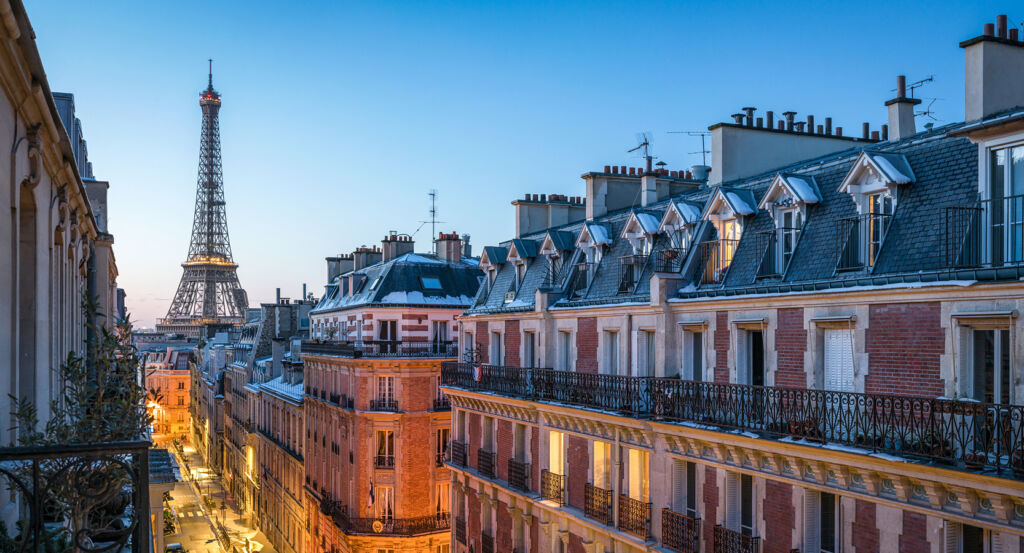
Set along Avenue des Ternes near Rue Poncelet and just steps from Passage Doisy, the hotel withdraws from the avenue through a discreet passage into interiors organized around an old staircase, a planted patio and a glass-roofed first-floor living room conceived as an oasis. The 33 guestrooms extend that idea through linen throws, botanical wallpapers, Art Deco headboards, warm natural materials and views across Parisian rooftops and Haussmannian façades, giving a relatively compact property an unusually coherent visual language. Rue Poncelet reinforces the hotel's neighborhood premise immediately outside, where produce shops, cheesemongers, butchers and food merchants sustain the market rhythm that distinguishes Ternes from the grand avenues surrounding the Arc de Triomphe. The result is a hotel where an old staircase, tropical pattern, neighborhood food culture and Orso's domestic approach to hospitality turn Ternes into something more intimate than its grand western-Paris geography suggests.
What you should know about Hôtel Doisy Etoile Orso Hotels.
Hôtel Doisy Etoile Orso Hotels is best known for its 2017 transformation by interior architects Raphaëlle Levet and Bénédicte Pierens of BR Design Intérieur, who reworked the property over several months around a 1930s tropical Art Deco style combining exotic geometries, natural materials, restrained colors and a deliberately feminine lightness. BR Design Intérieur organized 33 guestrooms across six floors around the hotel's retained old staircase, extending the concept through linen textiles, botanical wallpapers and Art Deco headboards while using views toward Parisian rooftops and Haussmannian façades to keep the escapist interiors connected to Ternes. The redesign continued into a planted patio centered on an olive tree and a glass-roofed first-floor living space, allowing Levet and Pierens to translate the tropical premise from decorative motifs into the architecture of the hotel's communal spaces. Completed in 2017 and subsequently operating as a four-star property, the reconstruction gave Hôtel Doisy a coherent authored character in which BR Design Intérieur's combination of 1930s references, botanical imagery, preserved circulation and contemporary Parisian hospitality extends from the old staircase through the guestrooms and shared spaces.
Anouk and Louis Solanet extend that authored character through Orso Hotels, the independent Parisian collection they created around a more personal model of hospitality and a portfolio in which individual properties retain distinct names and characters. Maison Colomba translates the Solanets' Corsican family memories into Hôtel Doisy's proprietary fig-and-wild-fennel bath fragrance, connecting the property's botanical interior language with a physical program developed specifically within the Orso collection. Lomi coffee roasted in Paris, Dammann tea, Laurent Simon's honey from the Oise, Haute-Savoie preserves and regional AOP cheeses carry the same philosophy into breakfast, replacing anonymous hotel provisioning with an identifiable network of French makers and origins. Together, Raphaëlle Levet, Bénédicte Pierens, Anouk Solanet, Louis Solanet and producers including Maison Colomba, Lomi and Laurent Simon give Hôtel Doisy a continuous creative logic from its 2017 architectural reinvention through the smaller rituals that define the property today.
How to fold Hôtel Doisy Etoile Orso Hotels into your trip.
Hôtel Doisy Etoile Orso Hotels works as the anchor for an afternoon tracing the dance halls, collector mansions and artist households that reveal the cultivated cultural history behind Ternes and the neighboring Plaine Monceau.
Begin at Salle Wagram, where coachman Jean-Antoine Dourlans opened the tax-avoiding Bal Dourlans beyond the Paris barriers in 1815 before the enterprise became Bal de l'Étoile, adopted the Wagram name after the avenue opened in 1864 and culminated in Alphonse Fleuret's two-gallery ballroom in 1865, later bequeathed to the Institut de France in 1899. Continue to Citéco, where banker and collector Émile Gaillard commissioned Victor-Jules Février to create the Hôtel Gaillard between 1878 and 1882 around a medieval and Renaissance art collection, celebrated its 1885 inauguration with nearly 2,000 costumed guests, and left a Loire château-inspired complex acquired by the Banque de France in 1919 and protected as a historic monument in 1999. Conclude at Musée national Jean-Jacques Henner, where Marie Henner acquired painter Guillaume Dubufe's former mansion to memorialize Jean-Jacques Henner, donated the building and collection to the French state in 1923 and opened the museum in 1924, establishing an institution that now conserves more than 2,200 works alongside Henner's brushes, palette, photographs and personal objects. The progression moves from Dourlans and Fleuret's culture of public dancing through Gaillard and Février's collector fantasy into Marie Henner's transformation of a private artist's house into a national museum, revealing the social ambition, craftsmanship and cultivated domesticity that give Hôtel Doisy Etoile Orso Hotels its deeper context in western Paris.
Where your story begins.
Foresyte Travel reveals places that feel extraordinary long before you arrive.
Experience premium editorial crafted for luxury travelers.














































































































