
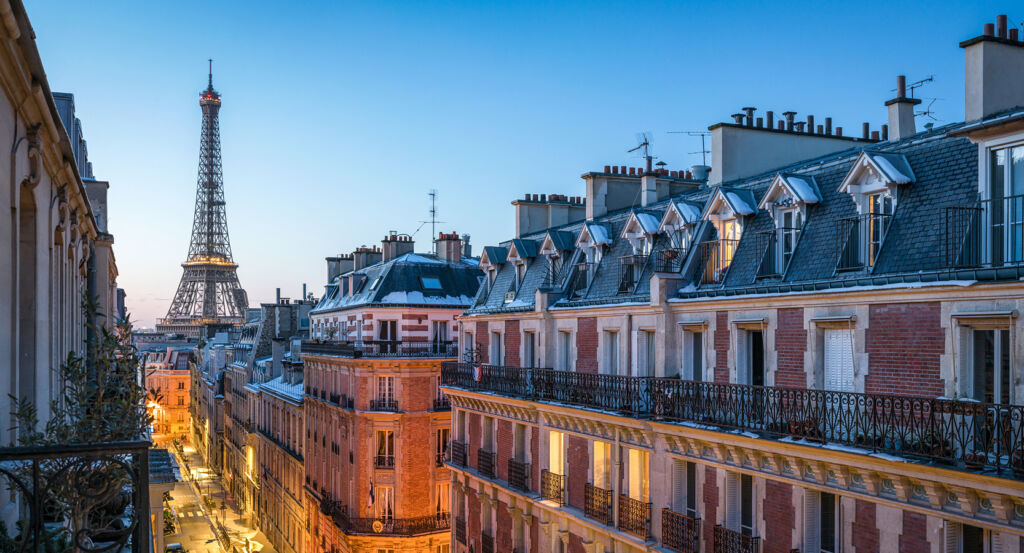
Why you should experience Hotel Du Jeu De Paume in Paris, France.
Hotel Du Jeu De Paume is an evocative four-star hotel where Île Saint-Louis's royal sporting culture, seventeenth-century craftsmanship, architectural memory and secluded character converge inside the last surviving royal jeu de paume court of its period in Paris.
Set along Rue Saint-Louis en l'Île near Rue des Deux Ponts and just steps from Église Saint-Louis-en-l'Île, the hotel inhabits a vast hall commissioned by Louis XIII in 1634 for the racket sport the king practiced enthusiastically. Matches continued here until 1747, leaving immense timber members, exposed stone and the unusual interior volume of the former court intact through its subsequent commercial occupation. Architect Guy Prache encountered that surviving structure in 1987 and transformed it into a 30-room hotel by inserting contemporary hospitality spaces around three-century-old fabric rather than suppressing the proportions inherited from play. The result is a hotel where a Bourbon king's sporting enthusiasm, 113 years of matches and Prache's late twentieth-century intervention remain physically intelligible within the same remarkable room.
What you should know about Hotel Du Jeu De Paume.
Hotel Du Jeu De Paume is best known for occupying the last surviving seventeenth-century royal jeu de paume court in Paris, commissioned in 1634 by Louis XIII, an enthusiastic practitioner whose patronage established the building around the aristocratic racket sport regarded as an ancestor of modern tennis. Matches continued inside the hall for 113 years until 1747, when declining enthusiasm for the game initiated its conversion to commercial purposes, yet the immense timber structure, exposed masonry and court-scale interior volume survived the change in function. Photographer Charles Lansiaux captured that timber structure on March 1, 1917 while the former court was serving as warehouse space, preserving a visual record of the building exactly 70 years before Guy Prache encountered it in 1987 and conceived a 30-room hotel around the three-century-old beams and stonework. Prache retained the vast former playing hall as the architectural nucleus of Hotel Du Jeu De Paume, organizing intimate contemporary spaces within a volume whose dimensions and structural character remain consequences of the building's original sporting purpose. Louis XIII's 1634 commission, the 1747 cessation of play, Lansiaux's 1917 photograph and Prache's 1987 conversion consequently form a continuous architectural biography extending across more than three and a half centuries.
Guy Prache's conversion established an independent hospitality project whose character continues through family stewardship rather than incorporation into an international hotel group, preserving the relationship between the architect's encounter with the former court and the house operating there today. The accommodation program combines 30 rooms and suites with separate two-bedroom and three-bedroom apartments, while the former playing volume survives as the soaring central atrium around which the contemporary interiors unfold. A 13-person team provides another unusual continuity within the property, with the hotel reporting that most employees have remained for more than a decade, extending the permanence expressed by the surviving architecture into the operation itself. Prache's authorship, the family ownership model, the expanded apartment program and the long-serving 13-person team deepen the same story established by the 1634 court, allowing Hotel Du Jeu De Paume to function as a living continuation of the building rather than a hotel merely occupying an old shell.
How to fold Hotel Du Jeu De Paume into your trip.
Hotel Du Jeu De Paume works as the anchor for an afternoon tracing sacred architecture, aristocratic patronage and sculptural memory through the unusually concentrated cultural inheritance of Île Saint-Louis.
Begin at Église Saint-Louis-en-l'Île, where François Le Vau designed the seventeenth-century parish church, Hardouin de Péréfixe laid the choir's first stone in 1664, Gabriel Le Duc continued construction and Jacques Doucet ultimately completed the building. Continue to Hôtel de Lauzun, built in 1657 and 1658 by Charles Chamois for financier Charles Gruyn, decorated by Michel Dorigny with mythological compositions and acquired in 1682 by the duc de Lauzun whose name it retains. Conclude at Square Barye, occupying the eastern point of the island where the sequence opens outward toward the Seine and Antoine-Louis Barye's sculptural legacy supplies a contemplative conclusion to the dense architectural world behind it. The progression moves from Le Vau's architecture of devotion through Chamois and Dorigny's aristocratic commission toward Barye's sculptural memory, revealing how religion, private patronage and artistic creation accumulated within the compact world surrounding Hotel Du Jeu De Paume.
Where your story begins.
Foresyte Travel reveals places that feel extraordinary long before you arrive.
Experience premium editorial crafted for luxury travelers.














































































































