
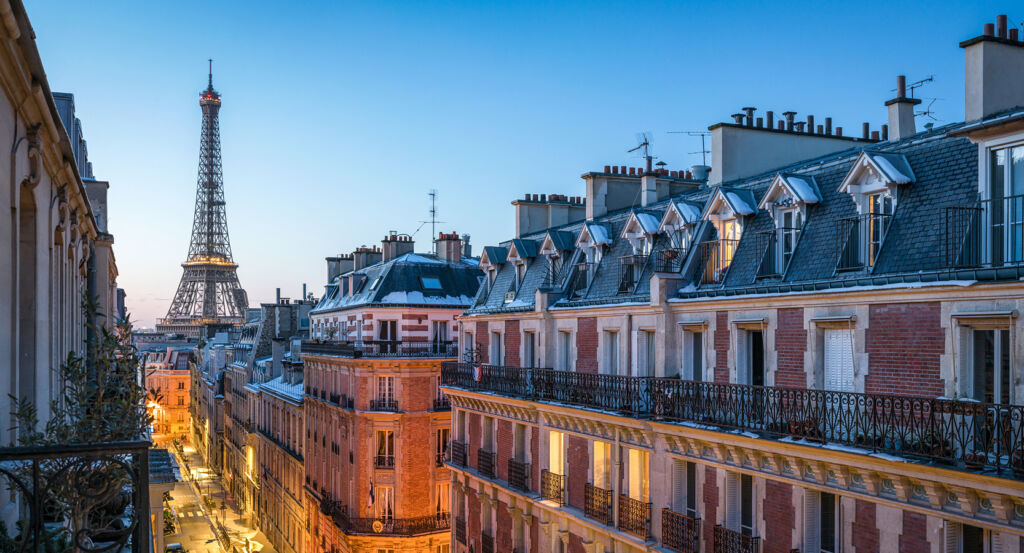
Why you should experience Hôtel Georgette in Paris, France.
Hôtel Georgette is an expressive four-star hotel where Beaubourg's contemporary-art culture, graphic experimentation, independent creativity and rebellious Parisian character converge within a 22-room house conceived as a journey through twentieth-century artistic movements.
Set along Rue du Grenier Saint-Lazare near Rue Saint-Martin and just steps from Stravinsky Fountain, the hotel organizes six floors around movements including Bauhaus, De Stijl, Dadaism, Nouveau Réalisme, Pop Art and Op Art, while its upper accommodations extend the chronology into Land Art and Street Art. Individual rooms interpret those movements through geometric forms, primary colors, distorted motifs, vintage references, optical graphics and graffiti, allowing artistic history to determine the visual character of the accommodations. The Deluxe rooms push the concept into contrasting directions through a graffiti-driven Street Art composition and a materially restrained Land Art interpretation, demonstrating how the hotel's curatorial premise accommodates radically different artistic languages within the same compact property. The result is a hotel where six floors of twentieth-century art history become the architecture of the guest experience, giving Hôtel Georgette an unusually coherent creative character within Beaubourg.
What you should know about Hôtel Georgette.
Hôtel Georgette is best known for structuring its 22 individually decorated rooms as a chronological exploration of twentieth-century art, assigning its six floors to Bauhaus, De Stijl, Dadaism, Nouveau Réalisme, Pop Art and Op Art before extending the program through Land Art and Street Art in its Deluxe accommodations. The Bauhaus rooms translate modernist reduction through minimalist geometry, De Stijl introduces primary colors and rectilinear forms associated with the movement, and Dadaism shifts toward distorted patterns and deliberately unexpected shapes. Nouveau Réalisme introduces a 1950s-inflected visual register, Pop Art turns toward saturated color and curving forms, and Op Art uses graphic effects to create optical movement, giving successive floors distinct formal systems rather than variations on a single decorative theme. Artist Marko 93 contributes another identifiable authorship through a graffiti fresco, while the De Stijl composition explicitly draws upon Piet Mondrian and the Nouveau Réalisme treatment incorporates artistically torn posters, connecting named creative references with the movements governing the hotel's interiors. Hôtel Georgette consequently operates less as a collection of art-themed rooms than as a deliberately sequenced interpretation of modern art history across the building.
The Deluxe accommodations continue the chronology through two movements that expanded artistic practice beyond conventional painting, with Street Art introducing graffiti-based visual language while Land Art shifts toward natural tones and materially quieter compositions. Piet Mondrian provides a documented reference point for the De Stijl interpretation, linking one room directly to an artist whose geometric style helps explain the property's use of primary colors and reduced forms. Marko 93 supplies a living connection to Parisian graffiti culture through his fresco, extending the hotel's artistic structure from canonical twentieth-century movements into contemporary urban authorship. Bauhaus, Mondrian, Nouveau Réalisme and Marko 93 create an evolving internal chronology in which Hôtel Georgette moves from modernist abstraction through postwar experimentation toward art made within the contemporary city.
How to fold Hôtel Georgette into your trip.
Hôtel Georgette works as the anchor for an afternoon tracing technological invention, collecting culture and theatrical experimentation through the institutions surrounding Beaubourg.
Begin at Musée des Arts et Métiers, founded through Abbé Henri Grégoire's 1794 proposal, established by law on October 10, housed in Saint-Martin-des-Champs and developed into a museum in 1802 whose collections now approach 80,000 objects and 15,000 drawings. Continue to Musée de la Chasse et de la Nature, founded by François and Jacqueline Sommer, inaugurated by André Malraux on February 21, 1967 inside François Mansart's Hôtel de Guénégaud, expanded into Hôtel de Mongelas in 2007 and now holding more than 5,000 works. Conclude at Gaîté Lyrique, relocated during Haussmann's works in 1862 into a new 1,800-seat theater, subsequently directed by Jacques Offenbach and associated across successive chapters with Russian ballet, Orchestre de Paris, Silvia Monfort, Alexis Gruss and Robert Wilson. The progression moves from Grégoire's revolutionary project for preserving invention through the Sommers' private collecting vision into a theater repeatedly reinvented through performance, revealing the unusually fertile relationship between experimentation, collecting and creative production surrounding Hôtel Georgette.
Where your story begins.
Foresyte Travel reveals places that feel extraordinary long before you arrive.
Experience premium editorial crafted for luxury travelers.














































































































