
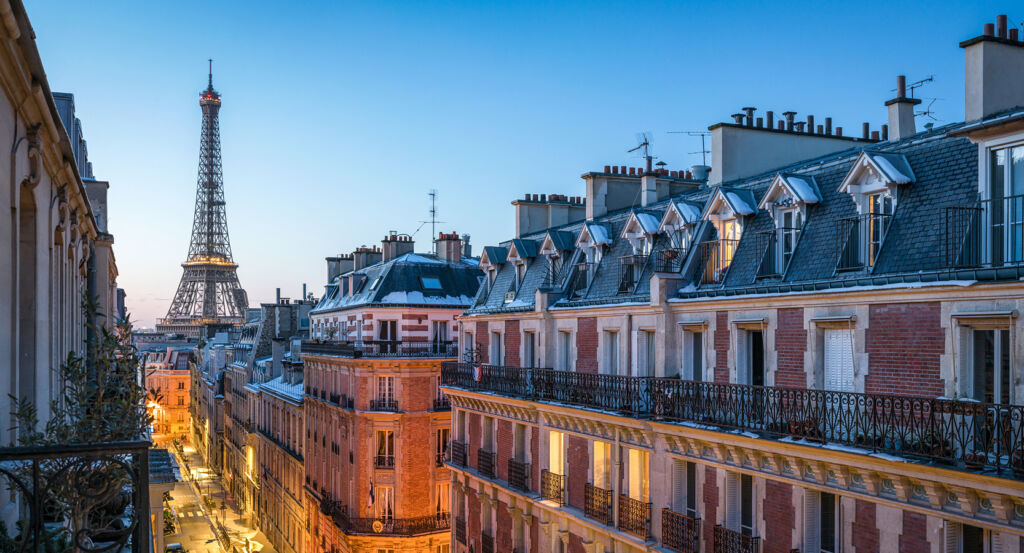
Why you should experience Hôtel Grand Powers in Paris, France.
Hôtel Grand Powers is a polished five-star hotel where Champs-Élysées's couture culture, Haussmannian refinement, interwar design and century-old hospitality converge within a historic house shaped by successive generations of Parisian style.
Set along Rue François 1er near Rue Pierre Charron and just steps from Avenue des Champs-Élysées, the hotel has welcomed guests since 1920 within a nineteenth-century Haussmannian building whose period moldings, marble fireplaces and generous proportions survived a comprehensive 2019 renovation. Owners Alexandra and Julie Marang worked with architects Vincent Bastie and Arnaud Behzadi and decorator Cathy Crinon to reposition the property as a 50-room five-star hotel, combining Parisian architectural style with Italian design and Anglo-Saxon residential influences. Custom furniture references a century of design through lacquer, aged brass, marble, oak and walnut, while powder pink, celadon and blue establish distinct palettes across the six floors. The result is a hotel where preserved Haussmannian fabric and the Marang family's contemporary commission allow a property opened in 1920 to carry its architectural inheritance into a distinctly modern chapter.
What you should know about Hôtel Grand Powers.
Hôtel Grand Powers is best known for opening in 1920 and entering a major new chapter in 2019, when owners Alexandra and Julie Marang completed a months-long renovation with architects Vincent Bastie and Arnaud Behzadi and decorator Cathy Crinon, establishing the present 50-room five-star property within its Haussmannian building. The intervention retained original moldings, marble fireplaces and substantial room volumes while introducing specially designed furniture spanning references to the previous 100 years of design, executed through oak, walnut, lacquered surfaces, aged brass, marble, velvet and silk. A separate cultural episode occurred inside the hotel in 1947, when composer Henri Betti met lyricist André Hornez there to name a newly composed melody, ultimately selecting “C'est si bon” from ten proposed three-syllable titles before the song became an international jazz standard through recordings including Louis Armstrong's English-language interpretation. The hotel's contemporary recognition now includes One MICHELIN Key, adding an independent hospitality distinction to a century-long record encompassing its 1920 opening, Betti and Hornez's songwriting encounter and the Marang family's 2019 architectural renewal.
The 2019 project also reorganized the house across six floors into 12 junior suites, 18 superior rooms, 19 deluxe rooms and the 75-square-meter L'Élégante suite, giving the redesign a precisely documented accommodation structure. Bastie, Behzadi and Crinon developed the interiors around three stated influences, Parisian elegance, Italian design and Anglo-Saxon comfort, while retaining solid-oak parquet, historic fireplaces and the proportions inherited from the building. Café 52 adds another identifiable creative authorship through executive chef Maxime Raab, previously at Fouquet's, whose present culinary program is organized around seasonal sourcing and certified producers. Alexandra and Julie Marang, Bastie-Behzadi, Cathy Crinon, Henri Betti, André Hornez and Maxime Raab consequently define distinct chapters of ownership, architecture, music and gastronomy that intrinsically belong to Hôtel Grand Powers itself.
How to fold Hôtel Grand Powers into your trip.
Hôtel Grand Powers works as the anchor for an afternoon tracing couture authorship, philanthropic collecting and exhibition-era architecture through the cultural institutions of western Champs-Élysées.
Begin at Musée Yves Saint Laurent Paris, housed within the couture house's former working premises, where Saint Laurent established his operation in 1974 before the address became the Fondation Pierre Bergé - Yves Saint Laurent in 2004 and subsequently opened as a museum in 2017. Continue to Palais Galliera, commissioned in 1879 by Marie Brignole-Sale from architect Paul-René-Léon Ginain, completed in 1894 with metalwork executed by Gustave Eiffel's company, inaugurated in 1895 and dedicated permanently to fashion by the City of Paris in 1977. Conclude at Petit Palais, where Charles Girault designed four wings around a semicircular garden for the 1900 Exposition Universelle before the building became a municipal fine-arts museum in 1902 and acquired an extensive decorative program executed between 1903 and 1925. The progression moves from Saint Laurent's twentieth-century couture house through the Duchess of Galliera's nineteenth-century collecting ambitions into Girault's architecture for the 1900 exposition, revealing the unusually concentrated relationship between fashion, patronage and decorative arts surrounding Hôtel Grand Powers.
Where your story begins.
Foresyte Travel reveals places that feel extraordinary long before you arrive.
Experience premium editorial crafted for luxury travelers.














































































































