
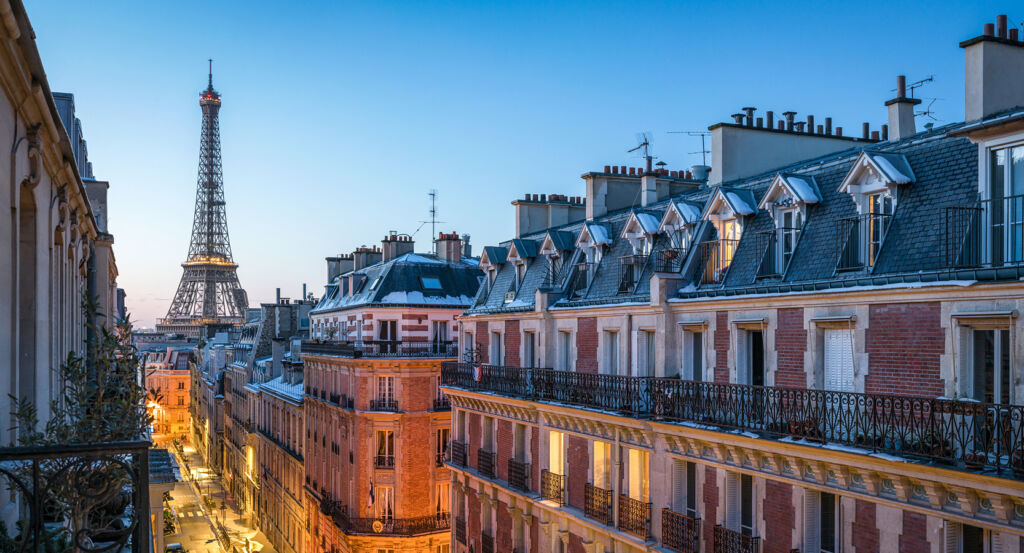
Why you should experience Hôtel L'Antoine in Paris, France.
Hôtel L'Antoine is an expressive four-star hotel where Faubourg Saint-Antoine's cabinetmaking heritage, revolutionary character, fashion culture and tradition of artisanal experimentation converge within Christian Lacroix's exuberant interpretation of the district.
Set along Rue de Charonne near Rue du Faubourg Saint-Antoine and just steps from Place de la Bastille, the hotel occupies the site of a seventeenth-century convent whose surviving structure was comprehensively reworked from a former 45-room two-star property into a 38-room four-star hotel. Christian Lacroix developed the interiors from his own familiarity with Faubourg Saint-Antoine before the 2000s, treating each of the five floors as a distinct recollection of the quarter through recycled materials, saturated textiles, cabinetmaking references and artistic-studio imagery. Rémi Perret created unconventional bedside tables specifically for the first floor, while another level pays direct homage to Dissidi, a cabinetmaking company historically based nearby, connecting contemporary furniture design with the woodworking trades that defined the faubourg. The result is a hotel where Lacroix's visual imagination, Rémi Perret's bespoke objects and the memory of local cabinetmaking translate the working history of Faubourg Saint-Antoine into an unusually site-specific design narrative.
What you should know about Hôtel L'Antoine.
Hôtel L'Antoine is best known for occupying the site of a seventeenth-century convent subsequently converted into a 45-room two-star hotel before a substantial architectural rehabilitation produced a four-star property containing 38 redesigned rooms within a timber-framed building only 7.3 meters deep. The reconstruction required specialized thin acoustic assemblies because of the unusually shallow structure and neighboring residential buildings, while the lobby was opened completely to create an uninterrupted spatial connection between Rue de Charonne and the former convent's interior courtyard. Christian Lacroix determined the materials and their placement throughout the project, translating his longstanding familiarity with Faubourg Saint-Antoine into five individually conceived floors rather than repeating a standardized decorative program. The first floor combines raw and reclaimed materials with bedside tables commissioned specifically from Rémi Perret, the second shifts toward brightly colored velvet hangings and carpets, and the third commemorates nearby cabinetmaker Dissidi through curving retro furniture. Lacroix's collaboration with the architectural rehabilitation connects seventeenth-century religious fabric, timber construction, contemporary building engineering and commissioned furniture within a single design project.
Christian Lacroix extended that narrative through the upper floors by turning the fourth level into an interpretation of the artist's studio before giving the fifth a 1950s vocabulary, allowing the building's vertical progression to move through different periods and creative identities associated with the faubourg. The hotel's 2023 renovation deliberately retained Lacroix's original decorative authorship while refreshing a project whose materials combine recovered elements with more refined contemporary interventions, preserving the designer's relationship with a district where he had worked extensively before the turn of the millennium. AAPHM's architectural work provides the technical counterpart to Lacroix's decorative program through the rehabilitation of the timber frame, redesigned room volumes and continuous ground-floor passage connecting street and courtyard. Christian Lacroix, Rémi Perret, Dissidi and AAPHM consequently establish Hôtel L'Antoine as a collaborative design record shaped by fashion, furniture, architecture and the surviving structure of its seventeenth-century predecessor.
How to fold Hôtel L'Antoine into your trip.
Hôtel L'Antoine works as the anchor for an afternoon tracing literary preservation, industrial production and the conversion of nineteenth-century infrastructure into contemporary Parisian culture around Bastille.
Begin at Maison de Victor Hugo, where Paul Meurice proposed a museum for Hugo's 1902 centenary inside Hôtel de Rohan Guéménée, the writer's home from 1832 to 1848, donating his collection before the institution opened on June 30, 1903. Continue to Atelier des Lumières, where brothers Jacques François Alexandre and Hilaire Pierre Plichon established Fonderie du Chemin-Vert in 1835, eventually producing castings weighing up to 10,000 kilograms for warships, locomotives and engines before the company dissolved in 1935. Conclude at Coulée verte René-Dumont, created from the Vincennes railway that opened in 1859 and ceased operating in 1969, before Jacques Vergely and Philippe Mathieux converted the abandoned infrastructure into an elevated promenade inaugurated in 1993. The progression moves from Meurice's preservation of Hugo's domestic world through the Plichon family's century of industrial production into Vergely and Mathieux's reinvention of obsolete railway infrastructure, revealing the cycles of creation and reinvention surrounding Hôtel L'Antoine.
Where your story begins.
Foresyte Travel reveals places that feel extraordinary long before you arrive.
Experience premium editorial crafted for luxury travelers.














































































































