
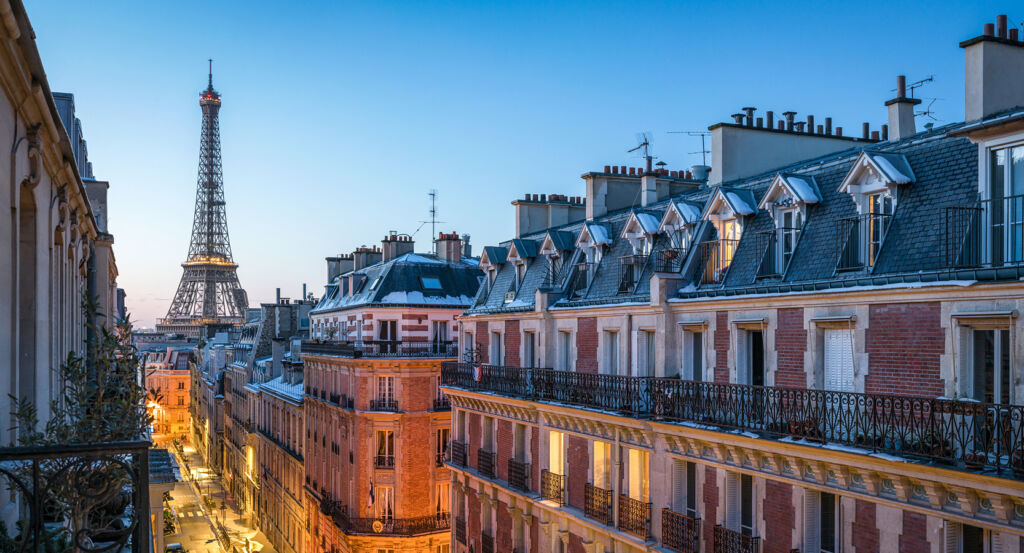
Why you should experience Hotel L'Échiquier Opéra Paris - MGallery Collection in Paris, France.
Hotel L'Échiquier Opéra Paris - MGallery Collection is a theatrical four-star hotel where Grands Boulevards's Belle Époque refinement, entertainment heritage, architectural ornament and interwar sophistication converge within a property carrying several centuries of Parisian history.
Set along Rue de l'Échiquier near Rue du Faubourg Poissonnière and just steps from Grand Rex, the hotel occupies a building whose documented story reaches the sixteenth century, when the property belonged to Henri IV and functioned as a hunting lodge surrounded by forest beyond the contemporary city. The structure later became a hotel during the nineteenth century, retaining carved woodwork, mosaic flooring, stained glass, an ornate lift and a marble spiral staircase as physical evidence of its earlier architectural chapters. Designers Yann Le Coadic and Alessandro Scotto subsequently reinterpreted the property through interiors drawing on the Années folles, Art Nouveau and the proportions of 1930s Parisian apartments, allowing historical fabric and contemporary design to coexist throughout the house. The result is a hotel where Henri IV's former hunting retreat, nineteenth-century craftsmanship and Le Coadic and Scotto's twentieth-century references compress several eras of Parisian decorative culture into a single Grands Boulevards address.
What you should know about Hotel L'Échiquier Opéra Paris - MGallery Collection.
Hotel L'Échiquier Opéra Paris - MGallery Collection is best known for occupying a building that belonged to Henri IV during the sixteenth century, when it functioned as a royal hunting lodge surrounded by an extensive forest, before becoming a hotel during the nineteenth century and preserving architectural fabric from that later period. The surviving interior record includes carved lobby woodwork, mosaic floors, stained glass, an ornate historic lift and the marble spiral staircase encircling it, giving the property a collection of architectural elements accumulated before its contemporary redesign. Yann Le Coadic and Alessandro Scotto became the principal modern creative authors, developing an interior style informed by the Années folles while combining Art Nouveau references with guestrooms conceived around the atmosphere and proportions of Parisian apartments from the 1930s. MGallery's own historical documentation emphasizes cabinetmaking, paintings and mosaic flooring as surviving components of the property, while Le Coadic and Scotto's intervention uses these inherited materials as the foundation for a contemporary interpretation rather than reconstructing a single historical period. Henri IV, the nineteenth-century conversion and Le Coadic and Scotto establish three distinct chapters of architectural use and design authorship within the same building.
The decorative program deepens that chronology through Le 38, where the designers extended the 1920s reference into a lounge conceived around the social culture of the interwar period while the guestrooms shift toward a more residential 1930s style centered on chandeliers and apartment-like composition. Period craftsmanship remains particularly legible in the carved timber, stained glass, mosaic surfaces and staircase ensemble, creating a material record that predates the contemporary furnishings layered around it. MGallery's preservation of those components also distinguishes the project from a purely stylistic reconstruction because the Belle Époque and Art Nouveau references operate alongside physical nineteenth-century fabric inherited from the building's earlier hotel life. Yann Le Coadic, Alessandro Scotto and the surviving decorative ensemble consequently allow the property's contemporary character to emerge from accumulated craftsmanship, royal origins and successive interpretations of Parisian domestic design.
How to fold Hotel L'Échiquier Opéra Paris - MGallery Collection into your trip.
Hotel L'Échiquier Opéra Paris - MGallery Collection works as the anchor for an afternoon tracing royal commemoration, technological invention and cinematic performance through the cultural history surrounding Grands Boulevards.
Begin at Porte Saint-Denis, constructed around 1672 and completed in 1673 to commemorate Louis XIV's victories over the Dutch, with architect François Blondel replacing the earlier gate through a 72-foot-high composition organized around a central 26-foot opening. Continue to Musée des Arts et Métiers, whose Revolutionary origins produced a collection now approaching 80,000 objects and 15,000 drawings, including Vaucanson's loom, Chappe's telegraph, Cugnot's fardier and Clément Ader's Avion No. 3. Conclude at Grand Rex, where Jacques Haïk welcomed 3,300 formally dressed guests on December 8, 1932 to Europe's largest cinema, beneath an atmospheric auditorium of artificial stars, palms, minarets and architectural fantasies crowned by a 35-meter tower. The progression moves from Blondel's architecture of Bourbon victory through Revolutionary technological preservation into Haïk's immense interwar cinema, revealing three centuries of ambition, invention and performance surrounding Hotel L'Échiquier Opéra Paris - MGallery Collection.
Where your story begins.
Foresyte Travel reveals places that feel extraordinary long before you arrive.
Experience premium editorial crafted for luxury travelers.














































































































