
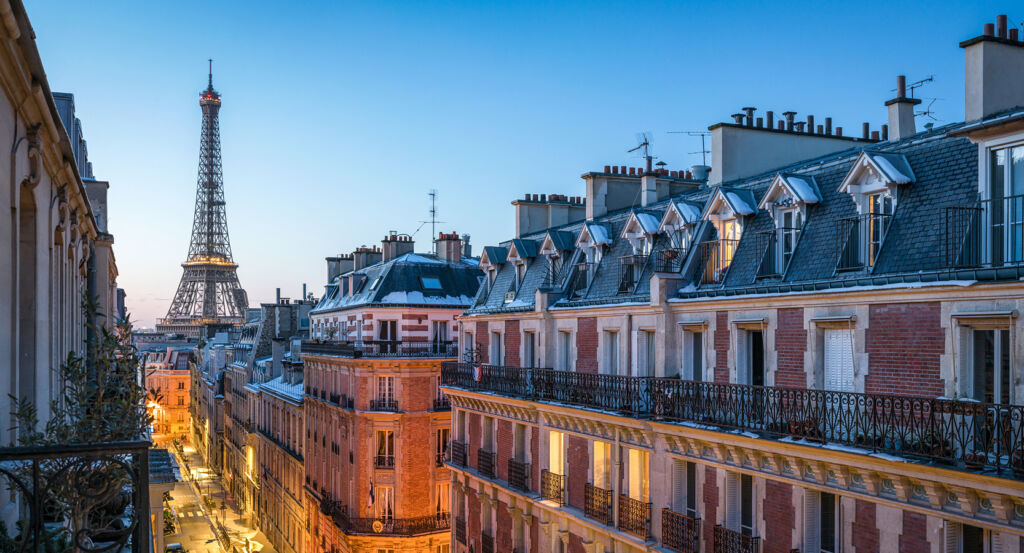
Why you should experience Hotel Le Ballu in Paris, France.
Hotel Le Ballu is an imaginative five-star hotel where Saint-Georges's artistic experimentation, theatrical irreverence, nineteenth-century architectural ambition and cosmopolitan design culture converge within a richly authored world of its own.
Set along Rue Ballu near Rue Blanche and just steps from Théâtre de Paris, the 37-room hotel occupies two adjoining buildings, including a private mansion constructed in 1888 for painter Charles Wislin, transformed by architect and owner Thomas Vidalenc into a 2,000-square-meter hospitality project completed in 2019. Vidalenc conceived the property as an invented journey through a vanished world, combining furniture of his own design with twentieth-century pieces by Slovenian, Czech, Polish and Bosnian creators in interiors whose precise outlines reference the ligne claire tradition of European comics. The address deepens that creative lineage through Rue Ballu itself, opened in 1841 as Rue de Boulogne before receiving the name of architect Théodore Ballu, while nearby No. 6 became the workshop of composer Claude Terrasse and the setting for an early marionette performance of Alfred Jarry's Ubu roi. The result is a hotel where Charles Wislin, Thomas Vidalenc, Théodore Ballu and the experimental world surrounding Ubu roi connect contemporary hospitality with the artistic eccentricity embedded in Saint-Georges.
What you should know about Hotel Le Ballu.
Hotel Le Ballu is best known for opening after Thomas Vidalenc transformed two adjoining buildings, including an 1888 private mansion constructed for painter Charles Wislin, into a 2,000-square-meter hotel containing 37 rooms, including four apartments, a 90-seat restaurant and a swimming pool. Vidalenc developed both the architecture and furniture around an imaginary voyage, using sharply delineated volumes inspired by the ligne claire language of European comics and assembling furniture by designers from Slovenia, the Czech Republic, Poland and Bosnia to evoke a difficult-to-date world shaped by multiple periods and geographies. Rue Ballu adds a separate architectural chronology: the 274-meter street was opened in 1841 as Rue de Boulogne during development of land associated with the former Pavillon La Bouëxière and Nouveau Tivoli before being renamed for Théodore Ballu in 1886. Ballu, born in 1817, designed nearby Église de la Sainte-Trinité between 1861 and 1867 and later worked with Édouard Deperthes on the reconstruction of Hôtel de Ville following its destruction during the Paris Commune, giving the hotel's street name a direct connection with major nineteenth-century Parisian architecture. Thomas Vidalenc's contemporary intervention, Charles Wislin's 1888 mansion and Théodore Ballu's architectural legacy consequently compress more than a century of design authorship into the character of Hotel Le Ballu and its immediate street.
Rue Ballu's creative history extends beyond architecture through composer Claude Terrasse, whose workshop at No. 6 became associated with Alfred Jarry and the prehistory of Ubu roi before the work erupted onto the Parisian stage in 1896. Théâtre de Paris subsequently became part of that same theatrical chronology when the Nouveau Théâtre opened in 1891, Lugné-Poe introduced Parisian audiences to Nordic playwrights including Henrik Ibsen and Firmin Gémier delivered the notorious opening of Jarry's Ubu roi there in 1896. Actress Réjane later owned the venue and gave it her name before producer Léon Volterra acquired it in 1918 and established the Théâtre de Paris identity, followed in 1929 by Marcel Pagnol's creation of Marius on its stage. Claude Terrasse, Alfred Jarry, Lugné-Poe, Réjane, Léon Volterra and Marcel Pagnol place Hotel Le Ballu within a remarkably concentrated theatrical geography where experimentation and performance repeatedly reshaped the cultural character of Saint-Georges.
How to fold Hotel Le Ballu into your trip.
Hotel Le Ballu works as the anchor for an afternoon tracing theatrical provocation, Romantic artistic sociability and Symbolist imagination through the creative institutions surrounding Saint-Georges.
Begin at Théâtre de Paris, where a Nouveau Théâtre established in 1891 became associated with Lugné-Poe's promotion of Henrik Ibsen before Alfred Jarry's Ubu roi caused a sensation there in 1896, followed by Réjane's ownership, Léon Volterra's 1918 acquisition and Marcel Pagnol's 1929 creation of Marius. Continue to Musée de la Vie Romantique, where Ary Scheffer settled in July 1830 and developed two studios that became gathering places for nineteenth-century artists and intellectuals before his daughter Cornélia mounted a major retrospective there in 1859, the studios served as a temporary hospital during the 1870 siege and the property eventually became Musée de la Vie Romantique in 1987. Conclude at Musée Gustave Moreau, where the Symbolist painter transformed his family home into the museum he intended to leave behind, creating vast upper-floor studios to accommodate his work and establishing an unusually complete artistic environment that preserves his paintings, drawings and personal world within the house where they were created. The progression moves from Jarry and Lugné-Poe's theatrical rupture through Scheffer's Romantic circle into Moreau's self-fashioned artistic universe, revealing the successive forms of creative authorship that give Hotel Le Ballu's own imagined world its deeper Saint-Georges context.
Where your story begins.
Foresyte Travel reveals places that feel extraordinary long before you arrive.
Experience premium editorial crafted for luxury travelers.














































































































