
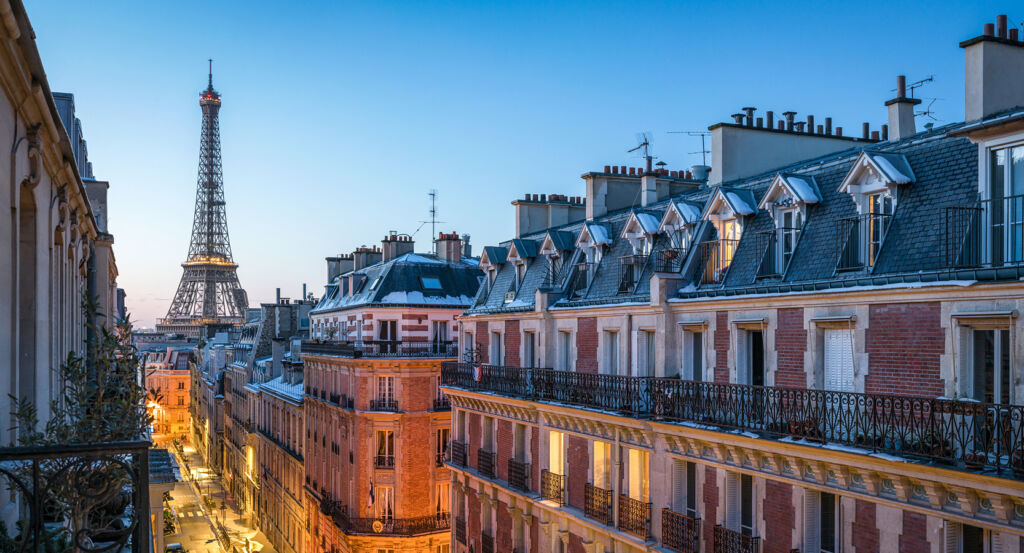
Why you should experience Hôtel Maison Pigalle Paris 9e in Paris, France.
Hôtel Maison Pigalle Paris 9e is a theatrical four-star hotel where Saint-Georges's artistic bohemia, Romantic inheritance, performance culture and enduring appetite for creative reinvention converge within an intimate house shaped around the spirit of Nouvelle Athènes.
Set along Rue Frochot near Rue Victor Massé and just steps from Place Pigalle, the 40-room hotel occupies a quarter where nineteenth-century painters, writers, composers and performers transformed the slopes below Montmartre into one of Paris's most concentrated creative enclaves. Interior designer Charlotte Catan developed the property as a contemporary maison through patterned wallpapers, saturated textiles, antique-inspired furniture and individually composed rooms, drawing on the domestic eclecticism of the artists and collectors who historically inhabited the surrounding streets. Accommodations extend from 12-square-meter Cosy rooms through Classic, Superior and Deluxe categories to a 35-square-meter rooftop suite, while selected rooms incorporate balconies and views across Paris toward Sacré-Coeur. The result is a hotel where Charlotte Catan's residential interiors, intimate scale and the artistic memory of Nouvelle Athènes give Saint-Georges's creative inheritance a contemporary hospitality expression.
What you should know about Hôtel Maison Pigalle Paris 9e.
Hôtel Maison Pigalle Paris 9e is best known for emerging from the former Trinité Haussmann as a completely reimagined 40-room property whose renovation placed interior designer Charlotte Catan at the center of a concept inspired by the artists, collectors and private residences of nineteenth-century Nouvelle Athènes. Catan treated the hotel as a sequence of individual domestic environments rather than standardized guestrooms, combining floral and geometric wallpapers, velvet, patterned fabrics, brass details, vintage references and bespoke furnishings while varying palettes and compositions across the accommodation program. The 40 rooms span 12-square-meter Cosy accommodations, 14-square-meter Classics, 16-square-meter Superiors and larger Deluxe categories before culminating in an 35-square-meter rooftop suite, while selected upper-level rooms add balconies and perspectives toward Sacré-Coeur. Maison Pigalle extends the residential premise into its communal spaces through a salon, library atmosphere and Honesty Bar, allowing the ground floor to operate with the informality of a private house. Charlotte Catan's authored interiors, 40-room scale, individually differentiated accommodations and rooftop suite established Hôtel Maison Pigalle Paris 9e as a design-led reinterpretation of the domestic culture that historically defined Nouvelle Athènes.
George Sand provides one of the strongest historical threads behind that cultural positioning, having settled in Nouvelle Athènes during the 1830s within the same artistic society that brought Frédéric Chopin, Eugène Delacroix, Ary Scheffer, Pauline Viardot and other leading figures of Romantic Paris into close intellectual proximity. Ary Scheffer's nearby home became one of the quarter's defining salons after the painter established himself there in 1830, receiving artists, writers, musicians and political figures while George Sand's relationship with Frédéric Chopin connected the neighborhood directly with some of the period's most influential literature and music. Hôtel Maison Pigalle Paris 9e draws upon that legacy through the idea of a collector's residence, using Charlotte Catan's layered objects, textiles and furniture to evoke a home accumulated through creative lives rather than a formally coordinated hospitality interior. Charlotte Catan, George Sand, Frédéric Chopin and Ary Scheffer give the property's design premise a coherent historical foundation, connecting its contemporary maison character with the artistic networks that made Nouvelle Athènes one of nineteenth-century Paris's defining cultural communities.
How to fold Hôtel Maison Pigalle Paris 9e into your trip.
Hôtel Maison Pigalle Paris 9e works as the anchor for an afternoon tracing the Romantic salons, Symbolist imagination and performance culture that established the slopes below Montmartre as a center of artistic Paris.
Begin at Musée de la Vie Romantique, where Ary Scheffer settled in 1830 and constructed two north-facing studios the following year, creating a salon frequented by Eugène Delacroix, Frédéric Chopin, Franz Liszt, George Sand, Charles Dickens, Gioachino Rossini and Pauline Viardot within the creative community of Nouvelle Athènes. Continue to Musée Gustave Moreau, where the Symbolist painter transformed his family home during the 1890s by commissioning architect Albert Lafon to create grand studios across its upper floors, then bequeathed the house and 1,200 paintings, watercolors and cartoons plus thousands of drawings to the French state before the museum opened in 1903. Conclude at Casino de Paris, whose entertainment history developed from an eighteenth-century pleasure venue through successive nineteenth-century transformations before Léon Volterra established the modern music-hall era there in 1914, creating a stage subsequently associated with Mistinguett, Maurice Chevalier, Joséphine Baker and later generations of international performers. The progression moves from the private salon culture of Romantic Paris through Gustave Moreau's purpose-built artistic environment into the theatrical tradition of the neighborhood's music halls, revealing the continuum of painting, literature, music and performance surrounding Hôtel Maison Pigalle Paris 9e.
Where your story begins.
Foresyte Travel reveals places that feel extraordinary long before you arrive.
Experience premium editorial crafted for luxury travelers.














































































































