
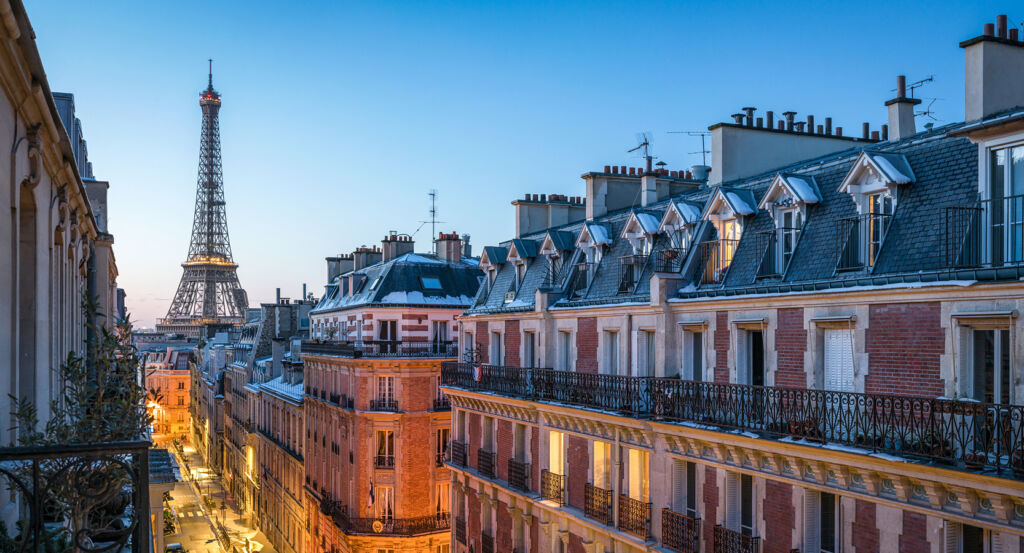
Why you should experience Hôtel Marceau Bastille in Paris, France.
Hôtel Marceau Bastille is an artistic four-star hotel where Quinze-Vingts's creative independence, railway inheritance, gallery culture and enduring spirit of urban reinvention converge within an intimate property built around contemporary art.
Set along Rue Jules César near Rue de Lyon and just steps from Port de l'Arsenal, the 55-room hotel divides its accommodations between contrasting Urban and Ecolo design languages while giving its ground floor to a light-filled gallery that functions simultaneously as exhibition space and salon. The gallery changes three times each year as the hotel invites emerging and established photographers, painters and sculptors to exhibit, with previous artists including David Gerstein, David Ferreira, Cécile Desserle, Laurent Paillier and Olivier Courty. Fifty-five guestrooms extend across six floors, while a flowered patio, fitness room, wellness treatments and an Honesty Bar operating from late morning until midnight give the compact property several distinct spaces beyond its accommodations. The result is a hotel where rotating exhibitions, contrasting room identities and courtyard intimacy give the creative culture surrounding Bastille a hospitality expression built around continual visual change.
What you should know about Hôtel Marceau Bastille.
Hôtel Marceau Bastille is best known for integrating a working contemporary art gallery directly into a 55-room hotel, with the ground-floor exhibition program changing three times annually as emerging artists and established creators are invited to transform the same light-filled space that contains the property's salon. The gallery deliberately spans multiple media, with the hotel documenting exhibitions by Israeli painter and sculptor David Gerstein, painter David Ferreira, painter Cécile Desserle, performing-arts photographer Laurent Paillier and sculptor Olivier Courty as part of a program conceived to place recognized creators beside younger artists seeking greater visibility. Guestrooms develop a second layer of visual authorship through two distinct collections, Urban and Ecolo, separating the accommodation program into contrasting design identities rather than repeating a single aesthetic across all six floors. Privilege rooms broaden that inventory alongside the two Standard collections, while soundproofing, individually controlled seasonal climate systems and high-speed fiber connectivity establish the contemporary infrastructure beneath the property's gallery-led identity. The 55-room scale, six-floor configuration, dual Urban and Ecolo concepts and three annual exhibitions make Hôtel Marceau Bastille an unusually concentrated example of contemporary art functioning as an evolving component of hotel life.
Hôtel Marceau Bastille extends that cultural program into a ground floor where the Art Gallery and salon occupy the same luminous environment, allowing each exhibition to alter the visual character of one of the property's principal communal rooms. Hôtel Marceau Bastille complements the gallery with a flowered patio and an Honesty Bar operating from 11 a.m. until midnight, creating two additional social settings within a relatively compact 55-key footprint. Hôtel Marceau Bastille also maintains a fitness room and wellness program delivered by experienced practitioners using products described by the property as 100 percent natural, adding a dedicated treatment component beyond the conventional exercise facilities of an urban four-star hotel. Hôtel Marceau Bastille's rotating gallery, David Gerstein and Cécile Desserle exhibitions, flowered patio and practitioner-led wellness program collectively create a contemporary character in which art, social space and personal restoration operate as recurring parts of the property.
How to fold Hôtel Marceau Bastille into your trip.
Hôtel Marceau Bastille works as the anchor for an afternoon tracing the architecture, landscape and cultural reinvention that have repeatedly transformed the former infrastructure surrounding Bastille.
Begin at Pavillon de l'Arsenal, where architect Clément designed a building in 1878 and 1879 for timber merchant Laurent-Louis Borniche to display a collection approaching 2,000 paintings, before successive lives as premises for Rivoire & Carret, a Samaritaine clothing workshop and a City of Paris archive preceded its December 1988 opening as Paris's center for architecture and urbanism. Continue to Port de l'Arsenal, where the basin between Bastille and the Seine preserves the maritime geography of a district once shaped by the King's Arsenal and the former Île Louviers, whose separation from the Right Bank disappeared when a branch of the Seine was filled in during 1843. Conclude at Coulée verte René-Dumont, where the former railway alignment departing Bastille was converted beginning in 1988 by Philippe Mathieux and Jacques Vergely into a 4.5-kilometer planted corridor threading through viaducts, gardens, tunnels and surviving railway structures toward eastern Paris. The progression moves from a nineteenth-century private museum repeatedly reinvented for new cultural uses through the surviving waterways of the Arsenal into railway infrastructure reclaimed as landscape, revealing the persistent culture of transformation surrounding Hôtel Marceau Bastille.
Where your story begins.
Foresyte Travel reveals places that feel extraordinary long before you arrive.
Experience premium editorial crafted for luxury travelers.














































































































