
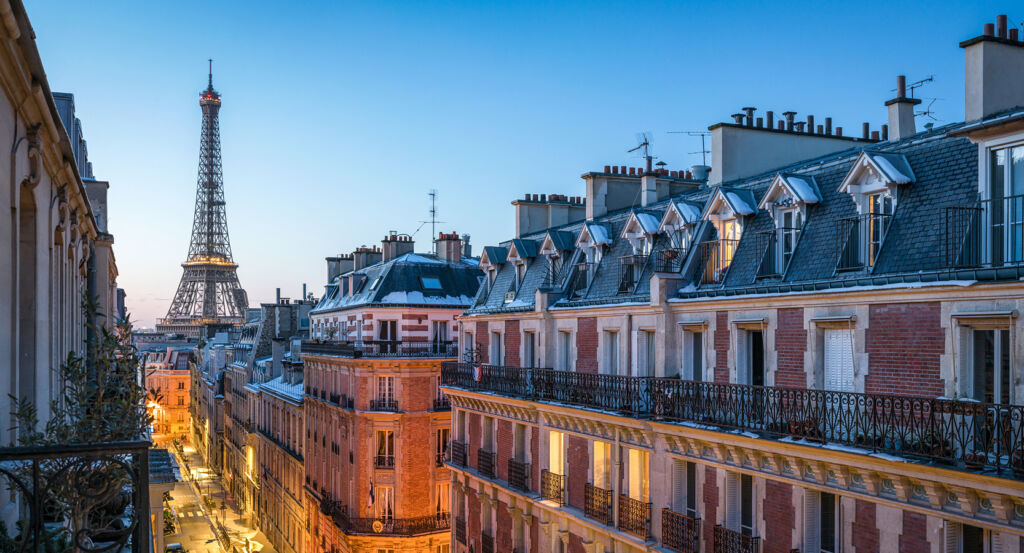
Why you should experience Hôtel Mercure Paris Opéra Grands Boulevards in Paris, France.
Hôtel Mercure Paris Opéra Grands Boulevards is a jazz-inspired hotel where Porte-Saint-Denis' performance culture, Rue des Petites Écuries' royal history and a building dating to the first half of the nineteenth century converge within a recently renewed 50-room property.
Set along Rue des Petites Écuries near Rue du Faubourg Poissonnière and just steps from Folies Bergère, the four-star property interprets the surrounding theater and music district through a contemporary interior character centered on jazz. Accor currently documents 50 renovated guestrooms alongside two fully equipped duplex apartments, extending the accommodation program beyond conventional hotel rooms into multi-level configurations designed for groups of up to four. Historical documentation places construction of the address between 1801 and 1850, while later alterations expanded hotel use and reshaped portions of the courtyard-facing building over successive decades. The result is a Porte-Saint-Denis hotel whose jazz narrative connects a nineteenth-century address with the performance culture that continues to define the surrounding streets.
What you should know about Hôtel Mercure Paris Opéra Grands Boulevards.
Hôtel Mercure Paris Opéra Grands Boulevards is best known for occupying a building at 42 Rue des Petites Écuries whose documented construction period falls between 1801 and 1850, while the street itself developed from an older route bordering Paris's grand sewer and took its name from the Petites Écuries du Roi established nearby during the eighteenth century. Municipal property records document a 2000 permit authorizing conversion of office areas across the basement, ground floor and first floor for expansion of an existing hotel, creating four additional guestrooms, followed by 2011 roof-window work and a 2016 conversion of courtyard-facing residential space into hotel accommodation. Current Accor documentation records 50 renovated rooms and two fully equipped duplex apartments, with Classic, Privilege, family and Opéra duplex configurations forming the contemporary inventory. A 2025 renovation provides the latest design chapter, with current materials presenting jazz as the organizing concept across the property and positioning the house within the theater and cabaret culture of the Grands Boulevards. Green Key certification followed for 2026, adding an independently administered environmental standard to a property whose physical evolution can be traced through more than two centuries of construction, hotel expansion and interior renewal.
New Morning gives the hotel's jazz character unusually strong local context, with the club operating at 7-9 Rue des Petites Écuries since 1981 and building an international performance history that includes Chet Baker, Dizzy Gillespie, Stan Getz and Dexter Gordon. Prince developed a particularly close relationship with New Morning, repeatedly returning for surprise after-show appearances, giving the same street now occupied by Hôtel Mercure Paris Opéra Grands Boulevards a documented connection with one of late twentieth-century popular music's most significant performers. Commission du Vieux Paris provides a deeper historical layer through its 1907 documentation of the nearby corner of Rue des Petites Écuries and Rue du Faubourg Poissonnière, where a surviving low-rise faubourg house was photographed by Union Photographique Française as one of the district's remaining early building types. Together, New Morning, Prince, Commission du Vieux Paris and Union Photographique Française place the hotel's contemporary jazz concept within a Rue des Petites Écuries history shaped by performance, documented architectural change and more than a century of cultural observation.
How to fold Hôtel Mercure Paris Opéra Grands Boulevards into your trip.
Hôtel Mercure Paris Opéra Grands Boulevards works as the anchor for an afternoon tracing waxwork performance, cinematic architecture and nineteenth-century performance culture through the Grands Boulevards.
Begin at Musée Grévin, founded in 1882 by journalist Arthur Meyer with caricaturist and sculptor Alfred Grévin, where wax portraiture and elaborate interiors preserve the boulevard culture of celebrity and performance that flourished during the late nineteenth century. Continue to Grand Rex, opened in 1932 for producer Jacques Haïk with architecture by Auguste Bluysen and an atmospheric auditorium developed with American theater designer John Eberson, bringing the scale and fantasy of the interwar movie palace into Central Paris. Conclude at Théâtre de la Porte Saint-Martin, whose history began with a rapidly constructed opera house commissioned in 1781 before the theater became closely associated with nineteenth-century drama. The progression moves from Meyer and Grévin's culture of celebrity through Haïk, Bluysen and Eberson's cinematic performance into the theatrical history of Porte Saint-Martin, creating a performance-centered sequence that complements the jazz character inside Hôtel Mercure Paris Opéra Grands Boulevards.
Where your story begins.
Foresyte Travel reveals places that feel extraordinary long before you arrive.
Experience premium editorial crafted for luxury travelers.














































































































