
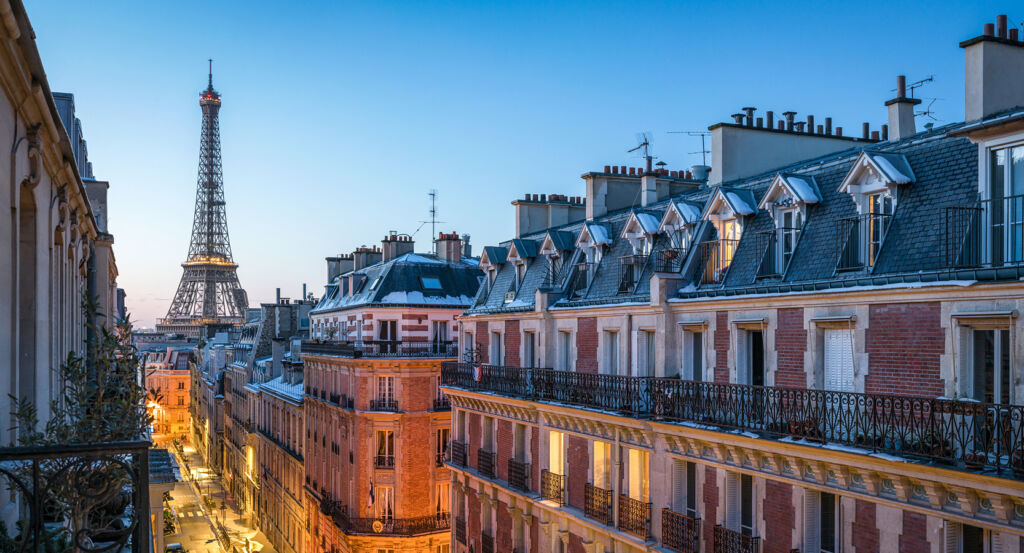
Why you should experience Hôtel National Des Arts et Métiers in Paris, France.
Hôtel National Des Arts et Métiers is a design-led hotel where Arts-et-Métiers' creative heritage, Raphaël Navot's material-driven interiors and La Clé Group founder Samy Marciano's independent hospitality vision converge behind a pair of Haussmannian façades.
Set along Rue Saint-Martin near Rue Réaumur and just steps from Musée des Arts et Métiers, the four-star property opened in 2017 as Marciano's second major Paris hotel project following Hôtel Bachaumont. Raphaël Navot approached the building through stone, terrazzo, steel, solid wood, concrete and marble, commissioning specialist craftspeople to translate natural materials into bespoke furniture and architectural surfaces throughout the house. The design extends vertically from a ground-floor restaurant beneath a steel-and-glass canopy to accommodation floors and a rooftop overlooking Sacré-Coeur and Centre Pompidou, creating distinct environments within the same architectural composition. The result is an Arts-et-Métiers hotel whose character comes from material craftsmanship, independent ownership and a design process built around the work of named makers.
What you should know about Hôtel National Des Arts et Métiers.
Hôtel National Des Arts et Métiers is best known for opening in July 2017 under La Clé Group founder Samy Marciano with interiors by Israeli-born, Paris-based designer Raphaël Navot, who developed the project around stone, terrazzo, steel, solid wood, concrete and marble while working with 30 specialist artisans. Navot later recalled that two retired woodworkers required one year to manufacture 70 tables for the project, demonstrating the unusually labor-intensive production behind furnishings created outside conventional industrial manufacturing. A steel-and-glass canopy introduces another technically expressive element above the restaurant, while oxidized copper tubes descend overhead and organically shaped velvet seating continues Navot's preference for sculptural forms. The accommodation inventory is currently documented at 66 rooms and suites across categories including Classic, Signature, Studio, L'Atelier and Penthouse, with selected configurations incorporating balconies or terraces and the Penthouse opening toward Place Saint-Martin. Navot's authorship subsequently gained broader recognition when Maison&Objet named him Designer of the Year in 2023, placing the 2017 hotel within a body of work that also encompasses Club Silencio, collaborations with Loro Piana and Roche Bobois and collectible design represented by Friedman Benda.
Samy Marciano positioned Hôtel National Des Arts et Métiers within La Clé Group, the independent hospitality company he founded and later expanded through Hôtel Bachaumont and Hôtel & Spa Belle Plage, establishing a portfolio organized around individually commissioned creative direction. Raphaël Navot extended that authored approach into Herbarium, where Italian mixologist Oscar Quagliarini developed cocktails through the logic of perfumery, assigning floral, botanical and aromatic identities to compositions originally presented through a perfumer-style notebook. Oscar Quagliarini's beverage program now operates alongside Ristorante National and Atelier Beauté, where French skincare company CODAGE supplies a separate wellness collaboration within the property's contemporary program. Together, Samy Marciano, Raphaël Navot, Oscar Quagliarini and CODAGE demonstrate how the hotel's 2017 design premise developed into a broader creative system spanning independent hotelmaking, artisanal fabrication, botanical mixology and French skincare.
How to fold Hôtel National Des Arts et Métiers into your trip.
Hôtel National Des Arts et Métiers works as the anchor for an afternoon tracing scientific invention, medieval architecture and contemporary art through the compact streets connecting Arts-et-Métiers with the Marais.
Begin at Musée des Arts et Métiers, where the Conservatoire national des arts et métiers preserves scientific instruments, mechanical devices, transportation technology and inventions across the former Saint-Martin-des-Champs priory, including Léon Foucault's celebrated pendulum. Continue to Église Saint-Merri, whose sixteenth-century architecture preserves an elaborate Flamboyant Gothic interior within the dense streets approaching Beaubourg. Conclude at Centre Pompidou, where Renzo Piano and Richard Rogers exposed circulation, structure and mechanical systems across the exterior of the building opened in 1977 for a major national collection of modern and contemporary art. The progression moves from France's history of technological invention through a surviving Gothic church into Piano and Rogers's rebellious twentieth-century architecture, creating a compact study of craftsmanship, engineering and creative experimentation around Hôtel National Des Arts et Métiers.
Where your story begins.
Foresyte Travel reveals places that feel extraordinary long before you arrive.
Experience premium editorial crafted for luxury travelers.














































































































