
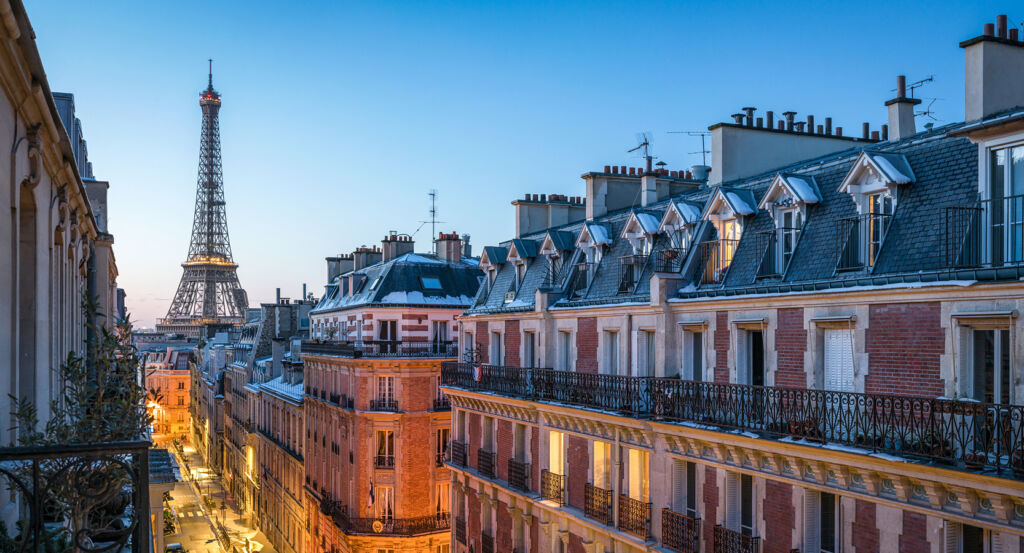
Why you should experience Hôtel Panache in Paris, France.
Hôtel Panache is a geometry-driven boutique hotel where Faubourg-Montmartre's theatrical history, a late nineteenth-century wedge-shaped building and Dorothée Meilichzon's contemporary interpretation of Art Nouveau converge across seven distinctive floors.
Set along Rue Geoffroy-Marie near Rue du Faubourg Montmartre and just steps from Folies Bergère, the four-star property occupies the former Hôtel Opéra-Madrid, whose narrow corner footprint gave hotelier Adrien Gloaguen an architectural constraint that ultimately became the organizing principle for its reinvention. Meilichzon drew parallels between the building and New York's Flatiron Building, translating difficult angles into triangular mirrors, patterned carpets, geometric mosaics and corner-fitted cabinetry while using curved headboards and bas-relief to reference design around 1900. Gloaguen opened Panache in 2016 following Hôtel Paradis and Bienvenue, establishing 40 individually composed rooms inside a building where conventional rectangular planning was frequently impossible. The result is a Faubourg-Montmartre hotel whose visual language emerges directly from the irregular architecture inherited by Gloaguen and Meilichzon.
What you should know about Hôtel Panache.
Hôtel Panache is best known for opening in 2016 when hotelier Adrien Gloaguen transformed the former Hôtel Opéra-Madrid, a late nineteenth-century seven-story corner building, into a 40-room property with interior architecture, decoration and graphic design by Dorothée Meilichzon. Meilichzon treated the building's resemblance to New York's Flatiron Building as a design problem, introducing triangular mirrors at difficult junctions, triangle patterns across carpets, walls and mosaics, and cupboards fitted directly into corners while declaring the bed virtually the only square element in the rooms. Design around 1900 supplied a second historical reference, expressed through bas-relief, curved headboards derived from turned Art Nouveau furniture, wicker, globe sconces and a palette of navy, emerald, anthracite and white. Gloaguen developed Panache after Hôtel Paradis and Bienvenue, while the 2016 opening reunited him with Meilichzon following their earlier collaboration on Paradis and gave the designer her fourth Paris hotel commission. Forty individually styled rooms remain documented by the property today, preserving the unusually direct relationship between the nineteenth-century footprint and Meilichzon's geometry-based interior system.
David Lanher established the original restaurant chapter alongside Adrien Gloaguen in 2016 after building a Paris portfolio that included Racines, Caffè Stern and Le Bon Saint-Pourçain, with chefs Paul Landre and William Ranson directing the opening kitchen inside Meilichzon's ground-floor interior. Liza Panache now occupies that restaurant space under chef Jean Fares, whose training at Liza Beirut informs a Lebanese menu documented by Gault&Millau through preparations including yellowtail crudo with yuzu, kebbé mechwiyé, ossmalié-style shrimp, confit lamb tacos and chocolate-zaatar mousse. Touriste provides the contemporary organizational structure for Adrien Gloaguen's hotel portfolio, connecting Panache with his broader collection while Diptyque supplies the French fragrance house's bath products across the current 40-room accommodation program. Together, David Lanher, Jean Fares, Liza Beirut and Touriste trace a hospitality program that has continued evolving since 2016 while Meilichzon's original architectural language remains the defining structure of Hôtel Panache.
How to fold Hôtel Panache into your trip.
Hôtel Panache works as the anchor for an afternoon tracing auction culture, nineteenth-century performance and grand theatrical architecture through the surrounding Grands Boulevards.
Begin at Hôtel Drouot, whose auction institution established itself on Rue Drouot in 1852 and became a central marketplace for paintings, furniture, jewelry and decorative arts traded through generations of Parisian specialists. Continue to Musée Grévin, founded in 1882 by journalist Arthur Meyer with caricaturist and sculptor Alfred Grévin, where wax portraiture developed alongside elaborate interiors created for the entertainment culture of the boulevards. Conclude at Palais Garnier, where Charles Garnier's competition-winning project combined marble, gilding, sculpture, painting and theatrical engineering before opening in 1875. The progression moves from Drouot's collecting economy through Meyer and Grévin's culture of performance into Garnier's architectural synthesis, creating a compact sequence around the artistic and commercial world that frames Hôtel Panache.
Where your story begins.
Foresyte Travel reveals places that feel extraordinary long before you arrive.
Experience premium editorial crafted for luxury travelers.














































































































