
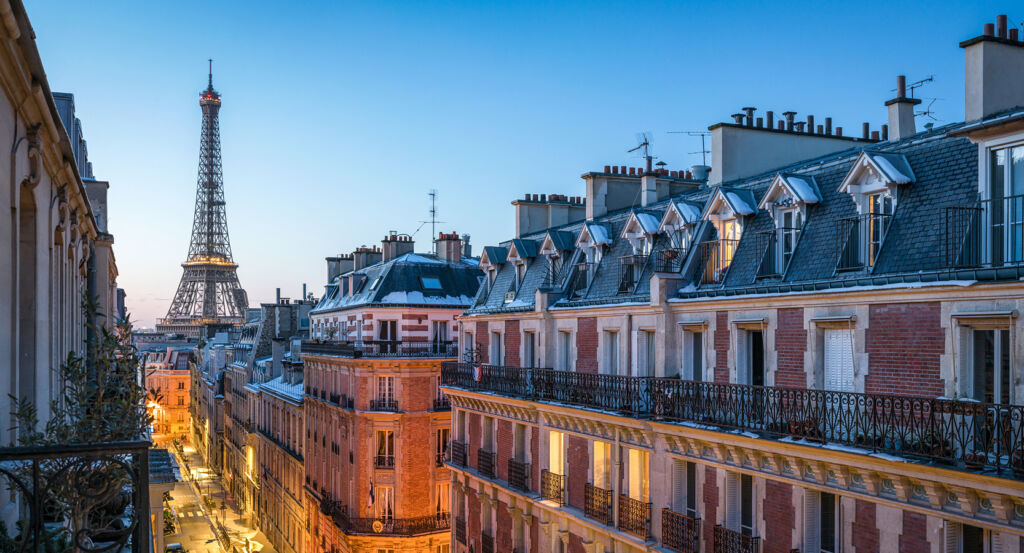
Why you should experience Hôtel Phileas Lazare & Spa Paris Opéra in Paris, France.
Hôtel Phileas Lazare & Spa Paris Opéra is a travel-inspired boutique hotel where Quartier de l'Europe's railway heritage, Jules Verne's fictional adventurer Phileas Fogg and the visual style of nineteenth-century transatlantic journeys converge inside a former family house beside Gare Saint-Lazare.
Set along Rue d'Amsterdam near Rue Saint-Lazare and just steps from Gare Saint-Lazare, the four-star property uses the station's historic connection with trains carrying travelers toward the Atlantic ports as the foundation for an interior narrative built around railways, ocean crossings and the Industrial Revolution. Designers Marie-Agnès Louboutin and Patrice Henry translated those references through compass-patterned carpets, travel trunks, wood and leather, black metal rails, miner-style lamps and an elevator conceived like a hot-air-balloon basket. The accommodation continues the same narrative through five room categories ranging from 15-square-meter Classic rooms to Family configurations spanning 30 to 40 square meters, while the property's recent wellness program occupies vaulted spaces below. The result is a Quartier de l'Europe hotel whose fictional namesake, railway setting and design authorship combine into a historically grounded interpretation of travel culture.
What you should know about Hôtel Phileas Lazare & Spa Paris Opéra.
Hôtel Phileas Lazare & Spa Paris Opéra is best known for debuting in 2015 after 18 months of work transformed a former two-star establishment into a 39-room four-star boutique hotel dedicated to Phileas Fogg, the protagonist of Jules Verne's 1872 novel Around the World in Eighty Days. Marie-Agnès Louboutin, whose hospitality work included Hôtel Plaza Athénée, and Patrice Henry, whose background included Westin projects, developed the original interiors around the nineteenth-century railway and transatlantic culture associated with Gare Saint-Lazare, incorporating luggage imagery, compass motifs, wood paneling, leather and metalwork throughout the property. Industrial-era references became unusually specific within the guestrooms, where desks were supported on black metal rails recalling railway construction, desk lamps reproduced nineteenth-century miners' and railway workers' lamps, and headboards combined wood, leather and metal in forms derived from travel trunks. Contemporary reporting documented 39 rooms at the 2015 opening, while current hotel materials divide the accommodation into Classic, Superior, Deluxe, Executive and Family categories measuring 15, 16, 18, 24 and 30 to 40 square meters respectively. The 18-month conversion, Louboutin and Henry authorship, Verne-derived identity, railway-specific detailing and five-category accommodation program established Hôtel Phileas as a unusually literal translation of Saint-Lazare's transportation history into hotel design.
Rituals extends the property's newer wellness chapter through bath products carrying B Corp certification, connecting the contemporary spa program with a named international cosmetics company while the hammam and jacuzzi operate through reservable 30-minute private sessions between 10 a.m. and 9 p.m. NOHrD develops the same wellness program through equipment installed inside a 30-square-meter vaulted fitness room, where the German brand's rowing machine, bicycle, treadmill and training equipment support a facility operating continuously for hotel residents. Hôtel Phileas also carries its cultural programming into Feel & Jazz evenings and musical breakfasts, extending the original Marie-Agnès Louboutin and Patrice Henry travel narrative through scheduled live programming rather than relying exclusively on the 2015 decorative scheme. Together, Rituals, NOHrD, Feel & Jazz and the expanded spa program document a second phase in Hôtel Phileas's development, adding branded wellness and cultural programming to the railway narrative established during the original 18-month reconstruction.
How to fold Hôtel Phileas Lazare & Spa Paris Opéra into your trip.
Hôtel Phileas Lazare & Spa Paris Opéra works as the anchor for an afternoon tracing nineteenth-century domestic art, theatrical architecture and the commercial performance that developed around the expanding railway districts of the Right Bank.
Begin at Musée de la Vie Romantique, where painter Ary Scheffer established his Rue Chaptal residence and studios in 1830 and received figures including George Sand, Frédéric Chopin and Eugène Delacroix within the artistic circles of Nouvelle Athènes. Continue to Palais Garnier, where Charles Garnier's competition-winning design developed into an immense synthesis of marble, sculpture, painting and theatrical engineering before the opera house opened in 1875. Conclude at Galeries Lafayette Haussmann, where the retail enterprise founded by Théophile Bader and Alphonse Kahn in 1894 expanded into an architectural showcase crowned by its celebrated early twentieth-century glass dome. The progression moves from Scheffer's Romantic-era salon through Garnier's theatrical Paris into Bader and Kahn's department-store culture, placing Hôtel Phileas Lazare & Spa Paris Opéra within the same nineteenth- and early twentieth-century Right Bank world of mobility, performance and urban reinvention.
Where your story begins.
Foresyte Travel reveals places that feel extraordinary long before you arrive.
Experience premium editorial crafted for luxury travelers.














































































































