Why you should experience Hyatt Centric The Loop Chicago in Chicago, Illinois.
Hyatt Centric The Loop Chicago is a trailblazing hotel where Chicago Loop's skyscraper inheritance, financial-district intensity, Art Deco craftsmanship and contemporary hospitality converge inside the building chosen to launch an entirely new Hyatt brand.
Set along West Monroe Street near South Clark Street and just steps from Federal Plaza, the hotel occupies a 22-story office tower completed in 1927 to designs by architect Frank Chase, whose composition brought the vertical proportions and decorative style of the period to the northwest corner of Monroe and Clark. The building's earlier history reaches beneath the tower itself through landowner Willard Jones, whose nineteenth-century cattle path survived within the property's unusual circulation and was incorporated into the later hotel conversion as a passage toward the rooftop. Chicago developer Murphy Asset Management partnered with Hyatt on the building's conversion, preserving architectural elements from the 1927 structure while reorganizing its former offices into 257 guestrooms and a new hospitality program. The result is a property where Chase's interwar tower, Jones's improbable agricultural trace and nearly nine decades of Loop evolution supplied Hyatt with a distinctly Chicago foundation for its next generation of hotels.
What you should know about Hyatt Centric The Loop Chicago.
Hyatt Centric The Loop Chicago is best known for opening on April 23, 2015 as the first Hyatt Centric anywhere in the world, turning a Chicago address into the inaugural expression of a lifestyle brand Hyatt had announced only three months earlier. Hyatt introduced Centric alongside Hyatt Place and Hyatt House within its select-service portfolio, positioning the new flag around centrally located properties intended to connect travelers with surrounding urban districts, while Chicago and Miami Beach became the first two announced openings. The Loop property debuted under General Manager Peter McMahon with management by Interstate Hotels & Resorts, while Chicago-based hospitality veteran Scott Greenberg and Murphy Asset Management served as the development force behind the project. Its 2015 opening represented more than another hotel conversion, connecting Hyatt's Chicago corporate roots, Greenberg's development organization, Interstate's operating platform and a new global brand strategy at the precise property selected to establish Centric's identity.
The opening assembled another network of Chicago culinary and artistic authorship through Cochon Volant, the French brasserie created with restaurateur Matt Creagh and James Beard Award-winning chef Roland Liccioni. Liccioni brought a formidable Chicago biography to Monroe Street after leading Le Français and establishing Le Lan, while Cochon Volant combined a bakery, brasserie and bar within the ground-floor hospitality program as Aire translated the building's verticality into a seasonal rooftop counterpart. The hotel also embedded Loop history into rooms named for transit magnate Charles Yerkes, novelist Frank Norris, sculptor Alvin Meyer and Willard Jones, turning individuals associated with Chicago commerce, literature, art and the property's land history into part of the original interior narrative. A further culinary chapter arrived in May 2026 when Roanoke Hospitality Group partnered with chef Dudley Nieto, whose Chicago career includes Fat Rosie's and Chapulín, to open Mexican Radio at the hotel, extending the property's restaurant story more than eleven years after Liccioni helped define its debut.
How to fold Hyatt Centric The Loop Chicago into your trip.
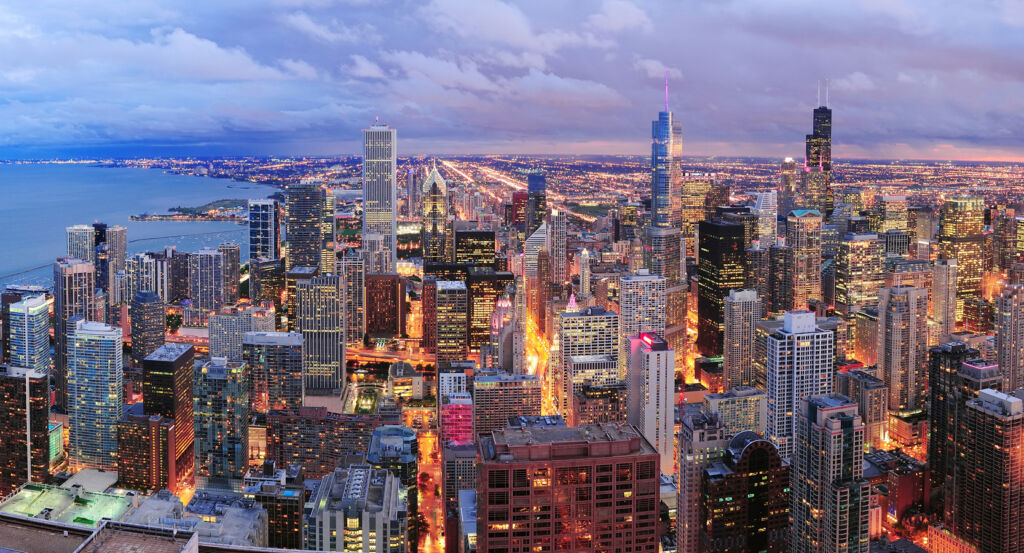
Hyatt Centric The Loop Chicago works as the anchor for an afternoon tracing the architects and artists who turned the surrounding government and financial district into a concentrated record of twentieth-century Chicago ambition.
Begin at Federal Plaza, where Ludwig Mies van der Rohe developed a three-building federal complex around the structural clarity of steel, glass and an open civic square, with the Dirksen Federal Building and Kluczynski Federal Building joined by a low post-office pavilion while Alexander Calder's 53-foot steel Flamingo introduced a sweeping vermilion counterpoint to Mies's rectilinear architecture. Continue to Rookery Building, where Daniel Burnham and John Wellborn Root completed their office building in 1888 before Frank Lloyd Wright remodeled its extraordinary central light court in 1905, creating a rare architectural discussion between three defining figures of Chicago design inside the same structure. Conclude at Chicago Board of Trade Building, where Holabird & Root completed the 605-foot Art Deco tower in 1930 at the termination of LaSalle Street, crowning the composition with sculptor John Storrs's 31-foot aluminum figure of Ceres while trading in agricultural commodities continued below. The progression moves from Mies and Calder's synthesis of architecture and public art through Burnham, Root and Wright's layered Chicago School experimentation into Holabird & Root and Storrs's interwar expression of financial power, placing Hyatt Centric The Loop Chicago within the architectural culture that made the surrounding Chicago Loop internationally consequential.
Where your story begins.
Foresyte Travel reveals places that feel extraordinary long before you arrive.
Experience premium editorial crafted for luxury travelers.