
Why Inokashira Park matters.
Inokashira Park is a water-centered landscape where Kichijoji's creative character meets an ancient spring-fed pond, wooded Musashino uplands and a public park whose history reaches from Edo's first water system to Tokyo's twentieth-century suburban expansion.
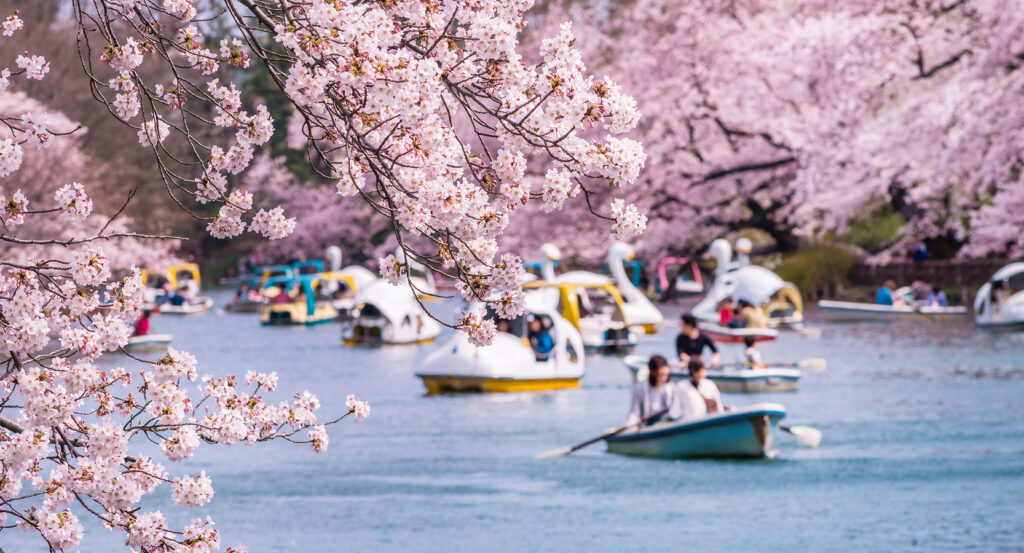
Set south of Kichijoji Station near Kichijoji-dori and just steps from the neighborhood's commercial center, the park extends across Musashino and Mitaka around Inokashira Pond and the wooded rise of Gotenyama. The 428,389-square-meter grounds divide into four principal areas, with the pond occupying the low ground and oak-and-hornbeam woodland rising across the plateau above it. A 1.5-kilometer circuit follows the 42,000-square-meter pond beneath tree cover, crossing bridges and passing shorelines where close to 200 cherry trees extend their branches over the water. The terrain changes again around Gotenyama, where coppice woodland of East Asian hornbeam, konara oak and sawtooth oak survives above archaeological ground associated principally with the Jomon period. The result is a metropolitan park whose pond, woodland and changing elevations preserve the physical landscape that existed before Kichijoji developed around its edges.
What defines Inokashira Park.
Inokashira Park is best known for transforming one of Edo's crucial water sources and a former imperial woodland into Japan's first imperial-gift park and first suburban park. Inokashira Pond had already acquired metropolitan importance after Tokugawa Ieyasu entered Edo in 1590 and selected its spring water for the Kanda water system, which carried drinking water toward the growing castle town. The pond became the headwater of the Kanda River, and a stone intake survives at its eastern end from the water-supply infrastructure that connected this western Musashino landscape with Edo. Third shogun Tokugawa Iemitsu later used the surrounding ground for falconry, a relationship preserved in the name Gotenyama, derived from the rest house associated with his excursions. The Kanda water system remained tied to the pond until Tokyo's modern waterworks ended its role as a municipal source in 1898. Inokashira had entered the imperial estate during the Meiji period, placing the woodland under a different institutional regime as the railway and suburban settlement began changing western Tokyo. Tokyo City subsequently prepared a plan for a public park, and imperial land was granted to the city in 1913 for that purpose. Inokashira Park opened on May 1, 1917, establishing a new model of recreational ground beyond Tokyo's densely built center and reaching its centenary in 2017. The original park has since expanded into 428,389.99 square meters containing 20,000 trees, yet its governing geography remains the relationship between the low-lying pond, Gotenyama plateau and headwaters that first made the site consequential to Edo.
The modern recovery of Inokashira Pond has developed through kaibori, the periodic draining of pond water to remove introduced fish, expose the bed and restore ecological processes that had deteriorated under urban pressure. Tokyo began the current restoration cycle in fiscal 2013 as preparations for the park's 2017 centenary created an opportunity to address declining water quality and aquatic habitat. Three major kaibori operations followed, coupling fish removal with ecological monitoring and direct participation by residents and volunteer groups. The exposed pond bed allowed dormant aquatic vegetation to reappear and gave managers a means of reducing populations of introduced species that had altered the food web. Restoration continued after the centenary through the Inokashira Kaibori Team, which began installing woven branch barriers and soil-retaining structures in 2017 to intercept sediment and leaf matter before stormwater entered the pond. Infiltration trenches later added another intervention, directing muddy runoff into depressions where sediment settles and water returns to the ground. Tokyo was still running pond monitoring and public restoration activities in 2026, extending what began as a centenary project into long-term management of the same spring-fed water body that once supplied Edo. Kaibori, runoff control and continuing ecological work have given Inokashira Pond a second infrastructure history, shifting human intervention from extracting drinking water toward rebuilding the aquatic system itself.
How Inokashira Park fits.
Inokashira Park works as the anchor for a Kichijoji and Mitaka route through three nearby institutions that move from wartime natural-science education through Hayao Miyazaki's conception of an animation museum and into the preserved home where novelist Yuzo Yamamoto produced some of his most consequential writing.
Begin at Inokashira Park Zoo, whose institutional history started with a small animal garden on Nakanoshima in 1934 and a freshwater aquarium added in 1936 before the larger Inokashira Park Natural and Cultural Garden opened on May 17, 1942. The institution developed an unusual artistic chapter in 1953 when sculptor Seibo Kitamura established an atelier on its grounds and created the full-size plaster prototype for the Nagasaki Peace Memorial Statue; Kitamura donated that prototype, more than 350 other works and his studio facilities in 1958, and more than 200 of his sculptures remain displayed across the sculpture garden. Continue to Ghibli Museum, Mitaka, whose planning translated Hayao Miyazaki's ideas about animation, architecture and discovery into a museum created with Mitaka City. The municipal ordinance establishing the animation museum passed in March 2001, the building was completed and donated to Mitaka that June, the Tokuma Memorial Cultural Foundation for Animation received authorization in September and the museum opened on October 1; Miyazaki subsequently remained closely involved with exhibition development, beginning with the inaugural special exhibition devoted to Spirited Away. Conclude at Mitaka City Yuzo Yamamoto Memorial Museum, a 1926 house occupied by Yamamoto and his family from 1936 until 1946. Yamamoto wrote The Stone by the Road and the play One Hundred Sacks of Rice there and opened the Mitaka Children's Library from his own books before the occupation authorities requisitioned the property after World War II. The building subsequently housed the Mitaka branch of the National Institute for Japanese Language between 1951 and 1953 and eventually opened as the Yuzo Yamamoto Memorial Museum in 1996, preserving the domestic setting of a writer who also edited the sixteen-volume Japanese Children's Library series, served in the House of Councillors and received the Order of Culture in 1965. The progression moves from Inokashira Park Zoo's union of natural science and Seibo Kitamura's sculpture through Ghibli Museum, Mitaka's translation of Hayao Miyazaki's animation practice into a purpose-built institution into Mitaka City Yuzo Yamamoto Memorial Museum's preservation of the house where literature, children's education and postwar cultural history converged, extending Inokashira Park through three distinct institutions shaped by the intellectual and artistic life surrounding its southern and western edges.
Where your story begins.
Foresyte Travel reveals places that feel extraordinary long before you arrive.
Enjoy editorial crafted for luxury travelers.
Foresyte may earn a commission when you book.

















































































































