
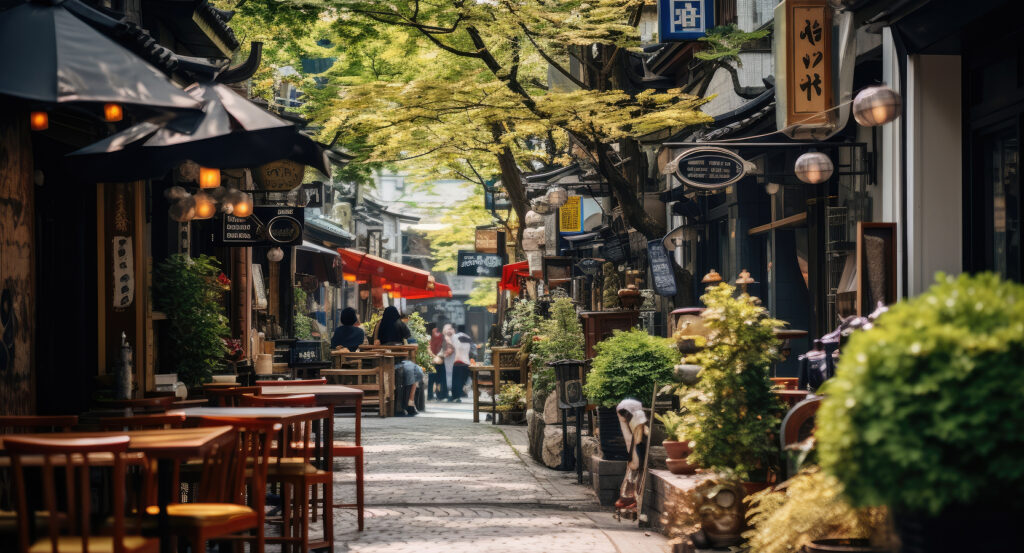
Why Insadong matters.
Insadong Street is Seoul's living gallery, a swirling, physical bridge between centuries where tea houses, art studios, and modern boutiques coexist like layers of a single breath.
Step onto its stone-paved avenue, and the city's usual pulse softens. The air smells of roasted barley tea and ink from calligraphy shops; traditional hanbok brushes against minimalist design, and the sound of bamboo flutes drifts between neon-lit signs written in old Hangul script. Every storefront feels like a conversation, pottery glowing in warm lamplight, galleries tucked behind sliding doors, brush shops selling handmade pigments that once colored royal scrolls. Yet amid the charm, there's rhythm, the laughter of students tasting street sweets for the first time, the hum of conversation spilling from hidden teahouses, and the constant discussion between what Seoul was and what it's becoming. Insadong isn't frozen in nostalgia; it's alive, a cultural artery that carries history forward with every step.
What defines Insadong.
Insadong's history stretches back over 500 years, its origins entwined with the artistic and intellectual core of the Joseon Dynasty.
During the 16th and 17th centuries, the neighborhood, then divided between In and Sa districts, became home to court painters, calligraphers, and scholars who served in the royal bureaucracy. Its narrow lanes filled with brush merchants, paper mills, and antique dealers catering to the nearby palaces of Gyeongbokgung and Changdeokgung. After Korea's liberation from Japanese rule in 1945, Insadong became a gathering place for writers, poets, and reformists, a haven for free thought during turbulent times. By the 1960s, it had evolved into a cultural sanctuary for Seoul's bohemian class, its teahouses serving as meeting rooms for artists and intellectuals. Many of these establishments still operate today, their interiors unchanged for generations. The street's iconic signs, written only in Korean characters by law, were part of a deliberate preservation effort in the late 1990s to protect native language and visual character amid rapid globalization. Few realize that beneath the cobblestones lie remnants of Hanyang's original drainage channels, early urban infrastructure from the Joseon capital. The area also hosts Ssamziegil, a multi-level courtyard mall built in 2004 that spirals upward in a continuous ramp, merging contemporary art with folk craft, a modern reinterpretation of Insadong's layered soul.
How Insadong fits.
Insadong Street works as an unhurried walk, a day of wandering where the destination is discovery itself.
Begin at Anguk Station's Exit 6, where the avenue opens in a cascade of color and sound. Stroll slowly past the first row of antique shops and calligraphy galleries; step into one or two, even a brief conversation with the owners can reveal generations of craftsmanship and family history. Stop for a cup of omija cha (five-flavor berry tea) or yuja cha (citron tea) at one of the wooden teahouses tucked down the side alleys, O'Sulloc, Tteuran, or Beautiful Tea Museum offer both warmth and serenity. Midway through your walk, explore Ssamziegil, where you'll find modern artisans reimagining traditional forms, glass jewelry inspired by hanbok patterns, recycled paper notebooks pressed with temple motifs, and handmade soaps scented with pine and mugwort. As evening approaches, linger for a street performance or pick up a brush and try your hand at Hangul calligraphy in one of the small studios. If you stay past dusk, the lanterns strung across the street begin to glow, transforming Insadong into a soft river of light. Pair your visit with Bukchon Hanok Village just north, or finish the day at Jogyesa Temple, whose golden pavilions are only minutes away. Insadong Street in Seoul isn't just a market or a memory, it's the voice of Korea's artistic heart, still singing in the language of tea, ink, and time.
Where your story begins.
Foresyte Travel reveals places that feel extraordinary long before you arrive.
Enjoy editorial crafted for luxury travelers.
Foresyte may earn a commission when you book.

















































































































