Why InterContinental Dubai Marina by IHG matters.
InterContinental Dubai Marina is a waterfront luxury hotel and residential development where Dubai Marina's engineered canal landscape meets contemporary high-rise hospitality, international restaurant culture, and the commercial expansion of Dubai's western coastline.
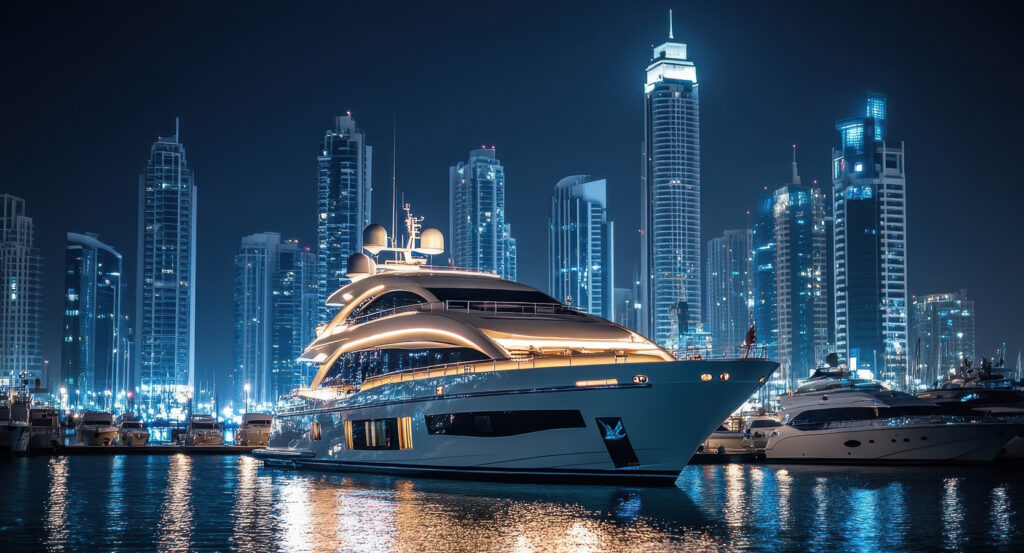
Occupying a prominent position within the Bay Central development, the hotel overlooks the marina's central waterway, with residential towers rising along both banks and the Arabian Gulf lying beyond the beachfront district to the west. Its contemporary tower incorporates extensive glazing, rectilinear elevations, and projecting balconies that connect the accommodations with the surrounding waterfront. The principal entrance leads into a double-height lobby distinguished by polished stone, contemporary furnishings, and large sculptural installations that transform the public interior into an exhibition space. A substantial suspended artwork occupies the central atrium, extending through multiple levels and connecting the lobby with the upper circulation areas. The outdoor swimming pool sits on an elevated terrace overlooking the marina, with glass balustrades preserving uninterrupted views across the water and surrounding towers. Waterfront dining terraces extend the hotel's public spaces toward the pedestrian promenade, connecting the interior hospitality program with the marina's recreational boating activity. The result is a contemporary urban hotel whose architecture, substantial art collection, and waterfront orientation connect international hospitality with the distinctive geography of Dubai's purpose-built marina district.
What defines InterContinental Dubai Marina.
InterContinental Dubai Marina is best known for becoming the hospitality centerpiece of Select Group's Bay Central development and introducing British chef Jason Atherton's first Middle Eastern restaurant to Dubai's waterfront dining industry. The project's origins connect the hotel with Select Group, a Dubai-based property developer founded in 2002 by Rahail Aslam, whose residential and commercial investments contributed to the expansion of the emirate's western coastal districts. Bay Central developed as a three-tower complex incorporating residential apartments, commercial facilities, and a dedicated hotel component overlooking the marina. The development formed part of Dubai's broader transition toward integrated waterfront communities combining privately owned residences with international hospitality operations. Select Group entered into a management agreement with InterContinental Hotels Group in September 2012, formally bringing the international hotel operator into the project. The agreement initially anticipated an opening before the end of 2013, with the completion timetable subsequently extending through 2014 and into the following year. InterContinental's involvement connected the development with a hospitality organization whose first property opened in Belém, Brazil, in 1949, following the establishment of InterContinental Hotels Corporation by Pan American World Airways in 1946. The brand subsequently expanded through international aviation destinations, developing a network of hotels associated with business travel and major metropolitan centers. By the time of the Dubai Marina agreement, InterContinental had become part of IHG's international portfolio, alongside established Dubai properties at Festival City and elsewhere in the United Arab Emirates. The new hotel opened on May 25, 2015, under general manager Michael Martin, marking the completion of a substantial hospitality investment within Bay Central. Its operating program incorporated 196 serviced residential suites alongside conventional hotel accommodation, connecting extended-stay hospitality with the privately owned residential character of the surrounding development. The opening also introduced nine restaurants, lounges, and bars, creating a substantial dining component within the waterfront complex. Pascal Gauvin, IHG's chief operating officer for India, the Middle East, and Africa, positioned the property as part of a new generation of contemporary InterContinental hotels emphasizing art, design, and international dining. The development strengthened the brand's presence in Dubai during a period of substantial investment in luxury accommodation outside the emirate's established central business districts. Its significance rests on the integration of residential hospitality, contemporary art, and international restaurant operations within one of Dubai's principal engineered waterfront communities.
Jason Atherton's culinary career provided the foundation for the hotel's most consequential restaurant commission, connecting Dubai's international dining industry with the development of contemporary British gastronomy. Atherton began his professional relationship with Dubai in 2001 as executive chef at Gordon Ramsay's Verre, the restaurant at Hilton Dubai Creek that helped introduce internationally recognized chef-led dining to the emirate. His subsequent career included the establishment of Pollen Street Social in London in 2011, which earned a MICHELIN star within its first year. In March 2014, IHG announced Atherton's return to Dubai through Marina Social, extending his international restaurant group into the Middle East. The restaurant opened on September 4, 2015, under executive chef Tristin Farmer and general manager David Vindis, introducing a British-Mediterranean culinary program organized around contemporary shared dining. Dawser and Partners designed Marina Social and its adjoining Social Room, developing a 535-square-meter interior divided between the restaurant and cocktail bar. A bridge connects the two spaces, with timber screens, colored glass, and carefully positioned partitions creating distinct dining environments within the substantial interior. Eight-meter sculptures rising from the ground floor connect the restaurant's upper-level position with the hotel's wider artistic program. Accents Restaurant & Terrace developed a separate international dining concept through an open-kitchen arrangement and a substantial outdoor terrace overlooking the water. Ginter introduced a specialized gin program incorporating an extensive selection of international spirits, establishing a dedicated cocktail destination within the property. The original YNot Bar and Kitchen developed a tapas-oriented dining format, broadening the hotel's culinary program beyond its principal restaurant. Gallery Lounge incorporated contemporary artworks into a separate social environment, extending the visual arts commission into the hospitality spaces. The property's wider decorative program includes commissioned sculptures and individually selected artworks distributed throughout the lobby and public interiors. Its spa incorporates separate treatment facilities and a wellness program supported by dedicated fitness spaces. These commissions connect Atherton's international culinary development with contemporary restaurant architecture, specialist beverage culture, and the hotel's substantial investment in visual art.
How InterContinental Dubai Marina fits.
InterContinental Dubai Marina works as the starting point for an evening outing tracing the development of Dubai Marina's waterfront retail district, its purpose-built restaurant architecture, and the engineering achievements that extended Dubai's coastal leisure industry onto Bluewaters Island.
Begin at Dubai Marina Mall, the commercial development created by Emaar Malls Group during the expansion of Dubai Marina into a substantial residential and retail district. The four-level shopping center opened on December 22, 2008, introducing 390,000 square feet of leasable space and an initial program of 160 retail outlets into the waterfront community. Its development formed part of a larger commercial complex incorporating a hotel, residential accommodation, and dedicated restaurant facilities, connecting retail investment with the surrounding concentration of high-rise housing. The building's circular atrium and waterfront-facing circulation spaces were designed to bring natural daylight into the interior, and subsequent environmental improvements included a roof garden, tinted glazing, and reductions in electricity and water consumption. Continue to Pier 7, the purpose-built dining tower developed as a separate architectural component of the marina's principal commercial complex. The seven-level structure organizes individual restaurant concepts vertically, creating a dining destination whose upper floors overlook the canal, residential towers, and surrounding waterfront. Emaar incorporated the building into its broader commercial planning for the district, establishing a dedicated restaurant destination connected to the adjacent shopping center and pedestrian promenade. Atelier M occupies the upper levels, combining a restaurant, lounge, and rooftop terrace within an interior influenced by European and Asian hospitality traditions. The tower's concentration of independent dining concepts represents a distinct stage in Dubai Marina's development, as the district expanded beyond residential construction into a substantial evening dining and entertainment destination. Conclude at Ain Dubai, the observation wheel constructed on Bluewaters Island as part of Dubai Holding's expansion of the emirate's coastal leisure infrastructure. Construction began in May 2015, and the attraction opened on October 21, 2021, introducing a 250-meter observation wheel with 48 passenger cabins and a total capacity exceeding 1,750 people. Its construction required 11,200 tonnes of steel, including a 1,805-tonne hub and spindle assembly lifted 130 meters above the ground using two exceptionally large cranes. Project management and construction consultancy firm Mace coordinated substantial elements of the engineering program, whose completion required millions of working hours and complex marine construction operations. The wheel reopened on December 26, 2024, following an extended closure, restoring a major observation facility overlooking Dubai's coastline and high-rise districts. The progression moves from Emaar's development of a waterfront commercial center through the concentration of international dining within a dedicated restaurant tower and culminates in Ain Dubai's large-scale engineering achievement, connecting successive investments that transformed the marina's residential waterfront into a major coastal leisure district.
Where your story begins.
Foresyte Travel reveals places that feel extraordinary long before you arrive.
Enjoy editorial crafted for luxury travelers.
Foresyte may earn a commission when you book.