
Why InterContinental Edinburgh the George matters.
InterContinental Edinburgh the George is a historic hotel where New Town's Georgian order meets Edinburgh's literary culture, Scottish political history and the continuing social life of George Street.
Occupying 19-21 George Street in the heart of Edinburgh's New Town, InterContinental Edinburgh the George stands between Hanover Street and Frederick Street, with Princes Street Gardens, the Scott Monument and Edinburgh Castle extending through the city's historic core. George Street forms the principal east-west axis of the New Town, linking Charlotte Square with St. Andrew Square through a sequence of Georgian façades, formal intersections and commercial addresses. The hotel's position places it within walking distance of Princes Street, Waverley Station, the Royal Mile and the Old Town's elevated ridge. Northward, Queen Street and the gardens of the New Town create a quieter residential edge, while southward the ground falls toward the railway, the gardens and the medieval city. George Street itself carries the spatial logic of the eighteenth-century expansion beyond Edinburgh's older walls, with broad pavements, regular blocks and architecture designed to project civic order. The result is a hotel positioned between Edinburgh's planned Georgian city and its older, more irregular historical core.
What defines InterContinental Edinburgh the George.
InterContinental Edinburgh The George originated in the eighteenth-century development of Edinburgh's New Town, whose orderly Georgian streets represented one of the most ambitious urban transformations of the Scottish Enlightenment. James Craig's celebrated plan established George Street as the principal east-west axis of the new district, attracting wealthy merchants, professionals and members of Edinburgh's intellectual establishment to an expanding residential quarter north of the Old Town. The five Georgian townhouses forming the hotel's historic core date to the 1770s, when the New Town's architectural character was taking shape through sandstone façades, classical proportions and carefully ordered residential terraces. One of the properties became associated with Scottish novelist Susan Ferrier, whose literary career placed her among the prominent women writers of nineteenth-century Britain. Ferrier's Marriage, published anonymously in 1818, established her reputation for social observation and satire, connecting the building's domestic history with Edinburgh's flourishing literary culture. The townhouses subsequently acquired commercial functions as the New Town developed into a center of banking, insurance and professional activity. In 1840, the Caledonian Insurance Company commissioned architect David Bryce to transform part of the complex, introducing an expansive classical façade that established the architectural character of the hotel's principal entrance. Bryce became one of Victorian Scotland's most influential architects, contributing extensively to the country's banking, institutional and domestic architecture. His intervention gave the former residential buildings a more imposing civic presence, expressing the prosperity of Edinburgh's expanding financial sector. The George Hotel emerged as an established hospitality institution in 1881, beginning a long association with the city's commercial, social and cultural life. Its development brought together buildings originally conceived for different purposes, creating a distinctive architectural composition shaped by successive generations of Edinburgh society. The former insurance company premises eventually became part of the expanded hotel, incorporating the expansive interior that developed into the King's Hall. Its Corinthian columns, elaborate plasterwork and ceremonial proportions preserved the grandeur of nineteenth-century commercial architecture within a functioning hospitality establishment. A substantial modernization completed in 2016 under the Principal Hotels collection renewed the historic interiors and strengthened the property's position within Edinburgh's luxury hospitality sector. The project introduced a contemporary interpretation of Scottish design through restored architectural detailing, richly textured furnishings and a palette influenced by the country's landscape and artistic traditions. InterContinental Hotels Group subsequently incorporated the property into its international luxury portfolio, reopening it under the InterContinental Edinburgh The George character in July 2019. The transition connected an institution rooted in Edinburgh's Georgian residential expansion with a global hospitality brand, preserving the architectural and cultural inheritance of the New Town within an internationally managed hotel. Its history reflects the evolution of Edinburgh's eighteenth-century domestic society, nineteenth-century financial establishment and modern luxury hospitality industry.
Riccardo Giraudi's culinary philosophy at Le Petit Beefbar gives InterContinental Edinburgh The George a distinctive gastronomic character through the relationship between exceptional beef, international street-food traditions and the convivial atmosphere of European brasserie dining. The Monaco-based restaurateur founded Beefbar in 2005, drawing upon his family's longstanding involvement in the international meat trade to develop a restaurant concept centered on ingredient provenance, distinctive cuts and contemporary interpretations of familiar preparations. His approach treats premium beef as an ingredient with considerable culinary versatility, exploring the differences created by cattle breeding, marbling, maturation and carefully controlled cooking. The Edinburgh restaurant introduces this philosophy to Scotland's capital through a dining program that connects the country's established appreciation for quality beef with Japanese, Mediterranean and Latin American influences. Japanese Wagyu contributes a distinctive dimension through its intricate marbling and delicate fat distribution, producing a rich, tender character that responds particularly well to precise temperature control. The kitchen develops further complexity through techniques associated with curing, grilling and teppanyaki, allowing different preparations to express the relationship between natural richness, caramelization and concentrated savory flavor. Giraudi's interpretation of international street food introduces a complementary social philosophy, adapting recognizable culinary traditions to the setting of a grand Georgian dining room. The restaurant's approach emphasizes sharing, contrasting textures and concentrated seasoning, connecting the informality of street-food culture with the attentive service of an international luxury hotel. Executive Chef Matthew Parker oversees the Edinburgh kitchen, translating the wider Beefbar philosophy into a dining program shaped by seasonal ingredients and the restaurant's distinctive Scottish setting. The beverage selection develops this international character through European wines, classic cocktails and carefully chosen accompaniments that balance the richness of the kitchen's principal ingredients. Sunday jazz lunches introduce another dimension to the restaurant's identity, connecting traditional British Sunday dining with live musical performance and the social atmosphere of Edinburgh's historic hotel restaurants. Burr & Co contributes a complementary expression of metropolitan hospitality through carefully prepared coffee, pastries and light dining, maintaining the New Town tradition of informal gathering places for residents, professionals and visitors. The hotel's King's Hall extends its ceremonial character through private celebrations and formal gatherings beneath expansive Corinthian columns and elaborate historic plasterwork. The Library offers a more intimate interpretation of Georgian entertaining, with substantial architectural proportions, a prominent fireplace and a residential atmosphere suited to private dining and receptions. Together, these culinary and social traditions establish InterContinental Edinburgh The George as a distinctive expression of international gastronomy, Scottish architectural heritage and the intellectual and commercial culture that shaped Edinburgh's New Town.
How InterContinental Edinburgh the George fits.
InterContinental Edinburgh the George works as a base for reading Edinburgh through its literary memory, formal New Town planning and medieval fortress city.
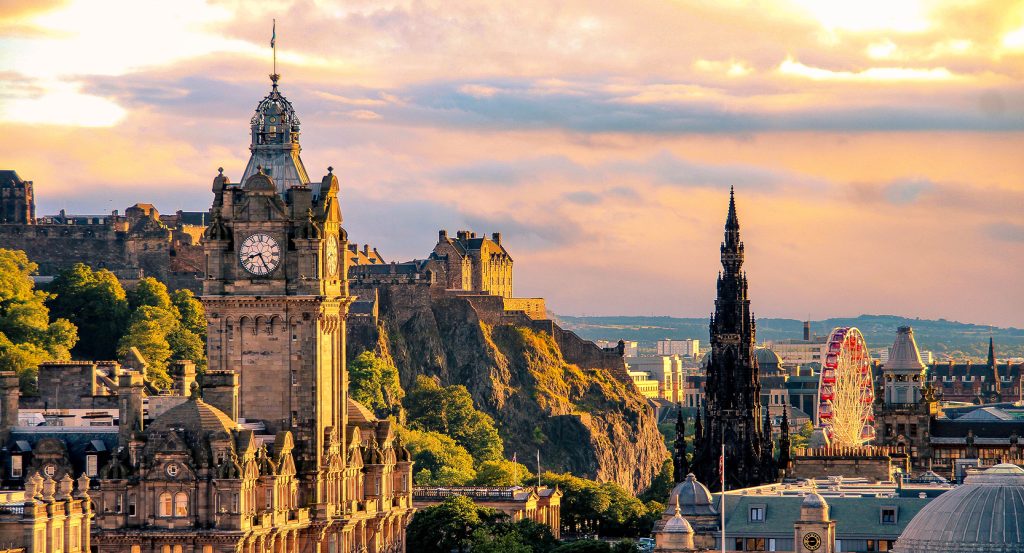
Begin at Scott Monument, rising beside East Princes Street Gardens as one of Edinburgh's most immediate visual markers. The Gothic monument was designed by George Meikle Kemp and completed in 1844 as a memorial to Sir Walter Scott, whose novels and poems helped shape modern ideas of Scottish history and landscape. Its dark sandstone structure rises more than 200 feet above Princes Street, with a central statue of Scott seated beneath the tower's arches. A climb of 287 steps leads through the monument's levels to views across the New Town, the Old Town and the surrounding hills. From the hotel, the monument is reached by moving south from George Street toward Princes Street, where its vertical silhouette contrasts with the regular horizontal order of the New Town. Scott Monument also strengthens the hotel's literary geography, linking the address associated with Scott's social world to a permanent civic memorial in the heart of the city. Continue to Princes Street Gardens, the broad public landscape occupying the valley between the New Town and the Old Town ridge. The gardens were formed after the Nor Loch was drained during Edinburgh's nineteenth-century urban improvements, transforming a marshy defensive basin into a green corridor below the castle. East and West Princes Street Gardens are divided by The Mound, which carries roads and galleries upward toward the Old Town. The landscape opens views toward Castle Rock, the Old Town skyline and the slopes beyond the city center. Paths connect the Scott Monument, the Ross Fountain, the National Galleries and the principal shopping frontage of Princes Street. The gardens provide a clear spatial pause between the hotel's ordered Georgian surroundings and Edinburgh's medieval core. Their position also explains the city's dramatic vertical composition, with the New Town above the valley, the gardens below and the castle rising beyond them. Conclude at Edinburgh Castle, occupying Castle Rock above the western end of the Royal Mile. The volcanic outcrop creates the fortress's commanding position, with steep sides separating the castle from the surrounding streets and making the site both a defensive stronghold and a symbol of Scottish sovereignty. Within the complex, St. Margaret's Chapel preserves a twelfth-century structure, while Crown Square contains buildings associated with royal residence, military administration and state ceremony. The Scottish Crown Jewels and the Stone of Destiny connect the castle to the country's monarchy and constitutional history. Its esplanade becomes the setting for the Royal Edinburgh Military Tattoo, bringing ceremonial performance into the same elevated space. The route from George Street to the castle crosses the city's principal historical divide, moving from the rational streets of the New Town through the gardens and upward into the fortified Old Town landscape. The progression moves from literary commemoration to planned public space and finally to the royal fortress that dominates Edinburgh's historic skyline.
Where your story begins.
Foresyte Travel reveals places that feel extraordinary long before you arrive.
Enjoy editorial crafted for luxury travelers.
Foresyte may earn a commission when you book.














































































































