
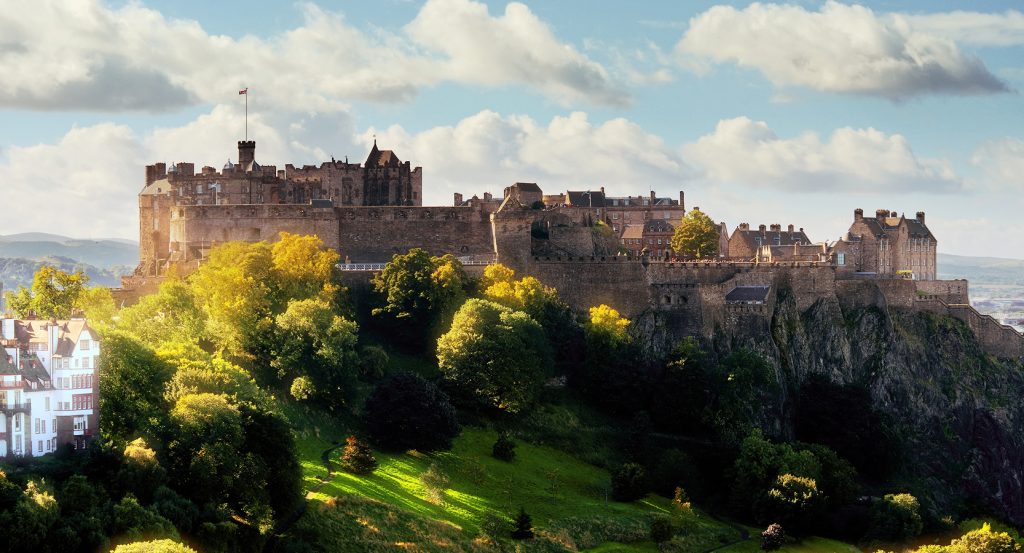
Why Edinburgh Castle matters.
Edinburgh Castle is a commanding hilltop fortress where Old Town's royal legacy, military power, architectural endurance, and Scotland's national story have unfolded across more than a millennium.
Set along Castlehill near Johnston Terrace and just steps from the Royal Mile, this formidable stronghold crowns the volcanic summit of Castle Rock through defensive gates, medieval halls, royal apartments, artillery batteries, and commanding ramparts where centuries of kings, queens, soldiers, and statesmen shaped the destiny of Scotland. Towering stone walls, panoramic terraces, historic barracks, and ceremonial spaces reveal an unparalleled concentration of royal, military, and architectural history overlooking the Scottish capital. Power, resilience, and national character remain embedded throughout every courtyard and bastion.
What defines Edinburgh Castle.
Edinburgh Castle is best known for occupying Castle Rock, the volcanic plug of an extinct volcano formed more than 340 million years ago, while serving continuously as Scotland's principal royal fortress since the reign of David I during the early twelfth century and becoming the most besieged place in Great Britain through twenty-six documented sieges, making it one of Europe's most historically contested fortified royal residences. Archaeological evidence places human activity on Castle Rock as early as the Late Bronze Age, while written records identify the fortress as a royal center by the reign of Malcolm III before David I established Edinburgh as one of Scotland's principal seats of royal authority. The castle preserves St. Margaret's Chapel, constructed 1130 and recognized as Edinburgh's oldest surviving building, alongside the Great Hall completed in 1511 for James IV with one of Britain's finest surviving medieval hammerbeam roofs. The Royal Palace contains the chamber where Mary, Queen of Scots gave birth to the future James VI of Scotland and James I of England in 1566, an event that united the Scottish and English crowns in 1603 through dynastic succession. National treasures including the Honours of Scotland, the oldest surviving Crown Jewels in Britain, and the Stone of Destiny remain central to Scotland's coronation tradition after the Stone's permanent return to Scotland in 1996. Military engineering evolved dramatically following the Wars of Scottish Independence, the Lang Siege of 1571-1573, Cromwell's capture of the fortress in 1650, and successive eighteenth-century modernization campaigns that introduced powerful artillery positions including the Half Moon Battery, Argyle Battery, and Mills Mount Battery. The castle also preserves Mons Meg, the six-meter-long fifteenth-century siege bombard capable of firing stone cannonballs weighing 150 kilograms, the Scottish National War Memorial opened in 1927, the National War Museum, extensive vaulted military prisons, and the One O'Clock Gun tradition established in 1861 to provide an accurate time signal for ships navigating the Firth of Forth. Today Historic Environment Scotland welcomes well over two million visitors annually while continuing internationally respected archaeological excavation, masonry conservation, structural stabilization, and scholarly research across one of Europe's most extensively studied medieval fortresses.
Centuries of architectural expansion transformed an early medieval royal citadel into a sophisticated artillery fortress whose defensive walls, fortified gatehouses, royal apartments, magazines, barracks, and ceremonial spaces document the evolution of warfare, monarchy, and state formation across Scotland. Carefully conserved collections, nationally significant regalia, military artifacts, archaeological discoveries, and immersive interpretation illuminate nearly one thousand years of constitutional history while sweeping views across the Old Town, New Town, Arthur's Seat, and the Firth of Forth reinforce the fortress's unrivaled strategic position above the capital. Continuing conservation engineering, archaeological investigation, and heritage research ensure the castle remains one of Britain's most important historical sites. Royal authority, defensive innovation, and enduring national memory combine to create one of the world's greatest fortified royal residences.
How Edinburgh Castle fits.
Edinburgh Castle works as the centerpiece of an exploration through Edinburgh's historic Old Town.
Begin at The Royal Mile, where medieval closes and centuries of civic history establish the approach before entering Edinburgh Castle. Continue to The Scotch Whisky Experience, whose immersive exhibitions celebrate one of Scotland's defining cultural traditions immediately beside the fortress. Conclude at Princes Street Gardens, where sweeping views back toward Castle Rock provide a memorable finale showcasing the fortress dominating Edinburgh's skyline. The progression moves naturally from medieval streets to Scotland's greatest stronghold before concluding beneath its volcanic cliffs, revealing why Old Town remains one of Europe's most compelling historic urban landscapes.
Where your story begins.
Foresyte Travel reveals places that feel extraordinary long before you arrive.
Enjoy editorial crafted for luxury travelers.
Foresyte may earn a commission when you book.














































































































