
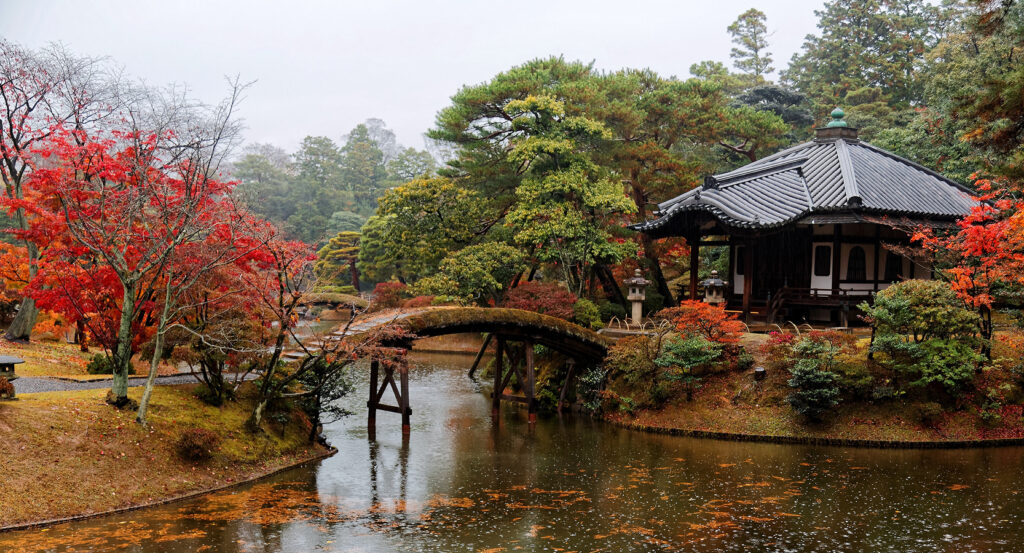
Why you should experience Katsura Imperial Villa Shokintei in Kyoto, Japan.
Katsura Imperial Villa Shokintei (Teahouse) is Kyoto distilled, a world reduced to light, breath, and silence.
Tucked deep within the Katsura estate's garden, it appears almost by accident, half veiled by pine and moss. The approach is humble: a winding path of uneven stones, the crunch of gravel, the rustle of bamboo in the wind. Then, suddenly, the teahouse reveals itself, modest, asymmetrical, and perfect. Its thatched roof sags gently with age; its paper screens glow with the muted warmth of filtered sunlight. Inside, the space feels weightless, suspended between precision and impermanence. Every element, the rough plaster walls, the bamboo ceiling, the hand-cut window frames, has been chosen not for ornament but for awareness. When the host kneels to prepare tea, time ceases to move. What you feel inside Shokintei isn't decoration; it's equilibrium, the quiet alignment of body, mind, and place.
What you should know about Katsura Imperial Villa Shokintei.
Built in the early 17th century under the direction of Prince Toshihito, Shokintei, meaning “Pine and Gold Pavilion”, captures the height of sukiya architecture: beauty achieved through restraint.
It was designed as the final pavilion on the villa's walking path, the place where the journey through art, garden, and reflection culminates in stillness. The structure's proportions follow the principles of wabi-sabi, embracing asymmetry, texture, and the passing of time as integral to beauty. The main tearoom holds only four tatami mats, its intimacy designed to erase hierarchy between host and guest. Windows are cut at irregular heights to frame specific scenes, the reflection of the pond, the silhouette of a pine, the pale sky through reed blinds. The materials are deliberately humble: bamboo, cedar, paper, and clay, each weathering differently, forming a living patina that deepens with every season. Few realize that Shokintei's placement was calculated not for sunlight, but for moonlight; the teahouse was aligned to capture the moon's reflection on the pond during evening gatherings, transforming each ceremony into an act of celestial harmony. The tearoom's crawl-through entrance, or nijiriguchi, symbolizes humility, even an emperor must bow to enter. Over centuries, this small structure has influenced architects across the world, from Japanese modernists to Western masters like Bruno Taut and Tadao Ando, who recognized in its simplicity the blueprint for timeless design.
How to fold Katsura Imperial Villa Shokintei into your trip.
To experience Katsura Imperial Villa Shokintei is to learn stillness by presence.
Access is granted only as part of the guided tour through Katsura Imperial Villa, and when the path finally curves toward the teahouse, silence tends to fall. Stop before entering; observe how it seems to breathe with the landscape. Step lightly onto the veranda, where the air carries the scent of pine and tatami. Peer inside, the tearoom is small enough that you could cross it in two steps, yet vast in calm. Visit in late afternoon, when the sun glows low through the shōji and the pond beyond mirrors the sky in silver. Imagine the tea ceremony here centuries ago, the soft clink of ceramic, the faint hiss of water, the host's deliberate movements forming a meditation in motion. In that moment, the garden outside and the room within dissolve into the same quiet field of awareness. Before leaving, walk once more down the stone path; turn back as you reach the clearing. The teahouse will appear framed by trees, its thatched roof blending into the horizon. It's hard to tell where architecture ends and nature begins, and that's the point. Katsura Imperial Villa Shokintei isn't a building. It's a state of mind.
Where your story begins.
Foresyte Travel reveals places that feel extraordinary long before you arrive.
Experience premium editorial crafted for luxury travelers.

















































































































