
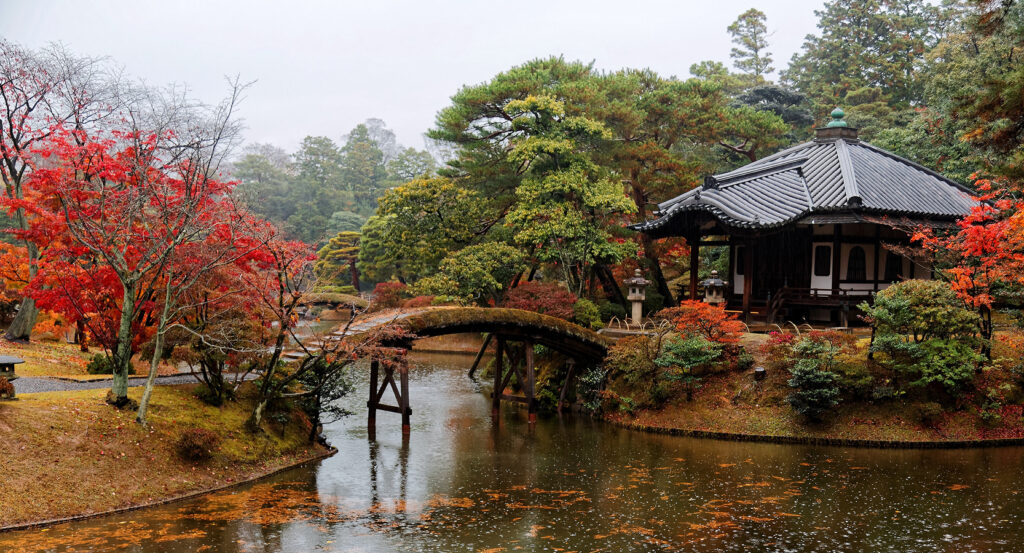
Why you should experience Katsura Imperial Villa in Kyoto, Japan.
Katsura Imperial Villa in Kyoto is one of Japan's purest expressions of harmony, a living masterpiece where architecture, landscape, and philosophy unite in perfect balance.
Tucked along the banks of the Katsura River in western Kyoto, this 17th-century estate was commissioned by Prince Toshihito of the Imperial Family as a place of quiet reflection and refined retreat. The result is not a palace in grandeur, but a study in restraint, where every line, garden, and view feels intentional. The villa's wooden pavilions, connected by delicate covered walkways, seem to float above the earth, framed by open-air verandas that dissolve the boundary between inside and out. Moss gardens roll like velvet, stones are placed as if by accident yet follow centuries of aesthetic precision, and ponds shimmer with reflections of teahouses and maples. Katsura's brilliance lies in what it withholds, asymmetry, impermanence, and the art of suggestion. Walking its grounds feels like moving through a scroll painting in motion, where each turn reveals a perfectly composed scene. Even the shifting perspective, from bamboo groves to moonlit water, is choreographed to invite contemplation. More than a villa, Katsura is a meditation on beauty itself: a place that whispers rather than shouts, teaching that perfection lies not in excess, but in grace.
What you should know about Katsura Imperial Villa.
Katsura Imperial Villa stands as one of the most influential architectural works in Japanese history, revered globally as a pinnacle of design simplicity and cultural depth.
Built in stages between 1620 and 1662 by Prince Toshihito and later expanded by his son Toshitada, the villa captures the ideals of the sukiya-zukuri style, a form of architecture rooted in the tea ceremony's principles of humility, texture, and harmony. The villa's designers sought not to display wealth, but to express refinement through subtlety. The layout of the estate follows a poetic journey, echoing the concept of shakkei (“borrowed scenery”), where distant mountains and river views become extensions of the garden's design. Every element has symbolic intent: the teahouses represent philosophical simplicity, the stepping stones mirror the rhythm of a heartbeat, and the reflective ponds embody the impermanence of time. Scholars, architects, and poets, from Bruno Taut to Le Corbusier, have studied Katsura as a model for modern design, admiring its natural materials, modular space, and spiritual unity. The moon-viewing platform, Gekka-dai, stands as a quiet tribute to the villa's purpose: to observe, to feel, and to be present. Though now under the care of the Imperial Household Agency, its timeless composition remains untouched by modernity. In a country where beauty is often intertwined with ritual, Katsura endures as the purest representation of Japanese aesthetics, a place where stillness is the greatest form of art.
How to fold Katsura Imperial Villa into your trip.
Experiencing Katsura Imperial Villa in Kyoto requires intention, both in planning and in presence.
Visits are only permitted through guided tours arranged in advance with the Imperial Household Agency, ensuring the sanctity of the site and its gardens remains preserved. The tour takes about an hour, moving at a measured pace through a sequence of five main pavilions and their surrounding gardens. Begin at the Shokin-tei, the estate's most famous teahouse, where bamboo blinds filter sunlight into soft lattices of shadow. From there, follow the path across the stepping stones to the main residence, observing how the architecture opens and closes like breath, framing each scene like a painting. The stillness is profound; even the sound of your footsteps blends with the rustle of wind through the reeds. Pause at the Gekka-dai to take in the moon-viewing pond, then look beyond the garden walls to see how Kyoto's landscape becomes part of the composition itself. Photography is limited, but that only heightens the experience, encouraging you to see, not just capture. Afterward, stroll along the Katsura River or visit the nearby Saihō-ji Moss Temple for another encounter with Kyoto's quiet majesty. To walk through Katsura Imperial Villa is to enter the living soul of Japanese design, a world where every leaf, shadow, and silence has meaning. It's not merely a destination; it's an awakening to the timeless rhythm of elegance that Kyoto has perfected for centuries.
Where your story begins.
Foresyte Travel reveals places that feel extraordinary long before you arrive.
Experience premium editorial crafted for luxury travelers.

















































































































