
Why Kuroda Memorial Hall matters.
Kuroda Memorial Hall is an intimate art institution where Ueno's museum quarter meets Kuroda Seiki's transformation of Japanese oil painting, Shinichiro Okada's interwar architecture and a collection formed directly from the painter's artistic legacy.
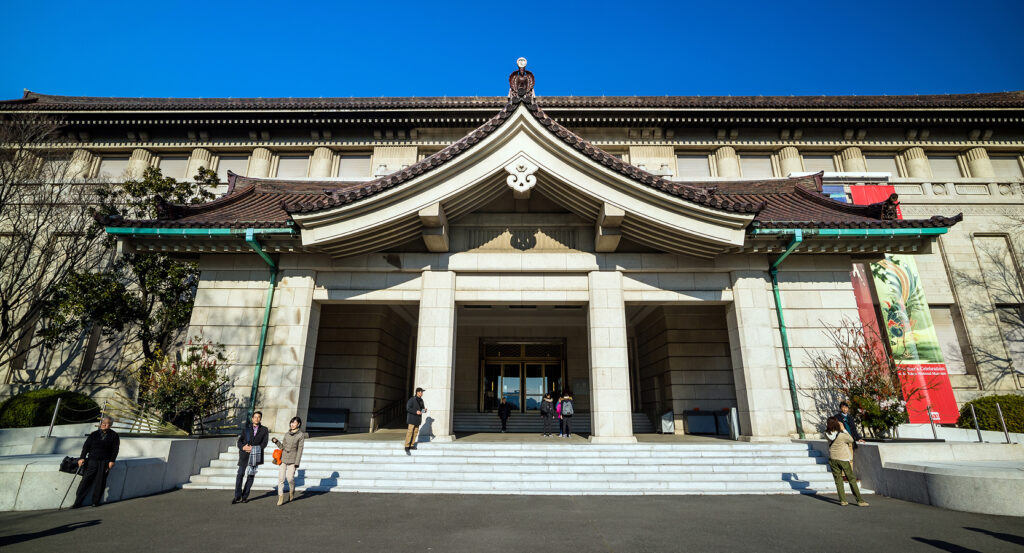
Set along the northern edge of Ueno Park near Kototoi-dori and just steps from the Tokyo National Museum, the brick-faced hall occupies a quieter cultural precinct beside the International Library of Children's Literature and Tokyo University of the Arts. Shinichiro Okada composed the building across two principal storeys above a basement, with exhibition rooms concentrated upstairs behind an exterior whose masonry gives the institution a markedly different scale from Ueno's larger museums. A compact sequence of galleries keeps Kuroda's paintings, drawings and biographical legacy close to the architecture created specifically around his contribution to Japanese art. The surrounding concentration of libraries, art schools and museums reinforces the hall's position within the institutional landscape that made Ueno central to Japan's modern cultural development. The result is a focused encounter with one artist whose career changed Japanese Western-style painting inside a building conceived to carry that influence beyond his lifetime.
What defines Kuroda Memorial Hall.
Kuroda Memorial Hall is best known for transforming Kuroda Seiki's final bequest into both a memorial to his work and an institution devoted to advancing art scholarship after his death in 1924. Kuroda had spent nearly a decade in France, trained under Raphaël Collin and encountered European painting at close range before returning to Japan in 1893 with the brighter palette and plein-air interests that altered the development of Japanese Western-style painting. His ambitions extended beyond individual canvases: Kuroda sought an academically rigorous form of Japanese oil painting, became a central figure in the Hakubakai and helped establish Western-style painting within Japan's institutional art world. He directed part of his estate toward the advancement of art when he died, and that bequest produced Kuroda Memorial Hall in 1928. The building assumed a broader scholarly purpose in 1930 when the Institute of Art Research for the Imperial Academy of Fine Arts opened inside it, joining Kuroda's personal legacy to systematic art-historical study. His family strengthened the memorial function by donating oil paintings, drawings and other works, creating a collection that now includes 130 oils and 170 drawings alongside sketchbooks. The holdings preserve major stages of Kuroda's career, including Reading from 1891, Maiko Girl from 1893, Lakeside from 1897 and the 1899 triptych Wisdom, Impression, Sentiment. Reading had entered the Paris Salon in 1891 as Kuroda's first accepted work there, years before his Japanese period produced the three later paintings now designated Important Cultural Properties. The hall subsequently passed into the Tokyo National Museum structure, preserving the unusual union Kuroda created between an individual artist's estate, a memorial collection and an institution built to advance the study of art itself.
Shinichiro Okada gave Kuroda's bequest architectural form during a concentrated period in which he was helping define the physical infrastructure of public art in Ueno. Okada taught at Waseda University and Tokyo School of Fine Arts, placing his architectural career directly beside the educational institutions shaping artists and architects in early twentieth-century Japan. His original Tokyo Prefectural Art Museum opened in 1926 with a European classicist composition organized around a naturally illuminated sculpture hall, establishing Japan's first public art museum two years before Kuroda Memorial Hall was completed. Kuroda Memorial Hall followed in 1928, and Okada also designed the Tokyo School of Fine Arts Museum during the same late-1920s period. Those three Ueno commissions formed a concentrated architectural program for exhibiting, studying and teaching art at a moment when Japan was creating permanent institutions for those activities. The Kuroda building eventually became a Registered Tangible Cultural Property, preserving one component of Okada's Ueno work after his original Tokyo Prefectural Art Museum was demolished in 1977. Its surviving brick exterior now carries an architectural history inseparable from the institutional ambitions that Kuroda's bequest set in motion.
How Kuroda Memorial Hall fits.
Kuroda Memorial Hall works as the anchor for a Ueno route through three nearby institutions that move from Japan's early national library architecture through surviving Tokugawa patronage and into the scientific institution rebuilt after the Great Kanto Earthquake.
Begin at International Library of Children's Literature, where the former Imperial Library preserves an architectural project first approved by the House of Peers and House of Representatives in 1896. Tatsuno Kingo and Kuru Masamichi joined its design committee, and Ministry of Education architect Mamizu Hideo studied American libraries before developing a far larger hollow-square scheme with Kuru; financial constraints reduced the building opened in 1906 to one-fifth of that original conception. Expansion completed another portion in 1929, leaving one structure with Meiji steel-and-brick construction beside Showa reinforced concrete before Tadao Ando Architect & Associates and Nikken Sekkei adapted it for the National Diet Library's new children's institution between 1998 and 2001. Continue to Ueno Toshogu Shrine, founded in 1627 within the former Kaneiji precinct to enshrine Tokugawa Ieyasu. Third shogun Tokugawa Iemitsu ordered the rebuilding completed in 1651, producing the surviving gongen-zukuri shrine, Karamon and Sukibei Wall with gilding, polychrome carving and contributions from daimyo represented by hundreds of lanterns. The complex escaped the destruction that consumed much of Kaneiji during the 1868 Battle of Ueno, survived the Great Kanto Earthquake and endured the wartime bombing of Tokyo, leaving an exceptional concentration of early Edo architecture inside the modern park. Conclude at National Museum of Nature and Science, whose institutional ancestry reaches to an 1872 Ministry of Education exhibition and whose official foundation dates to the Educational Museum established in Ueno in 1877. The Great Kanto Earthquake destroyed its facilities and specimens in 1923, forcing an institutional reconstruction that culminated in the present Japan Gallery in September 1931. Designed by the Ministry of Education around a Neo-Renaissance composition whose aerial footprint resembles an airplane, then a symbol of advanced technology, the building received national Important Cultural Property status in 2008; the museum has since expanded through the Global Gallery and major research facilities in Tsukuba while retaining Ueno as its public center. The progression moves from International Library of Children's Literature's unfinished Meiji vision for a national library through Ueno Toshogu Shrine's surviving seventeenth-century Tokugawa architecture into National Museum of Nature and Science's post-earthquake reconstruction of a national scientific institution, placing Kuroda Memorial Hall inside a district where successive governments and patrons repeatedly gave architecture a central role in preserving and transmitting knowledge.
Where your story begins.
Foresyte Travel reveals places that feel extraordinary long before you arrive.
Enjoy editorial crafted for luxury travelers.
Foresyte may earn a commission when you book.

















































































































