
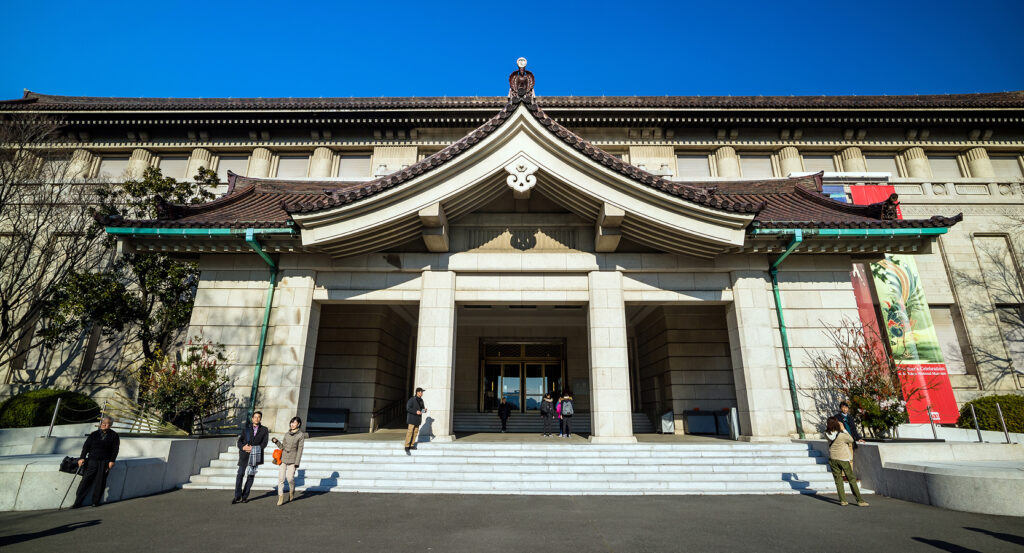
Why Tokyo National Museum matters.
Tokyo National Museum is a vast cultural institution where Ueno's concentration of museums and historic parkland meets more than 150 years of collecting Japanese and Asian art, archaeology and cultural heritage.
Set along the northern side of Ueno Park near Tokyo University of the Arts and just steps from the park's central museum district, the institution occupies an expansive precinct of galleries, gardens and historic architecture arranged behind a broad forecourt. Watanabe Jin's 1938 Honkan establishes the dominant architectural presence through a reinforced-concrete structure crowned by a Japanese tiled roof, with Katayama Tokuma's domed Hyokeikan introducing a contrasting early twentieth-century European composition across the grounds. Twenty-four galleries inside the Honkan move chronologically through Japanese art from the Jomon period to the Edo period before specialized rooms turn toward sculpture, swords, ceramics, lacquerware and the cultural production of Ainu and Ryukyu communities. Toyokan, Heiseikan and the Gallery of Horyuji Treasures extend the encounter across Asian art, Japanese archaeology and seventh- to eighth-century Buddhist objects, making movement between buildings part of understanding the institution's extraordinary chronological and geographic reach. The result is a museum complex where architecture, changing gallery sequences and more than three millennia of cultural production make the development of Japanese art legible within the wider history of Asia.
What defines Tokyo National Museum.
Tokyo National Museum is best known for developing from Japan's first modern museum experiment into a collection exceeding 120,000 objects, including 90 National Treasures and 652 Important Cultural Properties as of April 2026. Its institutional origin reaches March 1872, when the Museum Department of the Ministry of Education organized an exposition inside Taiseiden Hall at Yushima Seido, establishing the event that the museum recognizes as its foundation. That early institution became entangled almost immediately with Japan's international cultural ambitions when the Museum Department joined the Exposition Office preparing the country's participation in the 1873 Vienna World's Fair. A decisive move followed in Ueno, where British architect Josiah Conder designed a two-storey brick Honkan constructed from 1878 to 1881 and used during the Second National Industrial Exhibition before Emperor Meiji inaugurated the museum complex in March 1882. The institution passed to the Imperial Household in 1888 and became the Imperial Museum, then took the name Tokyo Imperial Household Museum in 1900 as its collections and architectural estate continued expanding. Katayama Tokuma supplied one major addition through Hyokeikan, financed by close to 24,000 contributors who gave 400,000 yen in honor of Crown Prince Yoshihito's marriage; construction began in 1901 and produced a steel-framed, cross-shaped gallery with a central circular hall and twin domed staircases. The Great Kanto Earthquake of 1923 severely damaged Conder's Honkan and forced another architectural reinvention. A public design competition selected Watanabe Jin for its successor, whose six-year construction cost seven million yen and produced a quake- and fire-resistant building containing 21,500 square meters of floor area. Emperor Showa attended its opening on November 10, 1938, completing a reconstruction that reorganized the institution's art, decorative art and historical holdings across 25 exhibition rooms. World War II forced the evacuation of important objects from Tokyo before the museum reopened after the conflict, and the institution received its present Tokyo National Museum name in March 1952. The museum's trajectory from Yushima Seido through Conder, the Imperial Household, Katayama, the 1923 earthquake and Watanabe's reconstruction places its present collection inside a continuous history of Japanese museum building stretching back to the first years of the Meiji state.
The Horyuji Treasures form another consequential chapter in Tokyo National Museum's development, beginning with more than 300 objects transferred by Horyuji Temple to the Imperial Household in 1878. Created principally during the seventh and eighth centuries, the group encompasses gilt-bronze Buddhist statues, repoussé images, ritual objects, textiles and Gigaku masks whose survival connects the museum directly with the artistic culture surrounding one of Japan's foundational Buddhist institutions. A dedicated Gallery of Horyuji Treasures opened with repository facilities in 1964, separating this historically unified group from the broader Japanese collection as the museum expanded its postwar campus. Architect Yoshio Taniguchi later received the commission for a replacement building, creating an austere glass, stone and water composition completed at the end of the twentieth century around stringent conservation requirements. Taniguchi subsequently designed the Museum of Modern Art in New York's major early twenty-first-century rebuilding, giving the Horyuji gallery an important position within the career of one of Japan's internationally prominent museum architects. The treasures themselves preserve an older institutional chain: Horyuji Temple transferred them to the Imperial Household during the Meiji period, imperial stewardship preceded their placement within the national museum system, and Taniguchi eventually created a purpose-built architectural setting for their conservation and display. Tokyo National Museum contains not only objects accumulated individually across its long history but an intact body of early Buddhist cultural property whose movement from temple to imperial collection to dedicated gallery encapsulates changing Japanese approaches to cultural preservation.
How Tokyo National Museum fits.
Tokyo National Museum works as the anchor for a daytime route through three Ueno institutions whose histories connect the district's Tokugawa religious origins with Meiji cultural infrastructure and twentieth-century public art.
Begin at Kaneiji, founded by the Tendai priest Tenkai in 1625 under Tokugawa patronage on the northeastern side of Edo Castle, a position chosen through cosmological ideas surrounding the protection of the shogunal capital. Imperial princes later served as abbots under the title Rinnoji-no-Miya, and Tokugawa Ietsuna's mausoleum helped establish Kaneiji as a funerary temple for the shogunal house. The vast temple compound dominated the Ueno plateau until the 1868 Battle of Ueno destroyed much of its architecture and the subsequent creation of Ueno Park absorbed a large portion of its former territory. Continue to the International Library of Children's Literature, housed within the former Imperial Library completed in 1906 and extended in 1929. The Renaissance-style building became part of the National Diet Library's specialist children's institution in 2000, with the conversion preserving the early structure while introducing seismic reinforcement; its transformation carries Ueno's Meiji commitment to national cultural institutions into a contemporary library devoted specifically to literature for younger readers. Conclude at Tokyo Metropolitan Art Museum, founded after Kitakyushu industrialist Sato Keitaro offered Tokyo Prefecture one million yen in 1921 for a public art museum. Okada Shinichiro designed the institution that opened in 1926 as Japan's first public art museum, and Kunio Maekawa replaced that classical building with the present complex in 1975, placing 60 percent of its floor area underground to satisfy Ueno Park's 15-meter height restriction and organizing three principal blocks around a sunken esplanade. The progression moves from Kaneiji's seventeenth-century command of the Ueno plateau through the Imperial Library's Meiji cultural infrastructure into Sato Keitaro, Okada Shinichiro and Kunio Maekawa's successive contributions to public art, revealing how the district surrounding Tokyo National Museum became one of Japan's densest concentrations of religious, educational and museum history.
Where your story begins.
Foresyte Travel reveals places that feel extraordinary long before you arrive.
Enjoy editorial crafted for luxury travelers.
Foresyte may earn a commission when you book.

















































































































