
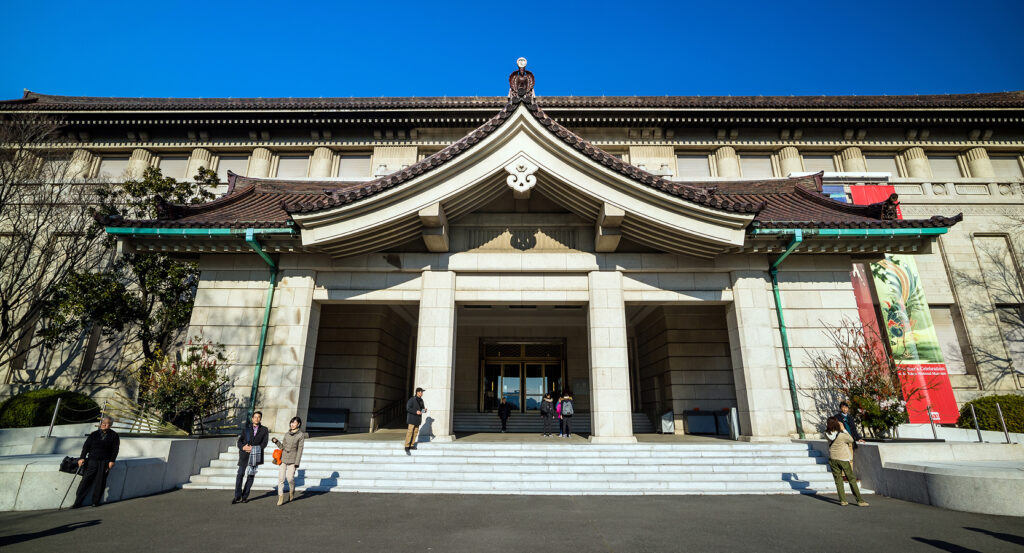
Why The Gallery of Horyuji Treasures matters.
The Gallery of Horyuji Treasures is a serene museum pavilion where Ueno Park's concentration of national culture meets Yoshio Taniguchi's architectural precision and an exceptional body of early Japanese Buddhist art preserved across thirteen centuries.
Set within Tokyo National Museum near the park road leading toward Ueno Toshogu and just steps from Hyokeikan, the gallery occupies a wooded corner of the museum grounds behind a long rectangular reflecting pool. A glass entrance volume projects beneath an exceptionally thin horizontal roof, with slender supports and expansive glazing creating a measured transition from the surrounding trees into the building. Movement through the bright entrance hall leads toward darker exhibition rooms where tightly controlled illumination concentrates attention on small-scale sculpture, metalwork and fragile objects. Stone surfaces, water, glass and deeply recessed galleries establish successive degrees of separation from the surrounding park, allowing the architecture to shift gradually from open daylight toward the protected conditions required by the collection. The result is an unusually disciplined museum encounter where landscape, controlled light and architectural restraint prepare the eye for objects whose physical scale belies their historical importance.
What defines The Gallery of Horyuji Treasures.
The Gallery of Horyuji Treasures is best known for housing more than 300 objects transferred by Horyuji Temple to the Imperial Household in 1878, preserving an extraordinary concentration of Buddhist art associated principally with the seventh and eighth centuries. The transfer occurred during the early Meiji period, when the ancient Nara temple entrusted a body of sculpture, ritual objects, textiles, paintings and other works to imperial custody. These objects eventually entered the national collection and received a dedicated building at Tokyo National Museum in 1964. Conservation requirements sharply restricted access to that first gallery, limiting public exhibition to one day each week and creating a fundamental tension between preservation and meaningful access. Tokyo National Museum resolved that problem through a replacement building commissioned from Yoshio Taniguchi, whose practice had already produced the Ken Domon Museum of Photography, Marugame Genichiro-Inokuma Museum of Contemporary Art and Toyota Municipal Museum of Art. Construction began in December 1994 and concluded in March 1999, followed by inauguration that July. Taniguchi organized the new building around protected interior galleries buffered by brighter peripheral areas, allowing environmental control to become an architectural principle across the museum. The collection now contains 14 National Treasures and 239 Important Cultural Properties, giving the relatively compact institution an exceptional concentration of nationally designated works. Architectural recognition followed in 2001 with an Architectural Institute of Japan award, two years before Taniguchi was selected to redesign and expand the Museum of Modern Art in New York. The 1878 transfer, restrictive 1964 gallery and Taniguchi's 1999 replacement form a continuous institutional history centered on a single problem: preserving some of Japan's oldest Buddhist treasures while bringing them into sustained public view.
Gigaku masks open another historical dimension through a performance tradition transmitted to Japan from continental Asia during the Asuka period. The Nihon Shoki associates its arrival with Mimashi, a performer who had studied the art abroad and reached Japan through the Korean peninsula in 612 during the reign of Empress Suiko. Horyuji's surviving group contains 31 masks, including examples from the Asuka period that distinguish the collection from later Gigaku holdings at Todaiji and the Shosoin. Gigaku itself disappeared from performance practice centuries ago, leaving masks, inscriptions and written references as critical surviving evidence for reconstructing its theatrical world. Tokyo National Museum and the National Center for the Promotion of Cultural Properties began translating that evidence into experimental reconstruction during the late 2010s, producing replicas of masks including Gojo, the Woman of Wu, and Karura, the Garuda figure, before extending the project into reconstructed costumes. Digital interpretation widened the project again in 2023 through high-resolution presentations devoted to the Illustrated Biography of Prince Shotoku and the murals of Horyuji's Kondo Hall. The original Gigaku masks received collective designation as a National Treasure in 2025, adding formal recognition to a group whose importance reaches beyond sculpture into the history of music, dance, costume and theatrical exchange across early East Asia.
How The Gallery of Horyuji Treasures fits.
The Gallery of Horyuji Treasures works as the anchor for a daytime route through three nearby institutions connecting Meiji library building, modern Japanese painting and Kunio Maekawa's postwar cultural architecture.
Begin at International Library of Children's Literature, whose Brick Building originated as the Imperial Library designed by Masamichi Kuru, Hideo Mamizu and Tokitaro Okada and opened in 1906. Expansion in 1929 carried the original scheme into the early Showa period, and Tadao Ando Architect & Associates later worked with Nikken Sekkei on its conversion for the National Diet Library, introducing glass interventions while preserving historic rooms and the grand staircase; an Arch Building designed by the same architectural team followed in 2015. Continue to Kuroda Memorial Hall, created through a bequest from painter Kuroda Seiki after his death in 1924 and completed in 1928 to support the advancement of art. Okada Shinichiro designed the building, which subsequently housed the Art Research Institute founded in 1930; Kuroda's family contributed works to a memorial room, and the surviving collection includes 126 oil paintings alongside 170 drawings, sketchbooks and correspondence. Conclude at Tokyo Metropolitan Art Museum, whose present building opened in 1975 to a design by Kunio Maekawa, the architect who had worked in Le Corbusier's Paris studio before becoming a central figure in Japanese modernism. Maekawa submerged much of the museum volume into the Ueno terrain and divided its mass into brick-clad blocks around a sunken plaza, extending the park's architectural history into a distinctly postwar cultural institution. The progression moves from the Imperial Library's Meiji ambitions through Kuroda Seiki and Okada Shinichiro's institutionalization of modern art into Kunio Maekawa's postwar museum architecture, surrounding The Gallery of Horyuji Treasures with three further chapters in Ueno's development as Japan's most concentrated cultural precinct.
Where your story begins.
Foresyte Travel reveals places that feel extraordinary long before you arrive.
Enjoy editorial crafted for luxury travelers.
Foresyte may earn a commission when you book.

















































































































