
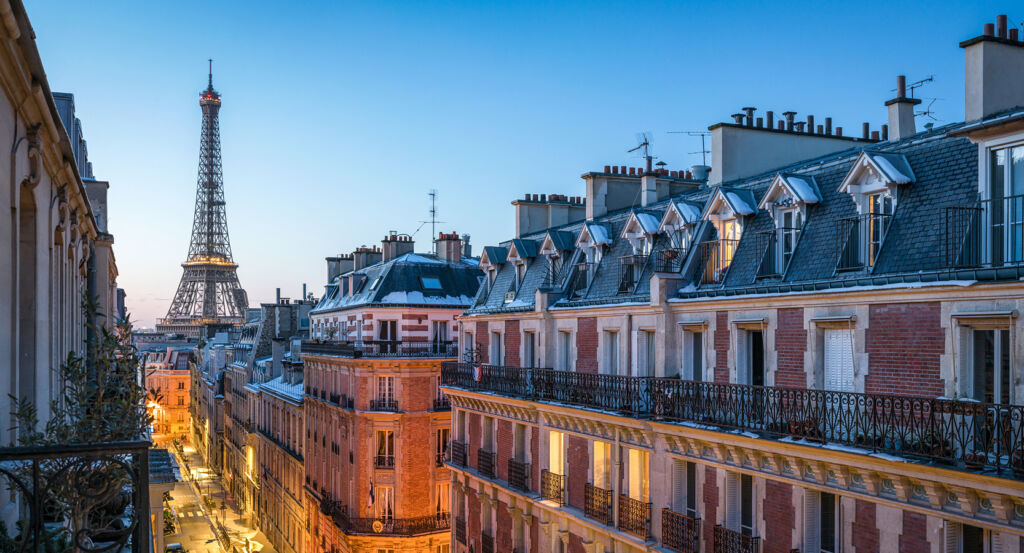
Why you should experience L'Hôtel du Collectionneur Paris in Paris, France.
L'Hôtel du Collectionneur Paris is an Art Deco luxury hotel where Faubourg-du-Roule's grand residential character, interwar decorative arts, transatlantic glamour and contemporary French hospitality converge through a modern homage to Jacques-Émile Ruhlmann's celebrated 1925 Hôtel du Collectionneur.
Set along Rue de Courcelles near Rue de Monceau and just steps from Parc Monceau, the five-star hotel opened in 2004 inside a building designed by architect Stanislas Fiszer, with Jacques Garcia shaping interiors around the geometry, materials and theatrical scale associated with French Art Deco. The creative premise reaches directly to Ruhlmann and architect Pierre Patout's Hôtel du Collectionneur at the 1925 Exposition Internationale des Arts Décoratifs et Industriels Modernes, a pavilion conceived as the imaginary residence of an affluent art collector and regarded among the defining displays of the exhibition. The contemporary hotel develops that reference through sculpted reliefs, murals, sweeping staircases and interiors influenced by 1930s transatlantic liners, while the current property encompasses 496 rooms and suites, 1,700 square meters of event space and an interior terrace garden exceeding 600 square meters. The scale turns Ruhlmann's collector-house premise into one of Paris's largest expressions of Art Deco-inspired hospitality while preserving the central idea that furniture, architecture, decorative objects and social spaces belong to a single composed environment.
What you should know about L'Hôtel du Collectionneur Paris.
L'Hôtel du Collectionneur Paris is best known for opening in 2004 as the Hilton Arc de Triomphe in a building designed by Polish-born French architect Stanislas Fiszer before becoming Hôtel du Collectionneur under the family-owned The Gate Collection in 2012, adopting a name that explicitly honors Jacques-Émile Ruhlmann and Pierre Patout's Hôtel du Collectionneur created for the 1925 Exposition Internationale des Arts Décoratifs et Industriels Modernes. Ruhlmann conceived the original pavilion as the imaginary residence of a wealthy collector, while Patout designed its architecture around a central rotunda and restrained classical geometry, and Ruhlmann assembled nearly 50 artists and 30 manufacturers including Edgar Brandt for wrought iron, Jean Dunand for lacquer and François Décorchemont and Maurice Marinot for glass. Ruhlmann had begun sketching the project by 1919, spending more than five years developing the scheme before the exposition opened in 1925, where the pavilion became one of the fair's most admired displays and helped establish the international reputation of the decorative language subsequently known as Art Deco. The contemporary Rue de Courcelles hotel carries that lineage into a property currently advertising 496 accommodations, including 40 suites, three Signature Suites and three Presidential Apartments with panoramic terraces, alongside 1,700 square meters of meeting space and an interior terrace garden exceeding 600 square meters. A major recent renovation has reinforced the 1930s style through interiors explicitly inspired by transatlantic ocean liners, connecting the scale of the modern hotel with the craftsmanship, collecting culture and integrated decorative vision established by Ruhlmann a century earlier.
Nicolas Amelin extends that French design narrative into gastronomy after becoming Executive Chef of Hôtel du Collectionneur in April 2025, returning to a property where he had previously worked in 2017 following a 20-year career that began at Dalloyau and continued through major Paris hotels. Le Collectionneur develops Amelin's approach through contemporary French cooking organized around seasonal produce, while the adjoining bar centers service around a granite counter extending more than seven meters and a drinks collection spanning cocktails, Champagne and rare spirits. Cellcosmet carries the hotel's renewed Art Deco program into nearly 450 square meters of wellness space as the Swiss cellular-cosmetics company's exclusive Paris address, with four treatment rooms, including a duo room, a sauna, hammam, Technogym-equipped fitness room and an 18-meter indoor swimming pool beneath mirrored ceilings. Together, Nicolas Amelin, Le Collectionneur, Cellcosmet and Technogym extend the hotel's collector premise from decorative arts into cuisine and wellness, allowing the contemporary property to interpret Ruhlmann's integrated vision through distinct disciplines rather than treating Art Deco solely as surface decoration.
How to fold L'Hôtel du Collectionneur Paris into your trip.
L'Hôtel du Collectionneur Paris works as the anchor for an afternoon tracing private collecting, artists' houses and Asian art through the cultural institutions surrounding Parc Monceau.
Begin at Musée Cernuschi, where banker, republican and collector Henri Cernuschi commissioned William Bouwens van der Boijen to construct a neoclassical mansion for 5,000 artworks acquired during his 1871 to 1873 journey through Japan and China with critic Théodore Duret, later bequeathing the house and collection to the City of Paris before the museum opened on October 26, 1898. Continue to Musée national Jean-Jacques Henner, occupying the mansion painter Guillaume Dubufe purchased as his home and studio in 1878 before Marie Henner acquired it from his heirs in 1921, commissioned Marcel Legendre to convert the residence and opened the museum in 1924, with more than 2,200 works now preserved in the collection. Conclude at Musée Nissim de Camondo, where Moïse de Camondo commissioned René Sergent in 1911 to create a residence inspired by the Petit Trianon for his collection of eighteenth-century French decorative arts before bequeathing the mansion to France in memory of his son Nissim, killed in combat in 1917. The progression moves from Cernuschi's Asian collection through Dubufe and Henner's artistic world into Camondo's eighteenth-century interiors, creating a study of collecting and residential display that directly complements L'Hôtel du Collectionneur Paris's own inheritance from Ruhlmann's imagined collector residence.
Where your story begins.
Foresyte Travel reveals places that feel extraordinary long before you arrive.
Experience premium editorial crafted for luxury travelers.














































































































