
Why La Pergola matters.
La Pergola is a three-MICHELIN-starred fine-dining restaurant where Monte Mario's elevated residential setting meets Heinz Beck's technically exacting Italian cuisine, a major collection of European wines and panoramic views across Rome's historic center.
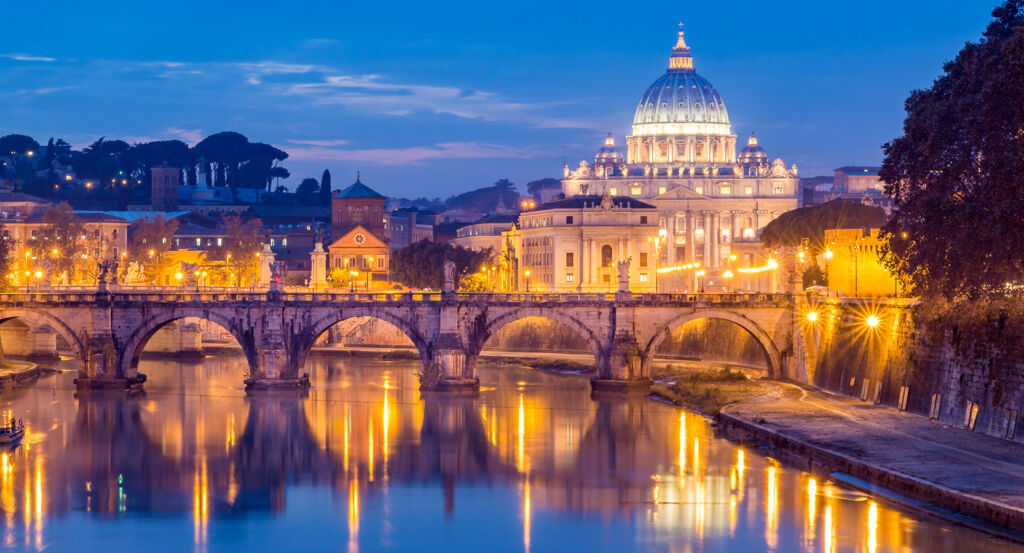
Set on the ninth floor of the Rome Cavalieri hotel along Via Alberto Cadlolo, the restaurant occupies a hillside position above the Balduina district, northwest of Vatican City and overlooking the Tiber valley toward the historic center of Rome. Floor-to-ceiling windows and an adjoining terrace frame the city's domes, rooftops and distant hills. Rich textiles, polished wood and decorative artworks establish an interior associated with European grand-hotel dining. Carefully spaced tables preserve uninterrupted sightlines across the illuminated city during evening service. The result is a dining room whose elevated position, formal architectural finishes and extensive views establish a distinctive setting for Rome's most technically ambitious restaurant cooking.
What defines La Pergola.
La Pergola is best known for becoming the first restaurant in Rome to receive three MICHELIN stars, achieving the distinction in 2005 under German-born chef Heinz Beck. The restaurant opened in 1994 within the Rome Cavalieri, establishing a fine-dining destination above the city's established hotel and restaurant districts. Beck, born in Friedrichshafen in 1963, trained in Germany before developing his career in prestigious European kitchens. His early professional experience included work at the Tantris restaurant in Munich, where he encountered the precision and disciplined organization associated with classical European haute cuisine. He subsequently worked at the Tristan restaurant in Mallorca under Eckart Witzigmann's culinary influence, strengthening his command of refined cooking techniques and ingredient combinations. In 1994, Beck accepted the position of executive chef at La Pergola, beginning a professional association that fundamentally shaped the restaurant's international standing. His appointment introduced a culinary approach combining Italian regional ingredients with techniques developed through his German and broader European training. MICHELIN awarded the restaurant its first star in 1996, recognizing the rapid development of Beck's kitchen. A second star followed in 2001, establishing La Pergola among Italy's most highly regarded fine-dining establishments. The third star arrived in 2005, making the restaurant a defining institution in Rome's modern gastronomic history. Beck's work subsequently expanded through the Beck and Partners restaurant group, which developed culinary projects in several international destinations. His professional interests extended into nutritional science, including collaborations examining the relationship between ingredient composition, cooking methods and human health. These investigations informed the development of lighter preparations emphasizing controlled fat content, digestibility and the preservation of natural flavors. La Pergola underwent an extensive renovation completed in 2024, introducing a redesigned dining room under the direction of architect Bruno Moinard and his studio, 4BI & Associés. The renovation retained the restaurant's formal character and major decorative collections, reinforcing its position within the international tradition of luxury hotel dining.
Heinz Beck's kitchen develops tasting menus through precise cooking temperatures, concentrated sauces and carefully balanced combinations of acidity, texture and aroma. His signature fagottelli La Pergola consists of delicate pasta parcels filled with a liquid carbonara preparation, incorporating the flavors of egg yolk, pecorino and guanciale into a single bite. The filling releases its warm sauce when the pasta is cut, demonstrating the technical control required to preserve a fluid interior within a thin pasta envelope. Beck's interpretation of carbonara transforms a familiar Roman preparation into a refined composition while maintaining its recognizable ingredients. Seafood courses incorporate carefully timed cooking and light emulsions, allowing the natural flavor of fish and shellfish to remain central. Vegetable preparations employ purées, reductions and controlled roasting to develop concentrated flavors across seasonal produce. His approach to sauces emphasizes texture and clarity, using measured reductions and emulsification to integrate richness with acidity. The tasting-menu sequence progresses through smaller compositions, substantial main courses and carefully structured desserts, maintaining balance across an extended meal. Pastry preparations combine fruit, chocolate and aromatic elements through contrasting temperatures and textures. The restaurant's cheese service incorporates selections from established European producers, extending the meal into a distinct stage of regional dairy traditions. La Pergola's wine cellar contains more than 70,000 bottles, representing 3,500 labels from major Italian and international wine regions. Head sommelier Marco Reitano has played a central role in developing the collection, including rare vintages from Burgundy, Bordeaux and leading Italian estates. The restaurant also maintains an extensive selection of vintage waters, reflecting its historically elaborate approach to beverage service. Tableside presentation and coordinated service accompany the tasting menu, with individual courses introduced through detailed explanations of ingredients and preparation. The kitchen's technical precision and the dining room's formal service establish a sustained relationship between contemporary Italian cooking and the ceremonial traditions of European fine dining.
How La Pergola fits.
La Pergola works as the culinary centerpiece for a Rome itinerary connecting the Vatican's artistic collections, the architectural achievements of the Italian Renaissance and the expansive public spaces developed during the city's Baroque transformation.
Begin at Vatican Museums, the extensive collection of galleries and ceremonial spaces developed through centuries of papal patronage. Pope Julius II initiated the foundations of the collection in the early sixteenth century, assembling ancient sculptures and commissioning major artistic projects. The Raphael Rooms contain frescoes created by Raphael and his workshop, including The School of Athens, whose architectural setting brings together figures associated with classical learning. The Sistine Chapel contains Michelangelo's ceiling frescoes and The Last Judgment, among the most consequential works of Renaissance painting. The museums' collections extend across ancient sculpture, tapestries, maps and decorative arts, documenting the cultural ambitions of successive pontificates. Continue to St. Peter's Basilica, the expansive church constructed above the traditional burial site of the apostle Peter. Construction began in 1506 under Pope Julius II, with architectural contributions from Bramante, Michelangelo, Carlo Maderno and Gian Lorenzo Bernini. Michelangelo developed the basilica's great dome, establishing one of the defining architectural features of Rome's skyline. Bernini's bronze baldachin rises above the principal altar, connecting the immense interior with the sacred site beneath. The adjoining colonnades of St. Peter's Square create a ceremonial approach to the basilica, organizing the movement of pilgrims and public gatherings through an expansive architectural composition. Conclude at Piazza Navona, the Baroque public square occupying the site of the ancient Stadium of Domitian. Its elongated form preserves the underlying geometry of the Roman athletic venue, connecting imperial urban planning with the later development of the city. Bernini's Fountain of the Four Rivers, completed in 1651, incorporates allegorical figures representing major rivers across four continents. Francesco Borromini contributed to the adjoining church of Sant'Agnese in Agone, whose curved façade and twin towers establish a major architectural feature of the square. The surrounding palaces and fountains preserve the theatrical urban design associated with seventeenth-century Rome. The progression moves from papal artistic patronage through Renaissance religious architecture and culminates in the Baroque transformation of Rome's public spaces.
Where your story begins.
Foresyte Travel reveals places that feel extraordinary long before you arrive.
Enjoy editorial crafted for luxury travelers.
Foresyte may earn a commission when you book.




















































































































