
Why La Taverna dell'Arte matters.
La Taverna dell'Arte is a distinguished Porto restaurant where Porto's historic university quarter meets Alfonso Gallotti's neighborhood dining tradition, Marcellino Amato's revival of Neapolitan hospitality and Viviana Marrocoli's contemporary interpretation of Campanian cuisine.
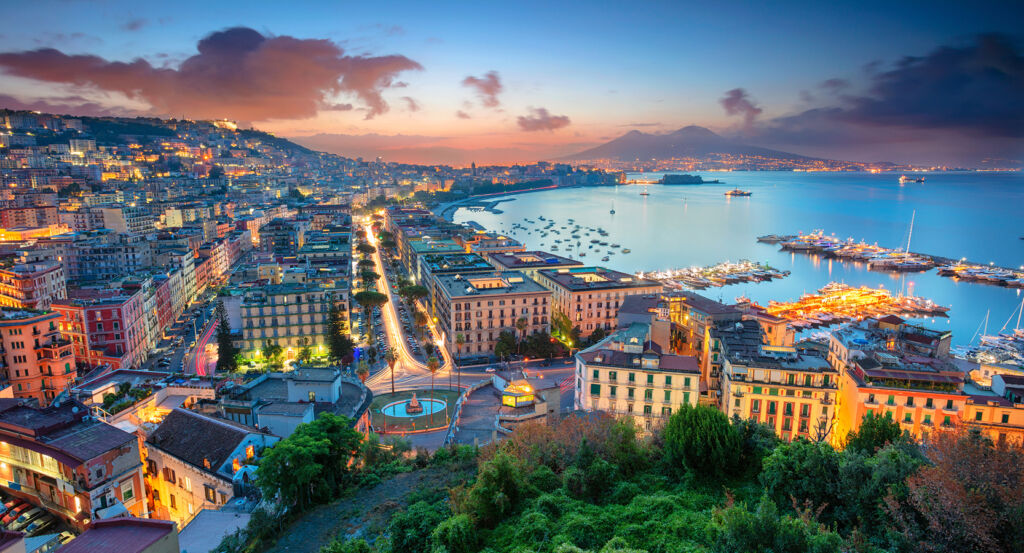
Occupying a sheltered position along the stepped passage connecting Via Mezzocannone with Largo San Giovanni Maggiore, the restaurant sits within Naples' historic university district, a short walk from Piazza San Domenico Maggiore and the commercial streets descending toward Corso Umberto I. Its modest entrance opens onto an intimate dining room whose warm lighting, closely arranged tables and decorative furnishings establish the character of a traditional neighborhood tavern. Exposed masonry, framed artwork and carefully arranged interior details introduce a domestic quality that complements the building's historic urban surroundings. Seasonal outdoor seating extends onto the adjoining pedestrian passage, creating a quieter dining environment beside the surrounding stone stairways and historic façades. The result is an intimate restaurant whose historic-center architecture, residential atmosphere and carefully composed dining spaces establish a distinctive setting for contemporary Neapolitan cooking.
What defines La Taverna dell'Arte.
La Taverna dell'Arte is best known for the transformation of Alfonso Gallotti's neighborhood restaurant into a contemporary Neapolitan dining establishment shaped by Marcellino Amato, chef Marco Di Martino and the subsequent culinary leadership of Viviana Marrocoli. Gallotti founded the restaurant in 1990, selecting a secluded position on the historic stairway connecting Via Mezzocannone with the square surrounding one of Naples' ancient basilicas. His decision came during a period when the surrounding historic center had yet to experience the extensive international tourism development that would transform its commercial streets during subsequent decades. Gallotti established a tavern devoted to traditional Neapolitan cooking and the social character of neighborhood dining, creating a restaurant whose appeal depended on its relationship with local customers and the surrounding university community. The enterprise developed through the 1990s as part of a wider generation of independent restaurants preserving Campanian culinary traditions within Naples' historic neighborhoods. A substantial change in ownership and culinary direction arrived on December 29, 2016, when Marcellino Amato and Marco Di Martino began their partnership at the restaurant. Amato entered the hospitality industry after a career as an insurance broker, bringing a longstanding personal interest in cooking developed through family experience and independent study. His earliest culinary influences included Giuseppina, a woman employed in his parents' household who introduced him to traditional home cooking during childhood. Amato subsequently studied his mother's copies of La Cucina Italiana and the writings of Auguste Escoffier, developing an interest in classical culinary technique through books and cooking for friends. At the age of fifty-eight, he decided to establish a professional restaurant enterprise alongside his existing business career. Di Martino provided the technical counterpart to Amato's hospitality ambitions, bringing formal culinary training from ALMA, the International School of Italian Cuisine, in Colorno. Their partnership established a division of responsibilities centered on Amato's personal approach to hosting and Di Martino's professional management of the kitchen. The restaurant subsequently developed a culinary program that reworked established Neapolitan preparations through seasonal ingredients, contemporary presentation and carefully controlled cooking techniques. Its growing reputation attracted attention from international publications, including The Guardian, whose Naples coverage introduced the restaurant to readers exploring the city's independent dining establishments. The restaurant also received attention through coverage of its vegetarian reinterpretations of traditional Campanian dishes, particularly its development of a vegetable-based Genovese filling for handmade pasta. A further stage of culinary development began in late 2024 with the arrival of Neapolitan chef Viviana Marrocoli. Born in 1984, Marrocoli began pursuing cooking professionally at twenty years old, initially developing her abilities through independent study and practical experience. She subsequently completed professional training through Gambero Rosso's culinary program in Naples, establishing relationships with chefs including Bacio Terracino, Antonio Tubelli and Michele Leo. Leo contributed particularly to her understanding of dough fermentation and leavening, introducing technical knowledge that became part of her broader culinary education. Marrocoli continued her development through experience with Francesco Sposito at the MICHELIN-starred Taverna Estia, Lorenzo Cuomo at Re Maurì in Vietri sul Mare and Viviana Varese at Alice in Milan. Her professional experience also included work with Igles Corelli at Mercerie in Rome, an innovative restaurant project devoted to technically developed small-format preparations. These appointments introduced different approaches to fine dining, seafood, modern Italian cooking and the treatment of regional ingredients. Marrocoli brought this experience to La Taverna dell'Arte through a program emphasizing seasonal produce, Campanian agricultural specialties and the reinterpretation of traditional dishes through contemporary culinary techniques. After nearly a decade at the restaurant, Di Martino announced his departure, leaving Amato responsible for the enterprise and Marrocoli in charge of the kitchen. The transition established a new culinary direction while preserving the restaurant's longstanding commitment to intimate hospitality and the regional cooking traditions that had shaped its development since Gallotti's original establishment.
Viviana Marrocoli's cooking develops the flavors of Campania through a sustained relationship between traditional preparations, seasonal agricultural ingredients and technical methods that alter the texture and concentration of familiar dishes. Her professional experience in Neapolitan kitchens provides the foundation for an approach that treats regional cooking as a collection of established flavor relationships capable of supporting further development. The kitchen's interpretation of Genovese demonstrates this principle through the transformation of the city's celebrated slow-cooked onion sauce into a vegetable-centered preparation. Traditional Genovese derives its sweetness and concentrated savory character from the prolonged cooking of onions alongside meat, producing a sauce whose depth depends on moisture reduction and gradual caramelization. Marrocoli develops the vegetable component into a filling for handmade ravioli, preserving the characteristic sweetness of the preparation within a more delicate pasta structure. Steaming introduces a different cooking environment, allowing the pasta to retain moisture and tenderness through indirect heat. Celery and wild fennel contribute aromatic freshness, creating a contrasting herbal component that balances the concentrated sweetness of the filling. The relationship between traditional flavor and altered technique extends into the kitchen's treatment of pasta produced in Gragnano, the Campanian town internationally associated with dried pasta manufacturing. Its substantial pasta shapes retain a firm texture during cooking, creating a structural foundation for sauces built around regional seafood and agricultural ingredients. Colatura di alici introduces a particularly concentrated expression of the Mediterranean coast through the fermented anchovy liquid traditionally associated with Cetara. Its pronounced salinity and savory depth allow relatively small quantities to influence the flavor of an entire preparation. Aromatic breadcrumbs contribute texture and carry the fragrance of coastal herbs, connecting the anchovy's intensity to the pasta's firm structure. Citrus introduces another important element through fruit grown along the Sorrentine Peninsula, whose natural acidity and aromatic oils provide a distinctive counterpoint to richer ingredients. The kitchen develops this relationship through preparations involving Acquerello rice, citrus preserves and carefully handled seafood, allowing the grain's starch to establish a creamy foundation for contrasting flavors. Controlled smoking contributes an additional layer of aromatic complexity, creating a relationship between the delicate character of fresh fish and the concentrated fragrance of wood smoke. Seafood preparation extends the same attention to temperature and texture through squid cooked rapidly over intense heat. Brief searing develops the exterior and preserves the flesh's tenderness, allowing the natural sweetness of the ingredient to remain prominent. Seasonal vegetables introduce freshness through carefully controlled preservation methods, including osmotic preparations that alter their moisture content and concentrate their flavor. Fennel and ginger contribute aromatic sharpness, balancing the squid's delicate marine character through a restrained combination of herbal and spicy components. The treatment of salt cod develops another established Mediterranean tradition through low-temperature cooking in oil, producing a tender texture that preserves the fish's characteristic flavor. Chickpeas from Cicerale introduce a creamy foundation with substantial agricultural significance, connecting the preparation to a Cilento village known for its traditional legume cultivation. Black olives and partially dried tomatoes contribute concentrated salinity and acidity, completing the relationship between preserved fish and southern Italian agricultural ingredients. The kitchen's treatment of zucchini follows the same principle through the traditional Nerano combination of fried courgettes and Provolone del Monaco, a protected Campanian cheese whose distinctive richness develops through maturation. Marrocoli's culinary program also incorporates contemporary small-format preparations, including house tacos, extending the restaurant's approach to shared dining through combinations influenced by international cooking. The progression from antipasti through pasta, seafood and dessert maintains a connection to the established structure of an Italian evening meal, with seasonal availability governing the composition of individual preparations. Amato's approach to service complements this culinary direction through personal attention to the dining room and an emphasis on the social traditions of the Neapolitan tavern. The restaurant's concluding coffee service preserves another local custom through the use of the traditional Neapolitan cuccuma, a stovetop coffee maker whose distinctive brewing method developed during the nineteenth century. La Taverna dell'Arte's culinary character emerges from the coordinated treatment of regional ingredients, precise cooking techniques and a hospitality tradition that connects contemporary restaurant dining to the domestic foundations of Neapolitan cuisine.
How La Taverna dell'Arte fits.
La Taverna dell'Arte works as the concluding destination for an exploration connecting Naples' early Christian architecture, the political ambitions of Renaissance aristocratic families and the artistic heritage of its Benedictine religious institutions.
Begin at Basilica di San Giovanni Maggiore, among Naples' oldest religious foundations, whose origins reach to the fourth century and the expansion of Christianity following Constantine's recognition of religious freedom. An ancient inscription associated with the building places its foundation around AD 324, although the precise circumstances of its establishment remain uncertain. Bishop Vincenzo undertook a substantial reconstruction during the sixth century, establishing the church among the four major basilicas of early Christian Naples. Successive medieval alterations transformed its original architectural arrangement, and Dionisio Lazzari introduced major Baroque modifications following an earthquake in 1635. His reconstruction included an elaborate domed arrangement completed in 1685, contributing to the architectural character preserved within the surviving interior. A further period of restoration followed structural damage during the nineteenth century, and extensive twentieth-century conservation work preceded the church's reopening in 2012. Continue to Palazzo Giusso, the expansive Renaissance residence whose development began after Alfonso Sánchez, Marquis of Grottola and treasurer of the Kingdom of Naples, acquired the property in 1546. Sánchez assembled surrounding buildings and parcels to create an unusually substantial aristocratic residence with façades opening onto three sides. A devastating flood in 1569 destroyed neighboring structures and contributed to the formation of the open space subsequently known as Piazza Banchi Nuovi. Cardinal Ascanio Filomarino acquired the palace in 1645, developing its decorative program through loggias, painted rooms and an important collection of artworks. The building subsequently passed through several owners before its acquisition by the Real Istituto Orientale in 1932. Its inauguration as a university building in 1934 established a new institutional purpose, and it now accommodates departments and library facilities of the University of Naples L'Orientale. Conclude at Chiesa dei Santi Severino e Sossio, the expansive Benedictine church associated with a religious community established in Naples during the early medieval period. The monks transferred the relics of Saint Severinus to their new foundation following attacks on their earlier monastery, and the relics of Saint Sossius joined the collection in AD 904. Construction of the present Renaissance church began in 1490 under Giovanni Francesco Mormando, establishing an ambitious architectural program subsequently completed during the sixteenth century. Its interior preserves paintings by Marco Pino, Francesco De Mura and Belisario Corenzio, together with substantial marble monuments and an elaborate presbytery designed by Cosimo Fanzago. The adjoining monastic complex became the headquarters of the State Archives of Naples in 1835, preserving an extensive collection of documents associated with the political and administrative history of southern Italy. The progression moves from Basilica di San Giovanni Maggiore's early Christian origins through Palazzo Giusso's Renaissance aristocratic development and culminates in Chiesa dei Santi Severino e Sossio's extraordinary combination of Benedictine history, religious art and archival preservation, connecting three important institutional traditions within Naples' historic center.
Where your story begins.
Foresyte Travel reveals places that feel extraordinary long before you arrive.
Enjoy editorial crafted for luxury travelers.
Foresyte may earn a commission when you book.




















































































































