Why Larvotto Beach matters.
Larvotto Beach is a landmark Mediterranean beachfront where Larvotto's reclaimed coastal landscape meets Monaco's tradition of public seaside recreation, Renzo Piano's contemporary waterfront architecture and the marine conservation priorities of the principality.
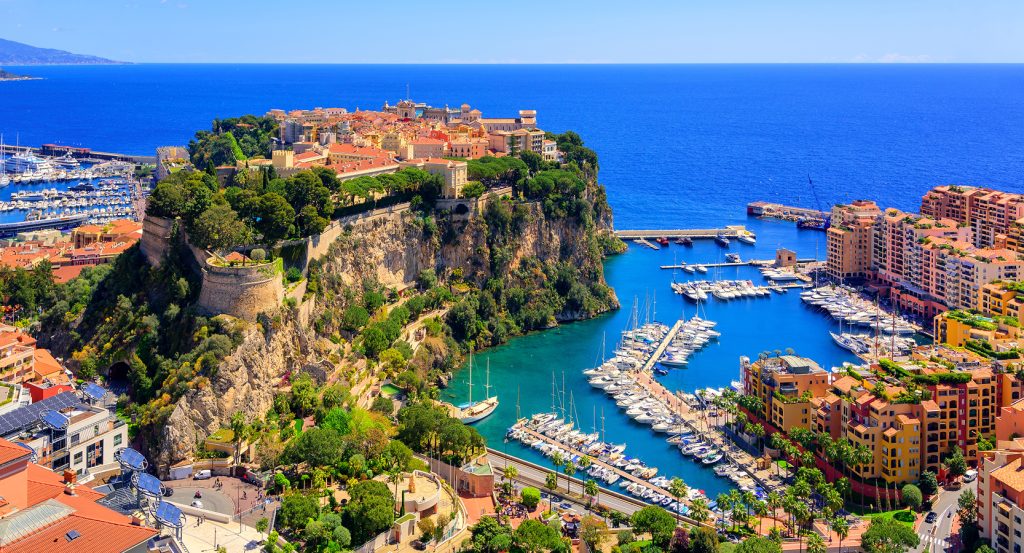
Stretching along Monaco's eastern shoreline beneath Avenue Princesse Grace, the beach occupies a sheltered coastal position between the Grimaldi Forum and the waterfront approaching Monte-Carlo Bay Hotel & Resort. Its 400-meter shoreline consists of pale sand and fine gravel arranged in gently curving sections, with offshore breakwaters creating protected swimming areas along the Mediterranean. A broad pedestrian promenade follows the beach, incorporating shaded terraces, landscaped planting, contemporary retail façades and a continuous architectural canopy that connects the waterfront's principal public spaces. Glass elevators, broad staircases and accessible pathways link the upper esplanade to the beach, establishing a vertical circulation system adapted to Monaco's steep coastal terrain. The result is a carefully engineered public waterfront whose protected swimming areas, landscaped promenades and contemporary architectural infrastructure provide Monaco with its principal accessible Mediterranean beach.
What defines Larvotto Beach.
Larvotto Beach is best known for developing from a narrow natural shoreline into Monaco's principal public seaside destination through successive engineering projects that transformed the eastern coast during the twentieth and twenty-first centuries. Its early history belongs to the Bas Moulins district, where the coastline consisted of rocky slopes, narrow beaches and scattered coastal facilities beneath the elevated route connecting Monte-Carlo with the French frontier. The district acquired an important place in the early development of aviation when French pilot Henri Fabre conducted pioneering hydroplane experiments along the surrounding Mediterranean coast. During the early twentieth century, Larvotto developed modest bathing facilities serving residents and visitors seeking direct access to the sea. A substantial retaining wall constructed during the 1930s separated the beach facilities from Boulevard des Bas Moulins, establishing an early engineered boundary between the waterfront and the increasingly developed urban district above. The shoreline retained its predominantly pebbled character through the 1950s, preserving a coastal environment substantially different from the reconstructed beach that subsequently emerged. Prince Rainier III initiated a major transformation in 1961 through a land-reclamation program extending 54,000 square meters into the Mediterranean. The project formed part of the sovereign's broader effort to expand Monaco's developable territory, addressing the geographical limitations imposed by the principality's steep terrain and surrounding French territory. Construction continued until 1963, establishing new coastal land capable of accommodating roads, residential development and public facilities. The extension also contributed to the transformation of the surrounding neighborhood into a prestigious residential district associated with the expanding luxury economy of Monte-Carlo. Property developer Gildo Pastor subsequently invested in residential projects along the newly developed coastal corridor, contributing to the concentration of apartment buildings overlooking the waterfront. In 1965, a further engineering program reconstructed the beach itself, replacing much of its original pebble surface with imported sand and introducing protective breakwaters. These structures moderated wave energy within the swimming areas, creating more favorable conditions for recreational bathing and supporting the development of permanent beach facilities. The transformation established the recognizable arrangement of the modern shoreline and strengthened Larvotto's position as the principal public beach of Monaco. The following decade introduced additional hospitality investment along the eastern waterfront, including the opening of the Monte-Carlo Sporting complex in June 1974. The development strengthened the district's association with seaside entertainment, luxury recreation and international tourism. Larvotto subsequently developed a concentration of restaurants, private beach concessions and recreational facilities operating alongside its publicly accessible swimming areas. The surrounding district also became an important location for Monaco's expanding cultural infrastructure. The Grimaldi Forum opened in 2000 on reclaimed land near the western end of the beach, establishing a major convention and exhibition center whose development reinforced the relationship between waterfront engineering and the principality's international cultural economy. The increasing intensity of development eventually created substantial challenges for the beach's aging infrastructure, including deteriorating public facilities, limited pedestrian connections and exposure to Mediterranean storms. Monaco's government began developing a comprehensive regeneration program intended to modernize the waterfront and strengthen its connection to the neighboring urban districts. The project acquired additional significance through its relationship with Mareterra, the major offshore extension planned immediately west of Larvotto. Renzo Piano Building Workshop assumed architectural responsibility for the reconstruction, introducing a contemporary design intended to integrate the beach with the expanding network of public spaces along Monaco's eastern coastline. Architect Emmanuel Deverini collaborated on the project, contributing to the technical and architectural development of the new seaside complex. Landscape architect Michel Desvigne developed the planting and public-space strategy, establishing a coordinated relationship between the upper promenade, beach-level circulation and surrounding coastal vegetation. The reconstruction covered 20,000 square meters of built facilities, with an estimated construction cost of €60 million before tax. Work began in 2019, introducing a substantial redevelopment of the promenade, commercial premises and supporting infrastructure. The project incorporated new offshore wave-protection structures positioned between existing breakwaters, improving coastal resilience and reducing the impact of storms on the reconstructed beach. Environmental planning also addressed the nearby Posidonia oceanica seagrass meadows, whose ecological importance required careful management of construction activities and marine infrastructure. The redevelopment introduced a new thalassothermal energy system designed to extract usable heating and cooling energy from seawater, supporting the environmental performance of the surrounding district. Additional measures included photovoltaic installations, energy-efficient lighting and improved water-management systems. The reconstructed promenade incorporated more than 130 newly planted trees, creating shaded public spaces and strengthening the relationship between the waterfront and Monaco's broader landscape network. The project also introduced a dedicated cycling route, improved pedestrian access and expanded recreational facilities. Prince Albert II inaugurated the reconstructed beach on July 3, 2021, accompanied by Minister of State Pierre Dartout and representatives of the princely government. The reopening followed twenty-two months of restricted public access during construction, restoring the principal recreational beach to residents and visitors. The completed complex introduced 14,000 square meters of public beach and promenade space, with additional commercial facilities supporting year-round activity. Its architectural program subsequently became part of the continuous waterfront redevelopment extending toward Mareterra, whose public spaces opened in December 2024. Larvotto's historical importance emerges from this sustained transformation of Monaco's natural shoreline through land reclamation, coastal engineering, public recreation and environmentally conscious urban development.
How Larvotto Beach fits.
Larvotto Beach works as the central destination for an exploration connecting Monaco's contemporary cultural infrastructure, the ecological landscaping of its newest waterfront district and the architectural transformation of the principality's eastern coastline.
Begin at Grimaldi Forum Monaco, the expansive convention and cultural center occupying reclaimed coastal land near the western end of Larvotto. The complex opened in 2000 and was designed by architects Fabrice Notari and Fred Génin, establishing a substantial contemporary institution dedicated to international conferences, exhibitions and performing arts. Its architectural composition incorporates extensive glass façades, substantial underground exhibition halls and a prominent coastal position overlooking the Mediterranean. The building's principal facilities include the Salle des Princes auditorium, whose capacity exceeds 1,800 spectators, supporting concerts, theatrical performances and major international events. The institution also hosts the annual summer exhibition program, which has presented substantial collections associated with major artists, historical periods and international cultural institutions. Continue to Mareterra, the contemporary waterfront district created through one of Monaco's most ambitious land-reclamation projects. Officially inaugurated on December 4, 2024, the development added six hectares to the principality through a major offshore engineering program incorporating eighteen massive concrete caissons. The project involved an investment of €2 billion and introduced luxury residences, landscaped public spaces and a new coastal promenade. Renzo Piano Building Workshop contributed to the district's architectural development, including the distinctive Le Renzo residential building overlooking the Mediterranean. Landscape architect Michel Desvigne developed extensive planting arrangements incorporating Mediterranean trees, shrubs and coastal vegetation, establishing a substantial green component within the newly constructed urban district. The development's public spaces include La Pinède, La Vallée and the Promenade Prince Jacques, creating a continuous pedestrian connection along the reconstructed shoreline. Conclude at Japanese Garden, the landscaped public garden developed under Prince Rainier III as a tribute to Princess Grace. Designed by Japanese landscape architect Yasuo Beppu, the garden opened in 1994 and introduced a traditional Japanese landscape composition within Monaco's coastal urban environment. Its 7,000-square-meter site incorporates a pond, waterfall, stone lanterns, wooden bridges and carefully maintained vegetation arranged according to Japanese garden-design principles. The landscape includes a traditional tea house and carefully positioned rocks, establishing a contemplative environment whose composition draws on the symbolic relationship between water, stone and cultivated vegetation. The garden's development involved consultation with Japanese specialists and a Shinto blessing ceremony, strengthening its connection to the cultural traditions underlying its design. The progression moves from Grimaldi Forum Monaco's contemporary cultural architecture through Mareterra's reclaimed coastal landscape and culminates in Japanese Garden's carefully composed horticultural environment, connecting the architectural, environmental and cultural development of Monaco's eastern waterfront.
Where your story begins.
Foresyte Travel reveals places that feel extraordinary long before you arrive.
Enjoy editorial crafted for luxury travelers.