
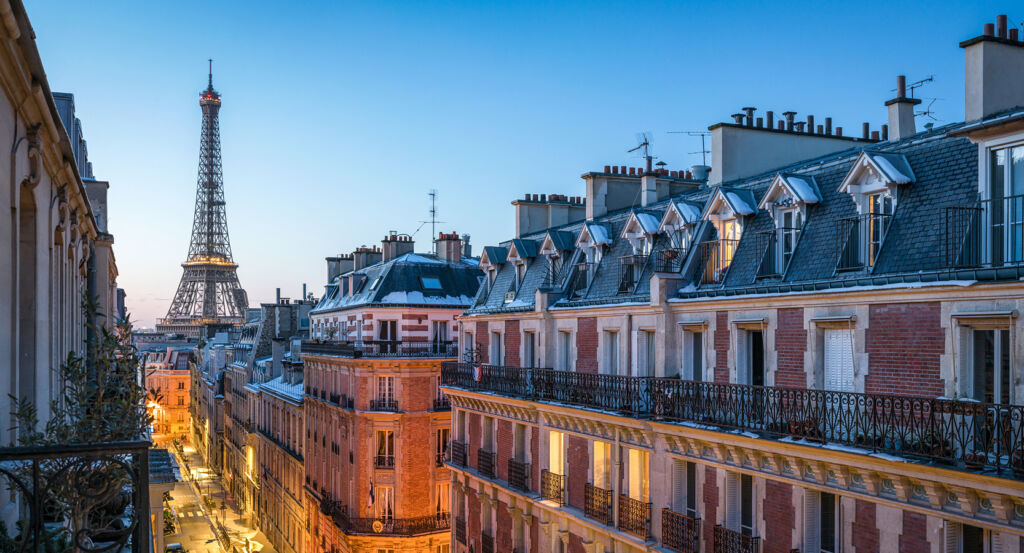
Why you should experience LAZ' Hôtel Spa Urbain in Paris, France.
LAZ' Hôtel Spa Urbain is a design-driven boutique hotel where Saint-Georges's Haussmannian character, South Pigalle creativity, industrial aesthetics and contemporary wellness culture converge inside a 56-room urban house conceived by interior architect Stéphanie Cayet.
Set along Rue de Milan near Rue de Clichy and just steps from Gare Saint-Lazare, the four-star hotel opened in September 2017 following 24 months of work that transformed 2,215 square meters across seven levels into guestrooms, social spaces and a substantial subterranean spa. Cayet drew directly from the surrounding railway district when developing the industrial-bohemian interiors, combining natural parquet, old brick, black-framed workshop glazing, mismatched furniture, patterned textiles and art photography while preserving the warmth of a residential loft. Selected rooms introduce planted balconies and terraces, while the 33-square-meter Loft Terrasse Vue Sacré-Coeur crowns the accommodation program with a king bed and direct perspective toward Montmartre. The result is a hotel where Saint-Lazare's metropolitan movement, South Pigalle's creative culture and Cayet's material style create a distinctive contemporary interpretation of the 9th Arrondissement.
What you should know about LAZ' Hôtel Spa Urbain.
LAZ' Hôtel Spa Urbain is best known for opening in September 2017 after a 24-month construction program developed by Suitcase Hospitality with HB Architectes Associés, Legendre Île-de-France and interior architect Stéphanie Cayet, creating a 2,215-square-meter four-star hotel containing 56 rooms across seven levels at 17 Rue de Milan. Suitcase Hospitality conceived LAZ' as the young French hotel group's second property after its first opening near La Défense in 2015, positioning the project inside the Saint-Lazare, Pigalle and Opéra triangle and building its program around accommodation, a cocktail bar, breakfast area, seminar salon, coworking space and wellness facilities. Stéphanie Cayet translated the railway-adjacent setting into an urban industrial language using natural wood parquet, painted brick, workshop-style glazing, mismatched furniture and bohemian fabrics, while ORSOL's Brique Black facing became part of the material composition Cayet described as authentic and connected to the constant movement surrounding Gare Saint-Lazare. The 56-room inventory now ranges from 15-to-18-square-meter Cosy rooms through 18-to-24-square-meter Executive rooms and 30-square-meter communicating Family accommodation to the 33-square-meter Loft Terrasse Vue Sacré-Coeur, with selected categories incorporating private planted balconies or terraces. Beneath those seven levels, the wellness program combines an indoor swimming pool, sauna, fitness room and treatment cabin, establishing spa culture as a structural component of the original 2017 concept.
Stéphanie Cayet extends the industrial language established upstairs into the spa through sand-toned mosaics and Mediterranean references that deliberately shift the atmosphere from Saint-Lazare toward the Balearic Islands while maintaining the material emphasis defining her wider interior scheme. CODAGE Paris deepens that wellness program through facial and body treatments grounded in the French cosmetics house's pharmaceutical-influenced approach to active ingredients and individualized formulations, while the indoor pool is maintained at 31°C and currently operates alongside the sauna and fitness room from 8 a.m. to 10 p.m. Suitcase Hospitality carries Cayet's social premise into the ground floor through the cocktail bar, planted patio terrace and naturally illuminated private salon, connecting the hotel's residential loft style with spaces designed for drinking, working and private gatherings. Together, Stéphanie Cayet, CODAGE Paris and Suitcase Hospitality sustain a coherent design narrative in which industrial materials, Balearic spa references, French cosmetology and flexible social spaces develop the original 2017 vision across the full 2,215-square-meter property.
How to fold LAZ' Hôtel Spa Urbain into your trip.
LAZ' Hôtel Spa Urbain works as the anchor for an afternoon tracing Romantic painting, artists' houses and nineteenth-century creative society through Nouvelle Athènes and Plaine Monceau.
Begin at Musée de la Vie Romantique, where Ary Scheffer moved into an Italianate pavilion on Rue Chaptal in July 1830 and established two north-facing studios that became gathering places for Eugène Delacroix, Frédéric Chopin, Franz Liszt, George Sand, Charles Dickens, Gioachino Rossini and Pauline Viardot during his celebrated Friday salons. Continue to Musée Gustave Moreau, where the Symbolist painter transformed his family home into the institution intended to preserve his artistic legacy, creating an unusually direct encounter between a nineteenth-century artist's domestic world and the works assembled around it. Conclude at Musée national Jean-Jacques Henner, occupying the mansion painter Guillaume Dubufe purchased as his home and studio in 1878 before Marie Henner acquired it from his heirs in 1921, commissioned Marcel Legendre to convert the residence and opened the museum in 1924, with more than 2,200 works now preserved in the collection. The progression moves from Scheffer's Romantic salon through Moreau's self-authored artistic environment into Dubufe and Henner's Plaine Monceau residence, creating a concentrated study of the painters, studios and private houses that shaped the cultural territory surrounding LAZ' Hôtel Spa Urbain.
Where your story begins.
Foresyte Travel reveals places that feel extraordinary long before you arrive.
Experience premium editorial crafted for luxury travelers.














































































































