
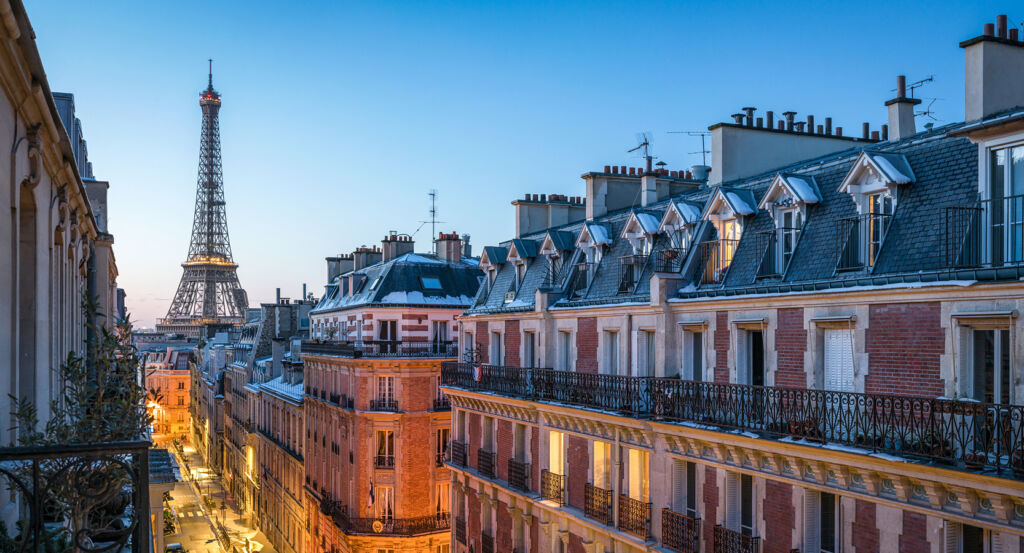
Why Le Marais matters.
Le Marais is a richly preserved enclave where medieval Right Bank geography meets aristocratic Paris through narrow inherited streets, secluded courtyards and an exceptional concentration of townhouses created as royal and noble life shifted eastward across the city.
Positioned between République, Bastille, and Hôtel de Ville, the neighborhood occupies a broad central pocket where Rue Vieille-du-Temple, Rue des Francs-Bourgeois and Rue des Archives cross a street network developed across former agricultural and religious estates. Narrow frontages repeatedly open into deep parcels containing paved courts, gardens and freestanding residences, allowing substantial domestic architecture to remain concealed behind comparatively restrained street facades. Rue Vieille-du-Temple establishes the primary encounter through a north-south route connecting successive layers of medieval, Renaissance and seventeenth-century construction across the quarter. Rue des Francs-Bourgeois deepens the physical character through an east-west sequence of historic houses whose gateways, courtyards and garden walls expose the extraordinary depth of properties created for noble households. Smaller streets around Rue des Barres, Rue du Figuier and Rue des Rosiers preserve another scale through irregular alignments and compact buildings inherited from older religious, mercantile and residential occupation. The result is a neighborhood where medieval street structure and aristocratic domestic architecture survive within the same dense urban fabric, preparing a history shaped by royal residence, speculative development and successive generations of Parisian patronage.
What defines Le Marais.
Le Marais is best known for becoming Paris's great concentration of hôtels particuliers after royal residence and seventeenth-century development drew aristocratic households into territory once dominated by religious holdings, cultivated ground and the communities surrounding the Temple. Construction of the Charles V wall between 1356 and 1383 brought much of the area inside the expanded city, and Charles V established the Hôtel Saint-Pol as a royal residence there. Noble households followed the court eastward, beginning a relationship between political proximity and private architecture that persisted long after the medieval palace disappeared. Henri II's death at the Hôtel des Tournelles in 1559 ended another royal chapter when Catherine de Médicis secured the residence's demolition, leaving a large tract available for redevelopment. Henri IV revived the territory in 1605 through the Place Royale, opening Rue de Birague as its principal approach and initiating a coordinated residential project whose brick-and-stone architecture gave the eastern Marais a powerful new center. Aristocratic construction accelerated around it, producing houses such as Hôtel de Saint-Aignan in 1650, Hôtel de Beauvais in 1657 and Hôtel Salé in 1659. The Hôtel de Guise supplied another major focus before François de Rohan-Soubise and Anne Chabot acquired it in 1700 and commissioned Pierre Alexis Delamair to recast the property, followed by Germain Boffrand's eighteenth-century interiors. These successive projects turned land shaped by royal residence into a district where architecture communicated proximity to court, lineage and wealth through courtyards, ceremonial entrances and private gardens.
A different chapter emerged as aristocratic households migrated west and former residences absorbed commercial, industrial and residential uses during the eighteenth and nineteenth centuries. Workshops occupied courtyards built for noble households, subdivided apartments entered former palaces and additions accumulated inside properties whose original spatial organization became progressively harder to discern. Hôtel Donon captures that change with unusual clarity: Médéric de Donon built the residence after acquiring its site in 1575, the Le Mairat family controlled it from 1640 to 1798, and later generations converted parts of the house to commercial purposes. Eugène Atget photographed the architectural additions that had altered the property by the early twentieth century, preserving evidence of the Marais before large-scale conservation changed its trajectory. The City of Paris acquired Hôtel Donon in 1974 and restored it before the Musée Cognacq-Jay moved there in 1990. That intervention belonged to a wider revaluation of a district whose old houses had survived precisely through centuries of adaptation. The Marais entered the modern era carrying an unusually complete range of domestic architecture, from sixteenth-century experiments in courtyard planning to seventeenth-century aristocratic residences and buildings transformed by later commerce.
How Le Marais fits.
Le Marais works as the anchor for a daytime exploration connecting a seventeenth-century ministerial residence, an eighteenth-century collection assembled by department-store founders and the Paris apartment where Victor Hugo spent sixteen years at the height of his literary career.
Begin at Hôtel de Sully, constructed from 1625 beside the newly established Place Royale and organized as a residence between court and garden, with sculptural decoration and an architectural scale suited to the elite residential district taking shape around Henri IV's square. Maximilien de Béthune, duc de Sully and former minister to Henri IV, acquired the property in 1634, linking the house directly to the statesman who had supervised the Place Royale project; the Sully family retained it into the eighteenth century, and the French state began restoration after acquiring the property in the twentieth century before establishing the Centre des monuments nationaux there in 1967. Continue to Musée Cognacq-Jay inside Hôtel Donon, where the architectural history of a sixteenth-century residence intersects with the collection Ernest Cognacq and Marie-Louise Jay assembled from eighteenth-century painting, sculpture, furniture, porcelain and decorative arts. Cognacq began exhibiting his collection at Samaritaine de Luxe in 1925, acquired eighteenth-century woodwork for a projected museum in 1927 and died the following year; the City of Paris received the collection through his bequest, opened the first museum in 1929 and transferred it to the restored Hôtel Donon in 1990, placing works by Boucher, Fragonard, Chardin, Greuze and Canaletto inside a house built four centuries earlier. Conclude at Maison de Victor Hugo on Place des Vosges, where Hugo occupied a second-floor apartment in the Hôtel de Rohan-Guéménée from 1832 until 1848, years spanning Ruy Blas, Les Voix intérieures and Les Rayons et les Ombres alongside the beginnings of works that developed into Les Misérables and Les Contemplations. Paul Meurice proposed a museum there in 1901 ahead of Hugo's centenary, assembled his own collection with material acquired from Juliette Drouet's estate and donated it to the City of Paris in 1902; the museum opened on June 30, 1903, transforming the writer's former residence into a permanent institution devoted to his life, art and literature. The progression moves from Sully's connection to the political patronage behind the Place Royale through Cognacq and Jay's private collecting into Meurice's preservation of Hugo's literary world, tracing how private residence, cultural patronage and commemoration repeatedly gave the Marais new public institutions.
Where your story begins.
Foresyte Travel reveals places that feel extraordinary long before you arrive.
Enjoy editorial crafted for luxury travelers.
Foresyte may earn a commission when you book.














































































































