
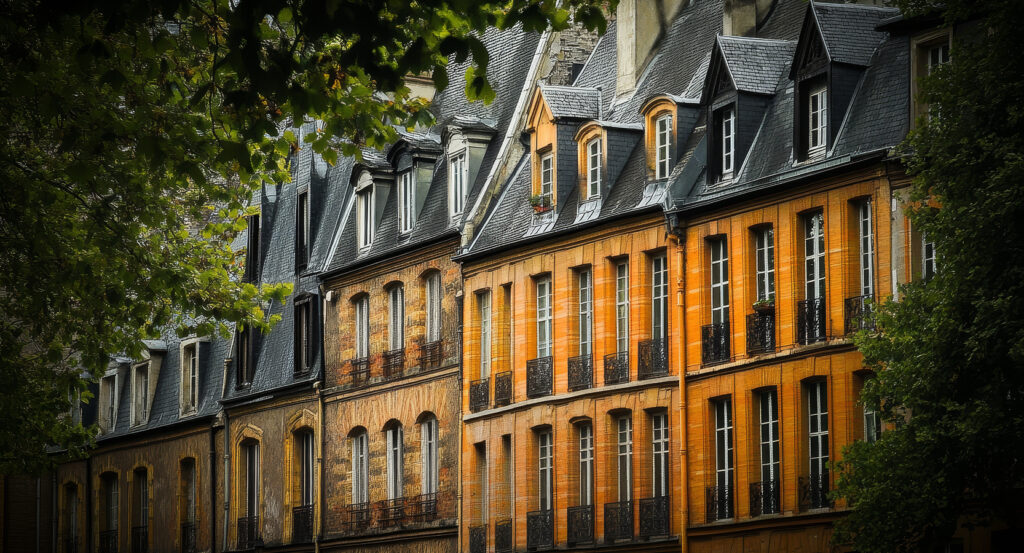
Why Place des Vosges matters.
Place des Vosges is a regal historic square where the Marais's aristocratic character meets Henri IV's revolutionary experiment in coordinated urban design, continuous arcades and an enclosed garden framed by thirty-six early seventeenth-century pavilions.
Set along Rue des Francs-Bourgeois near Rue de Turenne and just steps from Rue de Birague, the square occupies a near-perfect enclosure where red-brick and pale-stone facades, steep slate roofs, vaulted arcades and mature trees create a strikingly self-contained precinct within the irregular streets of the Marais. Thirty-six coordinated pavilions establish an almost continuous perimeter, broken by the taller Pavillon du Roi to the south and Pavillon de la Reine to the north. Covered galleries run beneath the residential fronts as four lawns and rows of trees organize Square Louis XIII around the equestrian royal statue at its center. Narrow passages through the surrounding buildings heighten the contrast between the confined streets outside and the expansive geometry revealed upon entering the square. The result is an exceptionally coherent Parisian enclosure where architecture, landscape and controlled approaches preserve the spatial ambitions of an early Bourbon rebuilding project.
What defines Place des Vosges.
Place des Vosges is best known for establishing a new model of coordinated urban space in Paris after Henri IV ordered the redevelopment of ground formerly occupied by the Hôtel des Tournelles. Henri II had suffered the fatal jousting wound that led to his death in 1559 near the royal residence, and Catherine de Médicis subsequently ordered the complex demolished, leaving territory later occupied by a horse market and military exercises. Henri IV initially pursued silk production there, seeking to establish workshops and attract skilled textile workers to France. Letters patent issued in July 1605 expanded the undertaking into the Place Royale, specifying a square of seventy-two toises per side and requiring surrounding proprietors to build coordinated brick-and-stone fronts above arcaded galleries. The royal instructions joined economic policy with public-space design: shops occupied the arcades, dwellings rose above them and the central ground supplied Paris with room for promenades and large public gatherings. Private investors received surrounding parcels under strict facade requirements, producing individual residences behind a unified architectural perimeter. Construction generated thirty-six pavilions around a square close to 140 meters per side, with the taller Pavillon du Roi and Pavillon de la Reine controlling the southern and northern axes. Rue de Birague was opened in 1605 as the principal approach from Rue Saint-Antoine, passing beneath the Pavillon du Roi built between 1605 and 1608. Henri IV was assassinated in 1610 before completion, leaving the Place Royale to be inaugurated in 1612 during festivities associated with the marriages of Louis XIII to Anne of Austria and Elisabeth of France to the future Philip IV of Spain. The square established a powerful precedent for royal urban composition in Paris by making uniform architecture, private development and a formally bounded public ground components of one coordinated project.
The center changed repeatedly as royal ceremony gave way to garden design, Revolution and nineteenth-century reconstruction. Open ground originally supported cavalcades, tournaments and ceremonial events before a fenced garden was introduced in 1682 and linden trees followed during the eighteenth century. Cardinal Richelieu commissioned Pierre II Biard's bronze equestrian statue of Louis XIII for the center in 1639, fixing royal sculpture within the space first developed under the king's father. Revolutionary authorities melted that bronze for cannon in 1792 as the Place Royale passed through new names associated with the political rupture. The designation Place des Vosges arrived under the Consulate in recognition of the Vosges department's early payment of taxes to the new government, though monarchical restorations temporarily returned the Place Royale name during the nineteenth century. Charles Dupaty prepared the model for a replacement Louis XIII monument after the Bourbon Restoration, and Jean-Pierre Cortot executed the marble equestrian sculpture. Cortot portrayed the king in Roman imperial dress without stirrups, a structural choice requiring a carved tree trunk beneath the horse for support. The statue was erected on November 4, 1829 and joined by four fountains, restoring a royal centerpiece decades after destruction of Biard's bronze. Place des Vosges preserves political change within its central ground as successive governments altered its name, sculpture and landscape without dismantling the architectural enclosure established under Henri IV.
How Place des Vosges fits.
Place des Vosges works as the anchor for a daytime exploration through the Marais using three nearby sites that move from a seventeenth-century private residence through one of Paris's oldest municipal museums into a late medieval archiepiscopal palace.
Begin at Hôtel de Sully, constructed from 1625 near the former Place Royale as a private residence arranged between courtyard and garden. Maximilien de Béthune, Duke of Sully and Henri IV's former minister, purchased the property in 1634, connecting the house with the political circle behind the district's earlier development. Sculpted female figures representing the seasons ornament the main residence, and the orangerie closes the garden through five central arcades flanked by steep-roofed pavilions. State acquisition in 1944 initiated a long restoration campaign, followed in 1967 by the installation of the institution now known as the Centre des monuments nationaux. A passage through the garden and orangerie opens directly into Place des Vosges, preserving a physical connection between the private residence and the neighboring royal square. Continue to Musée Carnavalet, housed in a Renaissance residence constructed between 1548 and 1560 for Jacques des Ligneris, president of the Parlement de Paris. François Mansart raised the Rue de Sévigné entrance and added two wings from 1660, and Madame de Sévigné occupied the house from 1677 into the 1690s. The City of Paris acquired the property in 1866 during Haussmann's reconstruction of the capital and opened its historical museum there in 1880. Later extensions incorporated architectural fragments rescued from demolished Parisian buildings, including the sixteenth-century Arc de Nazareth and seventeenth-century Pavillon des Drapiers, turning the complex itself into a repository of disappearing city fabric. Conclude at Hôtel de Sens, constructed between 1475 and 1519 for Tristan de Salazar as the Paris residence of the archbishops of Sens. Turrets, steep roofs and a fortified entrance preserve the late medieval character of a building created when the archbishopric of Sens held ecclesiastical authority over Paris. Marguerite de Valois lived there in 1605 and 1606 after annulment of her marriage to Henri IV, placing the residence within the same Bourbon-era Paris that soon produced the Place Royale. Later commercial uses included a coaching operation and jam factory before restoration recovered the building for the Bibliothèque Forney, which has occupied it since 1961. The progression moves from Sully's seventeenth-century residence through the Renaissance architecture and salvaged Parisian fragments of Carnavalet into Tristan de Salazar's late medieval archiepiscopal palace, carrying the surrounding Marais backward through three forms of elite residence and their later conversion into public institutions.
Where your story begins.
Foresyte Travel reveals places that feel extraordinary long before you arrive.
Enjoy editorial crafted for luxury travelers.
Foresyte may earn a commission when you book.














































































































