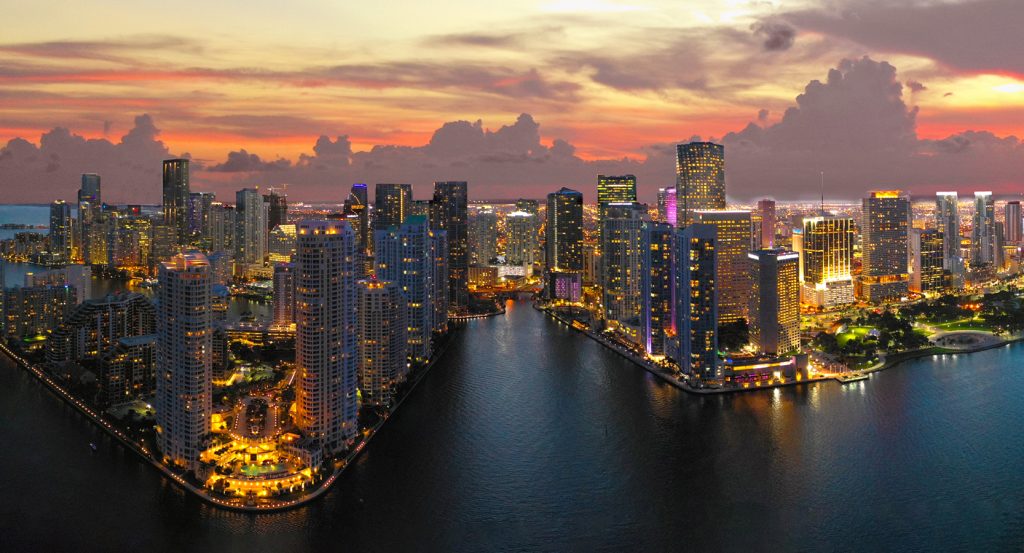
Why you should experience Liberty Avenue in Miami, Florida.
Liberty Avenue is a welcoming corridor where Mid-Beach's residential charm, architectural heritage, tropical landscape, and neighborhood character continue defining one of Miami Beach's most inviting inland streets.
Running through Mid-Beach between Bayshore and Nautilus, the corridor connects architect-designed apartment buildings, historic residences, neighborhood institutions, shaded sidewalks, and mature tropical landscaping that collectively reflect Miami Beach's evolution beyond its celebrated oceanfront. Mediterranean Revival apartments, Mid-Century Modern residences, broad parkways, and flourishing royal palms create a streetscape where architectural continuity and everyday community life remain closely intertwined. Throughout the corridor, thoughtfully preserved buildings, established civic institutions, and carefully maintained public landscapes reinforce a setting whose character has matured through decades of steady stewardship. The result is an experience defined by tranquility, architectural richness, and one of Mid-Beach's most distinctive neighborhood corridors.
What you should know about Liberty Avenue.
Liberty Avenue is best known for serving the residential districts that expanded west of Collins Avenue as Miami Beach experienced sustained growth following Carl G. Fisher's ambitious development campaigns during the 1910s and 1920s. Construction surrounding the corridor accelerated through the Florida Land Boom and continued after World War II, producing an architectural collection that includes Mediterranean Revival apartment houses, Art Deco residences, Streamline Moderne buildings, and Mid-Century Modern homes documenting successive phases of the city's residential evolution. Architects including Henry Hohauser, L. Murray Dixon, Igor Polevitzky, and Russell Pancoast influenced the surrounding built environment through curved façades, horizontal massing, glass block, terrazzo detailing, shaded balconies, and tropical site planning that became hallmarks of Miami Beach design. The nearby Collins Canal, completed in 1912, improved drainage and navigation across the barrier island while encouraging organized residential development throughout the neighborhoods adjoining Liberty Avenue. Royal palms, live oaks, gumbo limbo, sea grape, silver buttonwood, and flowering tropical understory plantings continue reinforcing the lush subtropical landscape that distinguishes the corridor from denser commercial districts.
Temple Beth Sholom, completed in 1957 and designed by architect Percival Goodman, introduced one of South Florida's finest examples of Modernist synagogue architecture while reflecting the postwar cultural growth that reshaped Mid-Beach. The Miami Beach Historic Preservation Board continues protecting contributing structures surrounding the corridor through local designation and architectural review, helping preserve the integrity of neighborhoods developed during the first half of the twentieth century. Oolitic limestone, decorative cast stone, terrazzo entrance courts, steel casement windows, and hand-forged wrought iron incorporated throughout neighboring historic properties demonstrate the craftsmanship and regional materials that continue defining this section of Miami Beach. Together, these cultural institutions, preservation efforts, and enduring architectural materials deepen the historical narrative established by Liberty Avenue's streetscape, demonstrating why the corridor remains an important expression of Mid-Beach's residential heritage.
How to fold Liberty Avenue into your trip.
Liberty Avenue works as a relaxed exploration of Mid-Beach's architecture, green spaces, and coastal atmosphere.
Begin at Pinetree Park, where mature shade trees, neighborhood gathering spaces, and a peaceful residential setting introduce the quieter character of Mid-Beach before following Liberty Avenue through its architecturally rich surroundings. Continue to Miami Beach Golf Club, whose beautifully landscaped fairways, historic origins, and carefully preserved grounds broaden the appreciation for the recreational landscapes that helped shape this part of the city. Conclude at Indian Beach Park, where native dune vegetation, broad Atlantic views, and a quieter stretch of shoreline provide the resonant payoff by revealing the natural coastal beauty that has always defined Mid-Beach beyond its celebrated architecture. The progression moves naturally from neighborhood green space through one of Miami Beach's historic recreational landscapes before concluding beside the Atlantic Ocean, revealing how Liberty Avenue gracefully connects residential heritage with the coastal environment that shaped its enduring identity.
Where your story begins.
Foresyte Travel reveals places that feel extraordinary long before you arrive.
Experience premium editorial crafted for luxury travelers.