
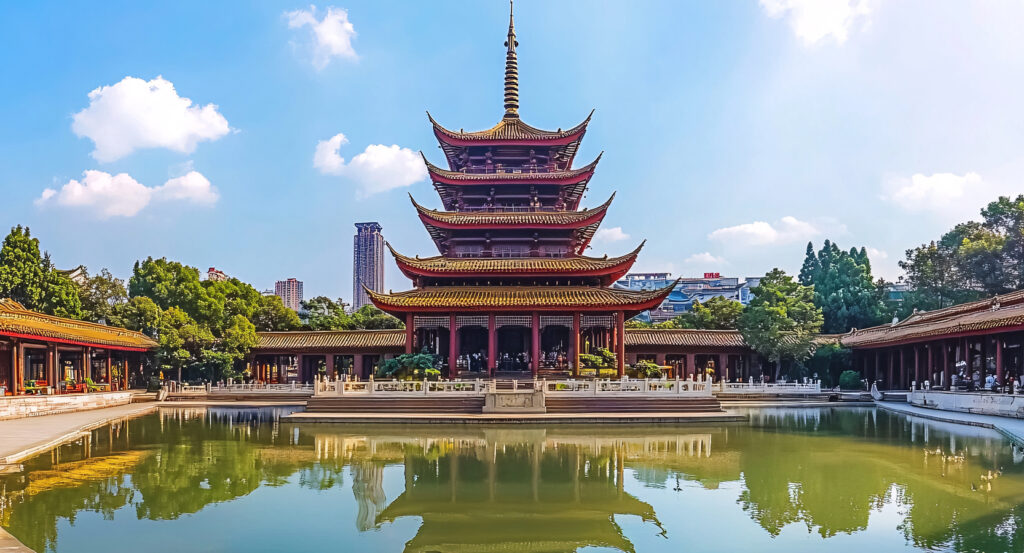
Why Longhua Pagoda matters.
Longhua Pagoda in Shanghai rises from the heart of Longhua Temple like a prayer turned to stone, delicate, balanced, and utterly timeless.
Its seven tiers of brick and wood seem to float upward in perfect proportion, their curved eaves tracing soft arcs against the Shanghai sky. When the wind moves through the surrounding courtyard, you can hear the faint rattle of its bronze bells, each note a whisper from another century. Built first in the Song dynasty (977 CE), the pagoda is Shanghai's oldest surviving architectural landmark, a rare fragment of the city's spiritual DNA. To see it in person is to watch centuries of faith stacked skyward, each level narrower, lighter, closer to the divine. Morning sunlight turns its bricks golden; evening brings the scent of incense drifting upward through its tiers. The pagoda isn't open to climb, yet it doesn't need to be, its beauty lies in the act of looking upward, in remembering that stillness can exist even in a skyline built on motion.
What defines Longhua Pagoda.
Longhua Pagoda stands over 40 meters tall and remains the most complete example of a Song dynasty octagonal tower in eastern China.
Its core is brick, but its balconies, railings, and spire are all carved from camphor wood, joined without a single nail, a structural system perfected through balance rather than force. The pagoda has been rebuilt or restored multiple times, surviving earthquakes, fires, and revolutions, yet it has always returned to its original design, a living symbol of Shanghai's resilience. The structure's alignment with the temple's main axis reflects both Buddhist cosmology and Tang-era urban geometry, where symmetry mirrored enlightenment. Archaeological studies suggest that a reliquary chamber once lay sealed beneath the foundation, containing crystal beads and fragments of scripture meant to sanctify the site. During the Ming and Qing dynasties, the pagoda served as both a religious monument and a navigation point for travelers along the Huangpu River, its upper tiers visible for miles through the old city's haze. The bells hanging from its eaves are tuned in pentatonic intervals to harmonize with the temple's bronze bell, creating an acoustic link between heaven and earth when they ring together. Each restoration, most recently in 1984, has followed ancient craftsmanship methods, wooden joinery, clay tile firing, and natural pigment finishes, ensuring that what you see today is not a replica but a continuation of the original vision.
How Longhua Pagoda fits.
Longhua Pagoda is best approached as a quiet moment within your visit to Longhua Temple, the axis where time, architecture, and faith converge.
Arrive in the early morning (8:30 a.m.) to catch the sunlight striking its eastern face, when shadows carve its form into high relief. Enter through the temple's southern gate, move through the courtyards in silence, and let the pagoda reveal itself gradually through the layers of halls, a journey mirroring spiritual ascent. Stand by the lotus pond to the east for the best reflection, where the pagoda's silhouette shimmers perfectly in the water. If you visit during spring, the cherry blossoms that encircle its base add a soft counterpoint to its solemn geometry. Allocate 30 minutes here, enough time to circle the pagoda slowly, noticing the fine grain of its wood and the rhythmic spacing of its balconies. Before leaving, pause beneath the lowest eave and listen, if the wind is right, the bells will chime one after another, a soft cascade of tones that seem to ripple straight through time. Then step back, look up, and let the sight of Shanghai's oldest tower remind you that true endurance doesn't roar; it rings.
Where your story begins.
Foresyte Travel reveals places that feel extraordinary long before you arrive.
Enjoy editorial crafted for luxury travelers.
Foresyte may earn a commission when you book.

















































































































