
Why Longhua Temple matters.
Longhua Temple in Shanghai is the city's oldest and most serene sanctuary, a place where centuries of devotion, incense, and quiet reflection linger in the air like a sacred rhythm.
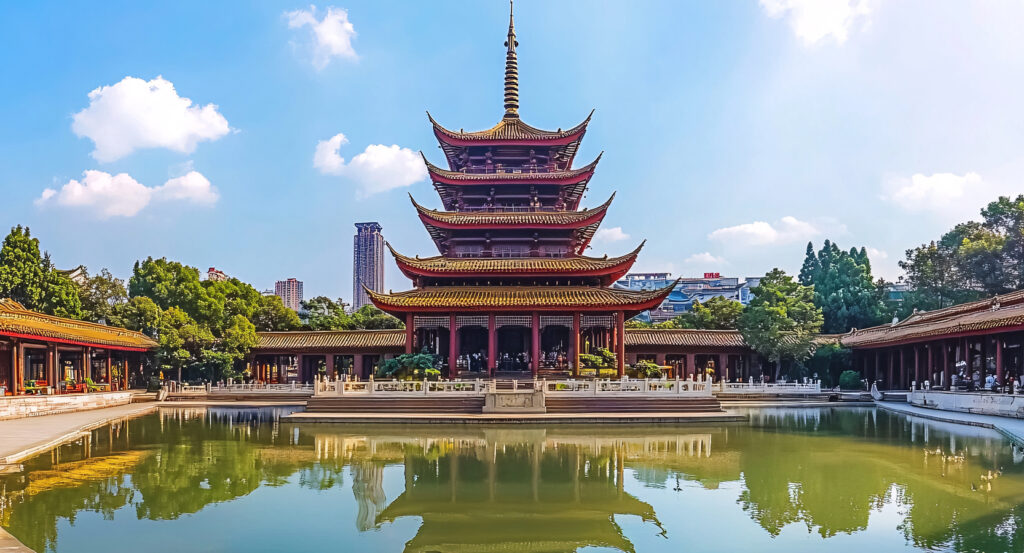
Standing in the southern part of the city, this ancient Buddhist temple is believed to date back to 242 AD, making it not only the oldest but also one of the most beautifully preserved temples in Shanghai. The moment you enter, the city's modern noise fades into the sound of temple bells and rustling prayer flags. Longhua's grandeur lies not in opulence but in authenticity, its vintage bricks, wooden halls, and towering pagoda exude an unforced reverence that modern shrines rarely match. The temple is dedicated to Maitreya, the Buddha of the Future, and its architecture perfectly captures Tang Dynasty style: symmetrical, balanced, and spiritually grounded. Visitors often speak of the temple's calm as something tangible, a tranquility that wraps around you like incense smoke. The iconic Longhua Pagoda rises seven stories high, visible from afar like a beacon of the past still watching over the city's present. It's easy to see why locals come here not just to pray, but to breathe, to think, and to find stillness amid Shanghai's constant motion.
What defines Longhua Temple.
Longhua Temple's endurance is a story of devotion, both spiritual and civic, that stretches across dynasties, wars, and modernization.
Though the temple's origins trace back 1,800 years, most of what stands today dates from the Song Dynasty (960-1279), when it was rebuilt after multiple fires and invasions. Its layout follows traditional Buddhist temple symmetry: a series of five main halls aligned along a central axis, the Maitreya Hall, Heavenly Kings Hall, Mahavira Hall, Three Sages Hall, and Abbot's Hall, each serving a distinct spiritual function. The towering Longhua Pagoda beside it, made of brick and wood, is one of Shanghai's most recognizable ancient structures. While visitors are no longer allowed to climb it due to preservation efforts, its silhouette continues to define the skyline of the district. Throughout history, Longhua has been more than a religious site; it has also served as a gathering place for the city's residents during festivals, particularly the Longhua Temple Fair held every spring. The temple's 20th-century story is more complex, it survived wartime damage during the Japanese occupation and later became a symbol of resilience in a rapidly transforming city. Few know that the grounds also include the Longhua Martyrs' Cemetery, a memorial honoring those who died in revolutionary struggles, a reminder that spirituality and sacrifice often intertwine in Chinese history. Today, Longhua remains an active temple with monks residing and chanting daily, their voices creating a timeless harmony that bridges the city's ancient faith with its modern heart.
How Longhua Temple fits.
Visiting Longhua Temple offers a glimpse of Shanghai that moves at a gentler pace, one shaped by prayer, patience, and peace.
Begin your visit early in the morning, when the temple grounds are hushed except for the faint tolling of the Longhua bell. Enter through the main gate and follow the incense trail through each of the five halls, pausing to admire the statues, golden Buddhas, and intricate wood carvings that tell stories of compassion and rebirth. Watch as worshippers bow in quiet devotion, their offerings of fruit and flowers placed before flickering candles. The temple's incense burners, always smoking, lend the air a soft haze that feels almost cinematic in the golden light. Take time to sit near the Longhua Pagoda and simply observe, the way the breeze stirs the prayer flags, the way sunlight glints off the tiled rooftops. If you visit in spring, plan to coincide with the Longhua Temple Fair, when locals gather to celebrate with lanterns, crafts, and vegetarian delicacies, turning the area into a spirited yet spiritual festival of renewal. After the temple visit, stroll through the adjacent Longhua Martyrs' Cemetery for a poignant reflection on Shanghai's modern history, its manicured gardens and memorial sculptures create a meditative contrast to the temple's ancient calm.
Where your story begins.
Foresyte Travel reveals places that feel extraordinary long before you arrive.
Enjoy editorial crafted for luxury travelers.
Foresyte may earn a commission when you book.

















































































































