Why LYLA matters.
LYLA is a MICHELIN-starred Scottish fine-dining restaurant where Calton Hill's Georgian architectural heritage meets Stuart Ralston's seafood-led gastronomy, bringing exceptional produce from the Scottish Isles into an intimate tasting experience shaped by international technique and classical hospitality.
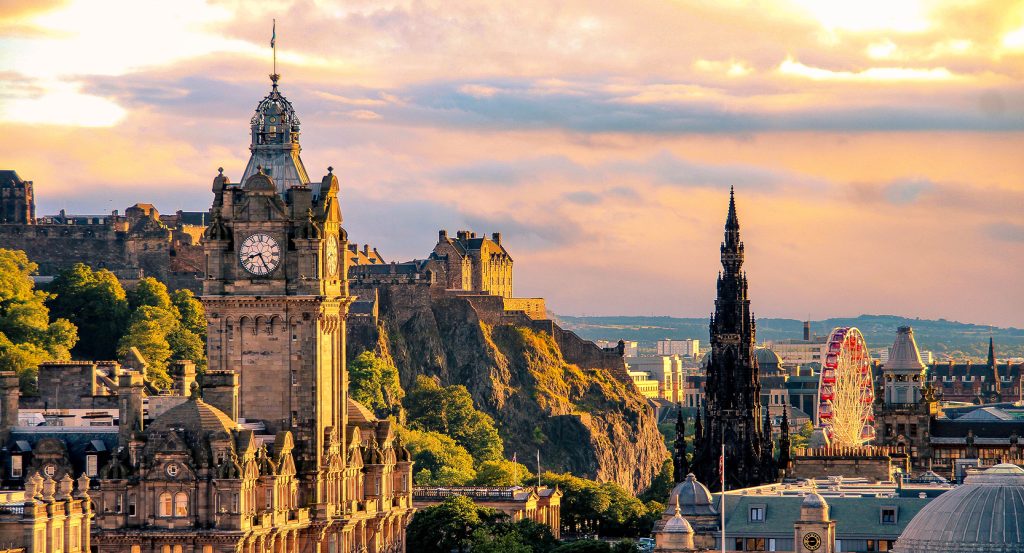
Positioned at 3 Royal Terrace on the northern slope of Calton Hill, between London Road Gardens, the eastern New Town and the historic streets descending toward Abbeyhill, the restaurant occupies a distinguished Georgian townhouse overlooking Edinburgh's northern landscape. Its classical sandstone frontage belongs to a continuous terrace of nineteenth-century residences whose elevated position affords views toward Leith and the Firth of Forth. An upstairs drawing room contains a central preparation counter, a Champagne trolley and carefully arranged seating, establishing a welcoming setting for the opening stages of dinner. The principal dining room below combines an open kitchen with restrained furnishings, soft lighting and an intimate arrangement of tables. The result is an elegant restaurant whose historic townhouse setting, carefully orchestrated interiors and commanding Royal Terrace position provide a distinctive architectural structure for contemporary Scottish gastronomy.
What defines LYLA.
LYLA is best known for Stuart Ralston's transformation of the former MICHELIN-starred 21212 into an ambitious Scottish seafood restaurant that earned its own MICHELIN star in 2025. Born in Glenrothes, Fife, Ralston developed his early career through international kitchens before establishing himself among Edinburgh's most influential independent restaurateurs. His formative experience included working with Gordon Ramsay in New York, where he encountered the demanding technical standards of high-end international restaurant kitchens. The city also gave him opportunities to work alongside David Bouley, Marcus Samuelsson, Daniel Humm, Paul Liebrandt and Jean-Georges Vongerichten, broadening his understanding of contemporary cooking. In 2009, he joined the Core Club in Manhattan before moving to Barbados as chef de cuisine at L'Acajou, the signature restaurant of the Sandy Lane resort. Returning to Scotland, Ralston established Aizle in Edinburgh in 2014, developing a restaurant centered on seasonal ingredients and a frequently changing tasting menu. He expanded his independent portfolio with Noto, which received a MICHELIN Bib Gourmand in 2021, and Tipo, an Italian-inspired restaurant that opened in March 2023 and entered the MICHELIN Guide within four months. The opportunity to create LYLA arrived through Katie O'Brien, whose late partner Paul Kitching had established 21212 as one of Edinburgh's most distinctive fine-dining destinations. Kitching had previously earned a MICHELIN star at Juniper in Altrincham before relocating to Edinburgh, where 21212 opened in 2009 and subsequently received its own star. His death in December 2022 preceded the restaurant's closure in 2023, bringing an important chapter of Scottish gastronomy to an end. O'Brien approached Ralston about taking over the premises, offering him the opportunity to develop a restaurant around his own culinary ambitions. Although he had recently opened Tipo, Ralston recognized the significance of the building and its association with Kitching, whose cooking had influenced his professional development. LYLA opened on October 18, 2023, becoming the fourth restaurant in Ralston's Edinburgh portfolio and replacing Aizle as his flagship fine-dining establishment. The intimate 28-cover format allowed him to concentrate his experience within a highly controlled tasting-menu operation, with Ralston maintaining a direct presence in the kitchen. The restaurant's early recognition included the National Restaurant Awards' Best Service Award in 2024, followed by Restaurant Newcomer of the Year at the Food and Travel Reader Awards and recognition among Britain's leading new restaurants. MICHELIN awarded LYLA its first star in the 2025 Great Britain and Ireland selection, establishing Ralston's restaurant among Edinburgh's most accomplished gastronomic destinations. The National Restaurant Awards subsequently named LYLA the Best Restaurant in Scotland for 2025 and ranked it seventeenth nationally. These distinctions completed a remarkable progression from Ralston's first independent restaurant to an internationally recognized flagship, carrying forward the fine-dining significance of Kitching's former address through a new generation of Scottish culinary leadership.
How LYLA fits.
LYLA works as the gastronomic culmination of an exploration of Calton Hill's scientific achievements, maritime connections and Greek Revival architecture, linking Edinburgh's nineteenth-century intellectual ambitions with the monuments that established its celebrated eastern skyline.
Begin at City Observatory, the historic astronomical complex on Calton Hill whose development established Edinburgh as an important center of scientific observation and timekeeping. An earlier observatory project began during the 1770s under Thomas Short, who brought a reflecting telescope made by his brother James Short to the city. William Henry Playfair designed the principal observatory building in 1818, giving the institution an expansive Greek Revival form that expressed Edinburgh's scientific ambitions. Astronomers Thomas Henderson and Charles Piazzi Smyth subsequently directed important observational work, including the measurement of stellar positions and the development of accurate astronomical time. The complex underwent a major restoration before reopening in 2018 as the home of Collective, integrating contemporary art with the preserved scientific architecture. Continue to Nelson Monument, the distinctive tower commemorating Admiral Horatio Nelson's victory and death at the Battle of Trafalgar in 1805. Robert Burn designed the structure as an inverted telescope, with construction beginning in 1807 and the monument reaching completion in 1816. Its elevated position made it particularly valuable for communicating with vessels navigating the Firth of Forth. A mechanical time ball installed in 1852 provided a visible signal allowing ships to calibrate their marine chronometers, connecting Edinburgh's astronomical knowledge with practical maritime navigation. The mechanism later operated in conjunction with the One O'Clock Gun at Edinburgh Castle, establishing one of the city's most recognizable daily traditions. Conclude at National Monument of Scotland, the expansive Greek Revival structure overlooking Edinburgh from the summit of Calton Hill. Conceived as a memorial to Scottish soldiers and sailors who died during the Napoleonic Wars, the project drew inspiration from the Parthenon in Athens. William Henry Playfair and Charles Robert Cockerell developed the architectural scheme, with the foundation stone laid during George IV's visit to Edinburgh in 1822. Construction began in 1826 but stopped in 1829 when the project exhausted its funding, leaving the expansive columns and entablature incomplete. The surviving structure became one of the defining landmarks of Edinburgh's skyline, reinforcing the city's nineteenth-century association with classical Athens. The progression connects Edinburgh's scientific observation with the maritime application of accurate timekeeping and concludes at an unfinished national memorial whose classical architecture helped establish Calton Hill's international reputation.
Where your story begins.
Foresyte Travel reveals places that feel extraordinary long before you arrive.
Enjoy editorial crafted for luxury travelers.