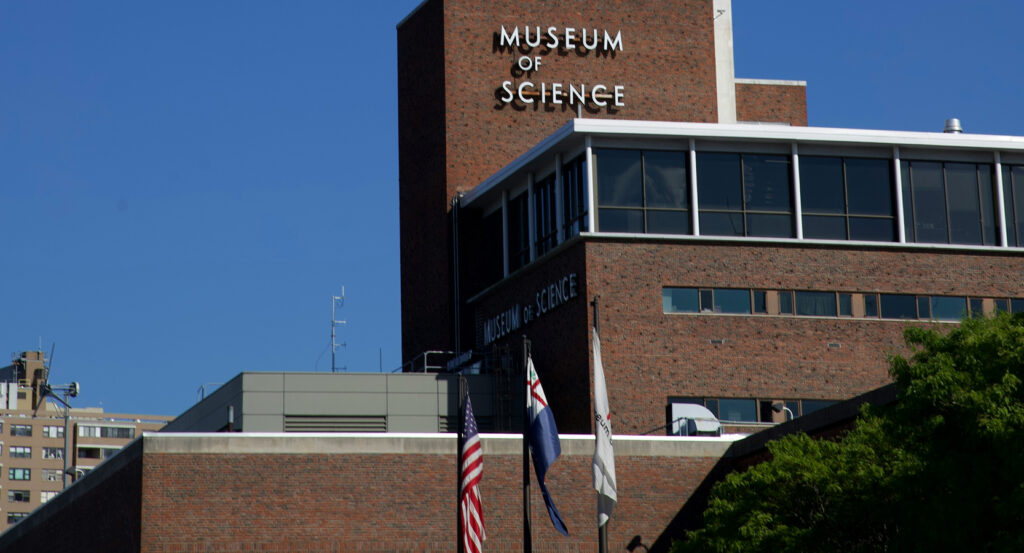
Why you should experience Mathematica at Museum of Science in Boston, Massachusetts.
Mathematica at Museum of Science turns numbers into a playground, a vibrant, hands-on world where logic, geometry, and creativity collide.
Far from the chalkboard stereotype, this exhibit invites visitors to feel math in motion: spinning shapes reveal symmetry, light patterns illustrate probability, and interactive puzzles challenge you to think like an architect of order. Every display transforms abstract ideas into physical experience, from building fractals and tessellations to decoding the secrets behind natural patterns like seashells and snowflakes. Whether you're a lifelong problem-solver or someone who's always feared equations, the Mathematics Exhibit proves that math isn't about memorization, it's about seeing how beautifully the world fits together.
What you didn’t know about Mathematica at Museum of Science.
Mathematica was designed as both art installation and learning environment, merging museum aesthetics with mathematical precision.
Developed in collaboration with educators and engineers from MIT, it features modular displays that evolve over time, new puzzles, digital simulations, and mechanical models are rotated in to keep the space alive. One of its signature pieces, the “Human Harmonics” station, translates motion into equations, allowing visitors to visualize rhythm as geometry. Another favorite, the “Topology Table,” lets guests twist and morph three-dimensional surfaces to explore how shapes transform without breaking. The exhibit celebrates math as the invisible engine behind every discipline, architecture, music, coding, and even weather forecasting. It's both a classroom and a canvas, revealing how pattern gives rise to possibility.
How to fold Mathematica at Museum of Science into your trip.
Approach Mathematica as an interactive lab.
Visit after exploring the Physics or Engineering halls to see how math binds all sciences together. Try at least three different puzzles or kinetic models, each one highlights a unique concept, from probability to motion. If you're visiting with children, challenge them to “beat” one of the problem-solving games; if you're solo, pause at the symmetry mirrors to study how math shapes perception. Midday visits tend to be quieter, allowing more time at each station. Mathematica at Museum of Science isn't just about numbers, it's about unlocking the elegant code that underlies everything we see and do.
Hear it from the Foresyte community.
Just enough life around you not to be overwhelming. Right pace.
Where your story begins.
Start your planning journey with Foresyte Travel.
Experience immersive stories crafted for luxury travelers.