
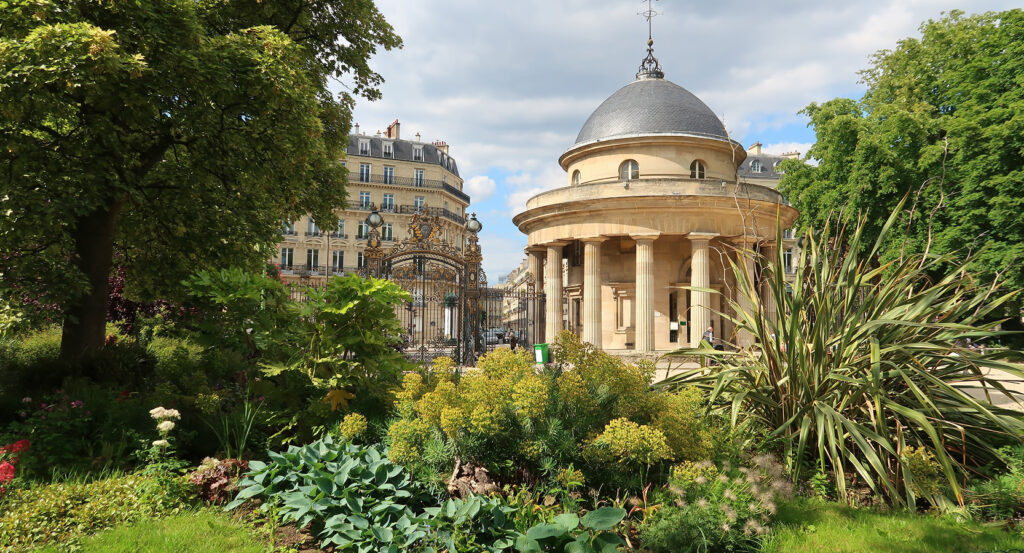
Why you should experience The Bridge at Parc Monceau in Paris, France.
Crossing the Monceau Bridge is like stepping into a painting where Paris flirts with poetry, an encounter between art, architecture, and the quiet hum of history.
This delicate structure arches gracefully over the park's pond, its stone balustrades softened by creeping ivy and filtered light. Though modest in scale compared to the grand bridges spanning the Seine, the Monceau Bridge radiates intimacy, the kind of beauty that doesn't clamor for attention but rewards those who notice. Designed in the 18th century as part of the Duke of Chartres' romantic vision for Parc Monceau, it captures the Enlightenment ideal of creating nature “improved” by art. Standing here, you sense the park's duality, a French garden arranged with English whimsy, a space that feels both deliberate and dreamlike. Beneath the bridge, the water mirrors its arc so perfectly that it forms a flawless oval, a symbol of balance and reflection that seems to slow time itself. Lovers linger here not for performance but for serenity, their whispers blending with the rustle of leaves and the soft glide of ducks below.
What you should know about The Bridge at Parc Monceau.
Its stone appears ancient, but it's artfully aged, carved to suggest centuries of weathering even though it was crafted as a fresh centerpiece for a park meant to enchant. The bridge was inspired by English landscape gardens, where faux ruins, artificial rivers, and “natural” cascades evoked a sense of cultivated wilderness. For Parisian aristocrats, this design language was an escape from order, a chance to experience emotion in a city built on symmetry. In that context, the Monceau Bridge becomes more than an architectural detail; it's a statement of freedom, an early rebellion against rigidity. Its gentle curve invites the eye to wander, its reflection conjures introspection, and together they create a rare harmony between artifice and authenticity. It's no wonder that painters like Claude Monet and Gustave Caillebotte found Parc Monceau irresistible, the bridge itself seems painted into being.
How to fold The Bridge at Parc Monceau into your trip.
To fold the Monceau Bridge into your Paris itinerary, come here not in haste but in reverence.
Arrive in the early morning, when the mist still clings to the pond and the park hums with understated elegance. Stroll across the bridge slowly, pausing at the midpoint to look both down and outward, one view captures the mirrored water and columns of the Roman ruins beyond, the other reveals winding paths and pastel townhouses peeking through the trees. Each angle is a composition waiting to happen, especially if you're fond of photography or plein-air sketching. If you linger toward sunset, the bridge becomes gilded in amber light, transforming into a living canvas of shifting color and reflection. It's an experience best paired with silence, a coffee from a nearby café in hand, and a willingness to let the park remind you that Paris's most profound beauty often hides in its quiet corners, where the past still breathes beneath your feet.
Where your story begins.
Foresyte Travel reveals places that feel extraordinary long before you arrive.
Experience premium editorial crafted for luxury travelers.














































































































