
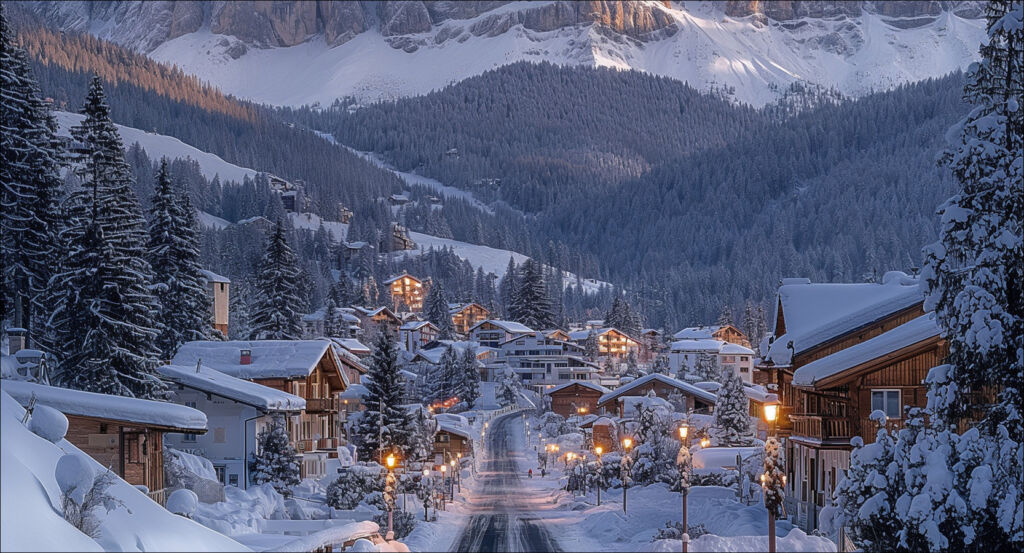
Why you should experience Monte Cristallo in Italy.
Monte Cristallo in Cortina d'Ampezzo, Italy feels less like a mountain and more like a crown, sharp, luminous, and impossible to ignore.
Its jagged limestone spires dominate the skyline northeast of town, changing color with every breath of daylight. At sunrise, they glow peach; by noon, they shine like silver; and when evening falls, they turn violet against the fading sky. Standing at 3,221 meters, Cristallo is among the highest peaks in the eastern Dolomites, but what sets it apart isn't its size, it's its sculptural perfection. From the meadows below, the mountain looks alive, its ridges rippling like frozen waves. It's a place where silence has texture, where wind sounds like history whispering through stone. Locals often call it la montagna elegante, the elegant mountain, and once you see it, you'll understand why. It's not just a backdrop to Cortina; it's the reason the town feels enchanted.
What you should know about Monte Cristallo.
The serenity that defines Monte Cristallo today hides a past marked by both ambition and war.
In the early 20th century, this mountain became a proving ground for climbers pushing the limits of alpinism. The Via Ferrata Ivano Dibona, a renowned fixed-rope route, crosses old suspension bridges and war-era tunnels that trace the front lines of World War I, where Italian and Austro-Hungarian troops once fought through snow and fire. Many of those structures remain, restored as part of a vast open-air museum, blending history with vertigo. Cristallo's dramatic ridges have also starred in cinema, from The Pink Panther Strikes Again to Cliffhanger, a natural film set that needs no filters. The mountain's geology is just as fascinating: it's made of dolomitic limestone dating back 230 million years, its spires carved by time and ice into shapes so surreal they inspired Renaissance painters and modern architects alike. Despite its grandeur, Cristallo is surprisingly accessible. Cable cars and hiking trails reach deep into its flanks, leading to refuges like Rifugio Son Forca and Rifugio Lorenzi, where hikers, bikers, and skiers gather for coffee and clear air that tastes like snowmelt. It's a peak that rewards curiosity, one that gives as much to those who climb it as to those who simply stand and stare.
How to fold Monte Cristallo into your trip.
Exploring Monte Cristallo is an experience that lingers, a discussion between challenge and awe.
Start the morning in Cortina d'Ampezzo, then drive or take the cable car from Rio Gere to Son Forca, where trails fan out like veins across the massif. From here, seasoned hikers can tackle the Via Ferrata Ivano Dibona, which crosses the famous suspension bridge seen in countless travel reels, a narrow walkway strung between air and eternity. If you prefer gentler exploration, follow the panoramic trail toward Rifugio Lorenzi, a cliff-side hut that serves steaming pasta and local wine with views that stretch across the Ampezzo Valley. In winter, Monte Cristallo transforms into part of the Dolomiti Superski network, offering long, open runs framed by cliffs that glow blue in the snowlight. Summer invites mountain bikers and photographers; autumn cloaks the slopes in gold larch. Whatever the season, the mountain's magnetism never fades. End your day with a drive back toward Cortina at sunset, when the Cristallo massif ignites in alpenglow, reflecting across Lago di Misurina in colors that seem unreal. It's that rare place that feels both ancient and immediate, untouchable yet intimately yours. Monte Cristallo doesn't just define the Dolomites, it defines what it means to feel small, and grateful, in the face of something infinite.
Where your story begins.
Foresyte Travel reveals places that feel extraordinary long before you arrive.
Experience premium editorial crafted for luxury travelers.




















































































































