Why Mordecai matters.
Mordecai is a refined American bistro where Wrigleyville's baseball culture meets Matthias Merges's seasonal cooking, vintage American whiskey and a bar named for Cubs pitcher Mordecai “Three Finger” Brown.
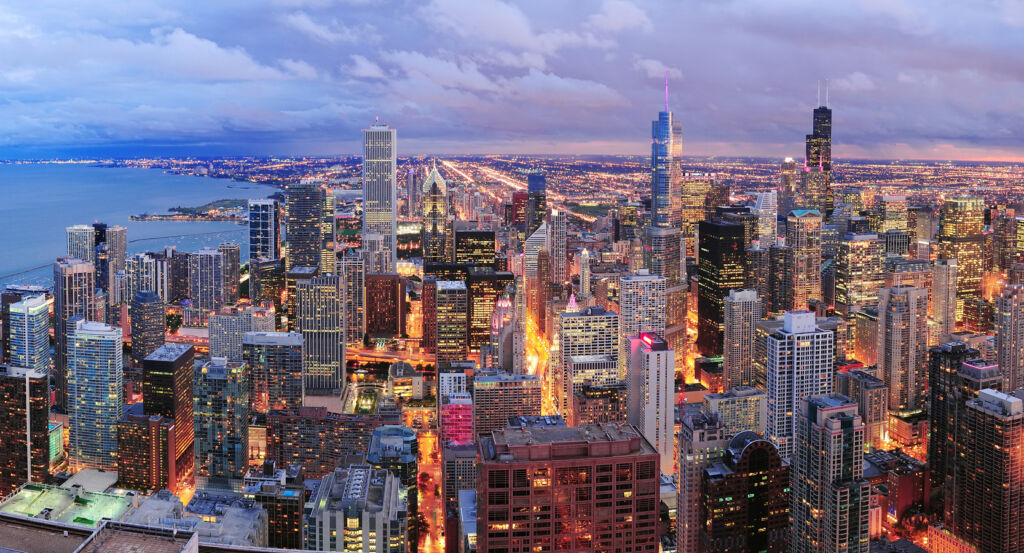
Set along Clark Street near Addison Street and just steps from Gallagher Way, the restaurant occupies the ground floor of Hotel Zachary directly opposite Wrigley Field, with the Southport Corridor extending west beyond the neighborhood grid and Lake Michigan lying east beyond Broadway and Lake Shore Drive. The bilevel interior by fcSTUDIO uses oak and walnut furnishings, curved leather banquettes and soft gray upholstery to build a midcentury-inflected room around baseball references. A long L-shaped bar anchors the principal dining level, with gold sliding screens concealing televisions above it until games bring the ballpark into the room. Large windows open the interior toward Clark Street and preserve a visual relationship with the stadium across the avenue. The result is a restaurant whose woodwork, curved seating, concealed screens and immediate Wrigley Field relationship turn baseball history into a composed architectural setting without reducing the room to sports-bar decoration.
What defines Mordecai.
Mordecai is best known for Matthias Merges's decision to bring the cocktail rigor of Billy Sunday into Wrigleyville as the blocks surrounding Wrigley Field underwent major redevelopment. Hickory Street Capital, the real-estate development arm associated with the Ricketts family, approached Merges about creating an elevated cocktail concept across from the stadium, initially prompting skepticism from a restaurateur who saw little precedent for his style of bar in the district. Merges had trained at the Culinary Institute of America before working at Chicago restaurants including Carlos', The 95th, LaTour at the Park Hyatt and Charlie Trotter's, where he eventually directed culinary, service and strategic operations. Mordecai Research into Cubs history led Merges to Mordecai Brown, whose childhood farm accident damaged his pitching hand yet helped produce the unconventional movement behind one of early baseball's most formidable curveballs. Folkart Restaurant Management opened the two-level restaurant in April 2018 inside the newly built Hotel Zachary, part of the larger redevelopment surrounding Wrigley Field. The drinks program was developed from the same cocktail lineage as Billy Sunday, but American whiskey became the deeper specialty: the opening cellar held 300 scarce spirits, with 70 percent of the backbar devoted to rare pours. Baltimore and Pennsylvania ryes from the 1930s and 1940s joined original Pappy Van Winkle releases and bottles acquired from the collection of German bourbon collector Heinz Taubenheim. Mordecai opened with 50 Pappy Van Winkle and Stitzel-Weller bottles, forming what Merges presented at the time as the country's largest concentration of those whiskeys. Eater Chicago subsequently selected Mordecai as its 2018 Bar of the Year, giving the experiment in historically grounded spirits culture recognition within months of its debut.
Bleacher Tea builds bourbon around Montenegro, Earl Grey, lemon, white balsamic shrub and sassafras, using tea, citrus, bitterness and acidity to stretch the whiskey into a lighter composition. Extra Bases shifts toward tequila blanco with Benedictine, blood orange, hibiscus honey and lime, bringing herbal sweetness against sharper fruit and citrus. Cracked Bat combines pisco, yuzu sake, dry curaçao, citrus and soda, giving the drinks list another structure based on aromatic fruit and carbonation. Full Count turns rum, velvet falernum, orgeat, bitters and lime toward spice, almond richness and tropical acidity. The food beside those cocktails moves through marinated olives with rosemary and citrus, deviled eggs finished with smoked trout roe, saffron arancini with mozzarella and marinara aioli, beer-battered enoki mushrooms and Swedish meatballs in gravy. Poutine layers house fries with cheese curds, gravy, cornichons and lardons, concentrating fat, salt and acidity into one of the heavier bar preparations. The combination keeps cocktails and food on parallel tracks, with the drinks using layered modifiers and the kitchen applying comparable detail to recognizable American and European bar forms.
How Mordecai fits.
Mordecai works as the anchor for a North Side Chicago outing connecting an early twentieth-century residential experiment, a neighborhood cinema built at the arrival of sound film and the ballpark whose architecture shaped Wrigleyville around professional baseball.
Begin at Alta Vista Terrace District, developed between 1900 and 1904 as one of real-estate entrepreneur Samuel Eberly Gross's final Chicago projects. Gross acquired the block after returning from Europe in 1900 and drew inspiration from London row houses, inserting a narrow street through the property so the houses faced inward instead of toward the railroad and alley at its edges. Forty houses line the block, with individual facades adopting varied architectural treatments and houses on one side reappearing in near-mirrored form diagonally opposite. Chicago designated the ensemble a municipal historic district in 1971, followed by National Register recognition in 1972. Continue to Music Box Theatre, opened on August 22, 1929 as a 700-seat neighborhood movie house when downtown palaces were seating crowds near 3,000. Louis I. Simon designed the building for the Southport Avenue Businessmen's Association, with $110,000 spent on the theater and $260,000 on the larger structure containing nine storefronts and 32 apartments. Its atmospheric auditorium places an Italian courtyard beneath a dark-blue ceiling animated by stars and moving cloud formations; repertory programming arrived after the 1983 reopening, and a second screening room followed in 1991. Conclude at Wrigley Field, constructed in 1914 as Weeghman Park for the Chicago Whales of the Federal League under architect Zachary Taylor Davis. The Cubs arrived in 1916 after the Federal League collapsed, the Wrigley family acquired the club in 1920 and the stadium received its present name in 1926. An upper deck followed in 1927 and 1928, Holabird and Root developed the bleachers in 1937 and 1938, and the hand-operated scoreboard and outfield ivy arrived in 1937, adding elements that survived successive renovations. The progression moves from Gross's London-inspired residential composition through a 1929 cinema engineered for the transition toward neighborhood sound-film exhibition and culminates at the 1914 ballpark whose architectural evolution created the baseball district from which Mordecai draws its name and historical foundation.
Where your story begins.
Foresyte Travel reveals places that feel extraordinary long before you arrive.
Enjoy editorial crafted for luxury travelers.
Foresyte may earn a commission when you book.