
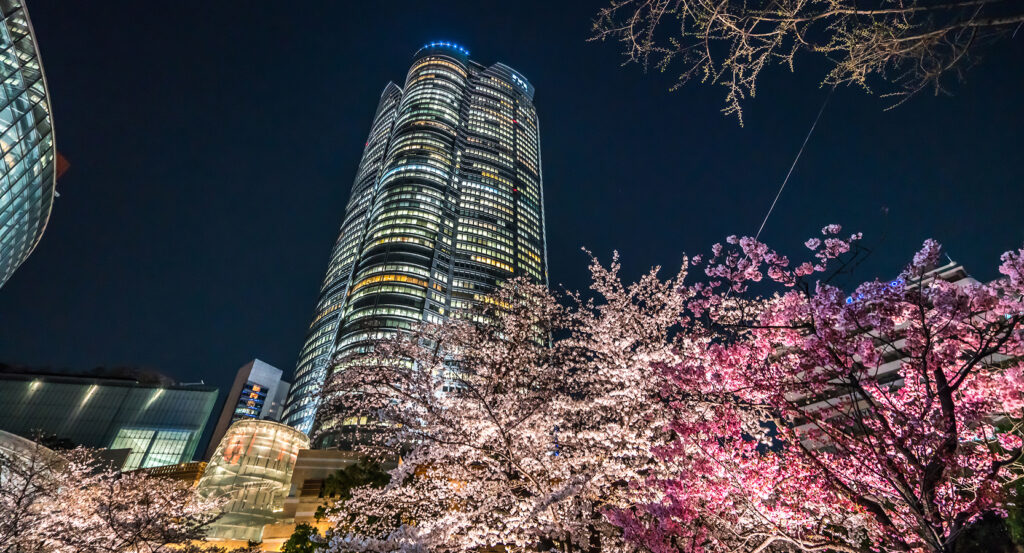
Why Mōri Garden matters.
Mōri Garden is a compact Japanese garden where Roppongi's contemporary cultural character meets a seventeenth-century daimyo estate, inherited topography and a preserved pond now enclosed by the architecture of Roppongi Hills.
Set within Roppongi Hills near Keyakizaka-dori and just steps from the TV Asahi headquarters, the garden occupies a sheltered depression beneath the surrounding towers on ground whose association with a daimyo residence reaches into the early Edo period. A circuit path curls around Mōri Pond through cherry, ginkgo, camphor and maple trees, with a small waterfall and stream exploiting the natural change in elevation across the site. Several mature trees were retained through the redevelopment, allowing substantial vegetation to interrupt views toward the glass and steel structures rising immediately beyond the water. Jean-Michel Othoniel's gold-beaded Kin no Kokoro stands beside the pond, adding a contemporary artwork to a landscape structured through water, stone and inherited vegetation. The result is a garden in which the physical depth of the former estate remains legible inside one of Tokyo's largest redevelopment projects, compressing several distinct periods of Roppongi into a single circuit around the water.
What defines Mōri Garden.
Mōri Garden is best known for preserving the historical core of an estate established in 1650 by Mōri Hidemoto, grandson of Mōri Motonari and lord of Chōfu Domain, who created his Upper Edo residence at Azabu Hīgakubo on the ground now occupied by Roppongi Hills. The estate entered national history after the Akō incident of 1702, when ten of the forty-seven rōnin were placed in Mōri custody following their attack on Kira Yoshinaka's residence and died on this property the following February. Another consequential connection arrived in 1849 with the birth of Nogi Maresuke, later an Imperial Japanese Army general, in the samurai residential quarter of the Chōfu domain estate; he spent his first nine years at Hīgakubo. Hotta Sagami-no-kami received the property in 1865, ending the Mōri tenure near the close of the Tokugawa period. Masujima Rokuichirō acquired the site in 1887, and the birthplace of Nogi received historic-site designation in 1919, followed in 1943 by designation of the former Mōri Kai-no-kami residence site. Nikka Whisky established its Tokyo factory on the property in 1952, giving the surviving water feature the popular name Nikka Pond. TV Asahi acquired the ground in 1977, placing the former daimyo estate inside the territory subsequently assembled for the Roppongi 6-chome redevelopment. The Tokyo Metropolitan Government designated that district for redevelopment in 1986; a preparatory association followed in 1990, construction began in April 2000 and Roppongi Hills opened in April 2003 after seventeen years of development activity. The project preserved the historic pond and green area as part of a development in which about half of the site became open space, and the former estate landscape emerged as the present Mōri Garden. A feudal residence, rōnin history, Nogi's birthplace, industrial use and television ownership survive within the chronology of one piece of ground whose garden became an organizing historical element of Roppongi Hills.
Mōri Pond acquired an entirely different connection to Japanese science in July 2003, three months after Roppongi Hills opened, when astronaut Mamoru Mohri released 10,000 medaka into its water. The fish descended directly from medaka carried aboard Space Shuttle Columbia in 1994 for a life-science experiment involving astronaut Chiaki Mukai. Four fish aboard the mission mated and produced offspring in orbit, marking the first successful vertebrate mating and hatching in space. Their descendants were subsequently raised in Japan through a foster program involving 1,000 families, selected after more than 15,000 people applied to participate. More than 1,000 schoolchildren attended the Roppongi release ceremony, turning the pond into the final destination of a biological lineage extending from Earth to orbit and back into an Edo estate landscape. The closed character of Mōri Pond also separated these medaka from external rivers, keeping the special population within a controlled body of water. Their presence adds a scientific episode to the garden through a living population descended from one of Japan's best-known spaceflight experiments, linking the pond to Columbia, Mukai and Mohri through a mechanism entirely separate from the estate history surrounding it.
How Mōri Garden fits.
Mōri Garden works as the anchor for a Roppongi route through three nearby sites that move from medieval religious geography through a shrine carrying the work of a Kamakura swordsmith and into a twentieth-century institution joining Japanese modern architecture with an older daimyo garden.
Begin at Tenso Shrine, a Shinto precinct whose older name, Ryūdo Shinmeigū, became embedded in the historical geography of eastern Roppongi. A local tradition connects the name with a dragon that rose from the sea and brought a light to the shrine, and the surrounding settlement became known as Ryūdo Village before the district was absorbed into metropolitan Tokyo; the former Ryūdo-chō later covered territory associated with fishermen and timber commerce, preserving another layer of the area's premodern settlement pattern. Continue to Hisakuni Shrine, whose name preserves an unusually direct connection to medieval Japanese swordmaking. The shrine received a blade by Awataguchi Hisakuni, a celebrated Kamakura-period smith associated with the Kyoto Awataguchi school, and subsequently adopted Hisakuni as its name; Katsu Kaishū, the Tokugawa naval administrator who became a major political figure during the transition into Meiji government, later supplied the calligraphy for the shrine's front tablet. The small precinct joins two distant historical periods through objects created by named practitioners, placing Kamakura metalwork and Bakumatsu calligraphy within the religious geography east of Roppongi. Conclude at International House of Japan, occupying ground that belonged to the Kyōgoku family of Tadotsu Domain before passing during the Meiji period to statesman Inoue Kaoru. Emperor Meiji, Empress Shōken, Empress Dowager Eishō and foreign diplomats attended an 1887 gathering at Inoue's Hassō-an tea house, where leading actors staged kabuki before the imperial family. Later owners included Prince Kuninomiya and the Iwasaki family, with Iwasaki Koyata commissioning Ogawa Jihei VII to create the surviving garden. The present International House building followed in 1955 through the collaboration of Maekawa Kunio, Sakakura Junzō and Yoshimura Junzō, three central figures in Japanese modern architecture; Maekawa designed its 1976 expansion, and the building received national Registered Tangible Cultural Property status in 2006. The progression moves from Tenso Shrine's connection with the older Ryūdo settlement through Hisakuni Shrine's preservation of medieval swordmaking and Katsu Kaishū's calligraphy into International House of Japan's convergence of daimyo land, Meiji diplomacy, Ogawa Jihei VII and postwar modernism, placing Mōri Garden within a Roppongi landscape repeatedly remade.
Where your story begins.
Foresyte Travel reveals places that feel extraordinary long before you arrive.
Enjoy editorial crafted for luxury travelers.
Foresyte may earn a commission when you book.

















































































































