
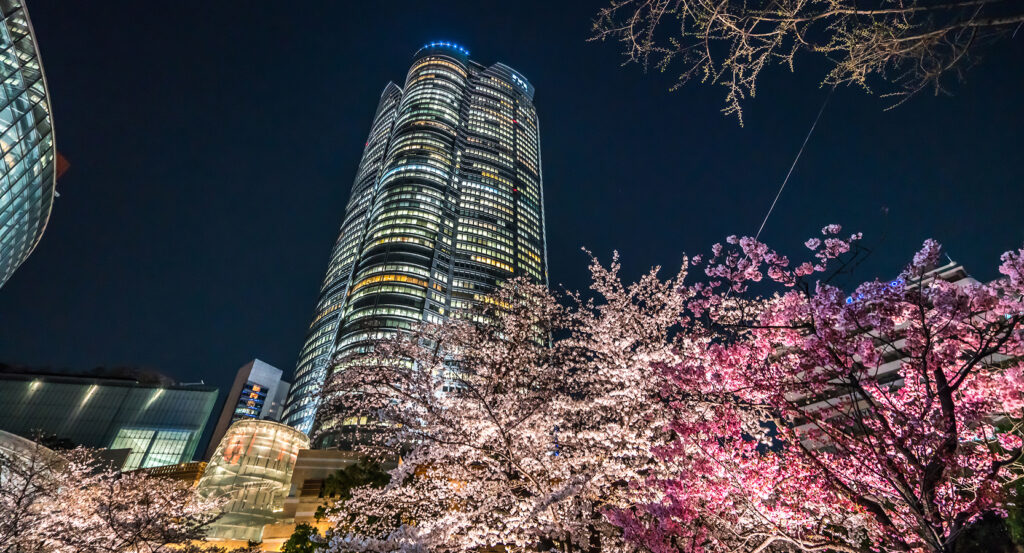
Why Roppongi Hills matters.
Roppongi Hills is an expansive urban complex where Roppongi's cosmopolitan character meets high-rise architecture, contemporary culture and a deliberately layered cityscape of plazas, gardens and pedestrian streets.
Set along Roppongi-dori near Keyakizaka-dori and just steps from Roppongi Station, the complex spreads across an 11-hectare district organized around the 238-meter Mori Tower, with lower buildings and exterior routes descending across Roppongi's naturally uneven terrain. Broad plazas tighten into covered passages, elevated walkways reconnect with street level and Keyakizaka creates a long southern axis between residences, shops and TV Asahi, producing substantial spatial variation across a single development. Mohri Garden introduces pond, stone and mature vegetation below the surrounding towers, then 66 Plaza opens beneath Louise Bourgeois's giant Maman before circulation feeds into West Walk, Hillside and the arena. The combination of high-rise offices, residences, cultural institutions, broadcasting facilities and open ground keeps the complex active across markedly different parts of the day, with the same routes serving commuters, museum audiences, residents and people moving through Roppongi. The result is a district-scale encounter in which architecture and public space operate together, allowing Roppongi Hills to feel less like a single development than a deliberately constructed piece of Central Tokyo.
What defines Roppongi Hills.
Roppongi Hills is best known for realizing Minoru Mori's Vertical Garden City concept through a redevelopment that required 17 years of planning, negotiation and construction with close to 400 property-rights holders. The project began when TV Asahi, then considering reconstruction of its headquarters, consulted Minato City and was encouraged to examine redevelopment of the surrounding neighborhood as well; the broadcaster subsequently approached Mori Building, which was already developing ARK Hills. Tokyo designated Roppongi 6-chome for redevelopment in November 1986, yet the district presented an unusually difficult starting point through fragmented land ownership, narrow roads and a topographic drop of 17 meters across the site. Residents concerned about losing the former Chofu Mori estate's pond and cherry trees submitted a preservation petition in September 1987, and Minato City accepted its principles the following month, embedding preservation concerns into later planning. A preparatory redevelopment association formed in December 1990, the city plan was confirmed in April 1995 and the formal redevelopment association received approval in September 1998. Approval of the ownership transfer plan in February 2000 cleared the final major procedural threshold, and construction began that April. Mori's Vertical Garden City strategy concentrated enormous quantities of floor area vertically and underground, freeing substantial portions of the ground for greenery, pedestrian circulation and transportation infrastructure across a development totaling 760,000 square meters of floor area. Kohn Pedersen Fox Associates designed Mori Tower, Jerde shaped Metro Hat, Hillside and West Walk, Fumihiko Maki designed TV Asahi Broadcasting Center, Conran and Partners worked on the residences and Richard Gluckman designed Mori Art Museum. Completion in April 2003 turned the long negotiation among landowners, government and developer into one of Japan's largest private-sector urban redevelopment projects.
Public art became another mechanism for carrying the development's cultural ambitions beyond museum walls and into ordinary movement through the district. Mori Art Museum supervised six works placed throughout the public areas, and Fumihiko Maki selected three additional works for the TV Asahi property, forming part of a broader program that commissioned more than 20 international artists and designers. Louise Bourgeois's Maman became its most conspicuous intervention at 66 Plaza: the bronze, stainless-steel and marble spider rises 10.23 meters and derives from Bourgeois's long-running association between spiders, weaving and her mother's work restoring tapestries. Isa Genzken's eight-meter Rose introduces a radically different scale nearby, enlarging a familiar flower until it competes visually with the surrounding architecture. Andrea Branzi, Jasper Morrison, Karim Rashid and other designers extended the program into functional street furniture, erasing a simple division between art object and urban equipment. The cultural strategy also reached the summit of Mori Tower, where Mori Art Museum, Tokyo City View and other Mori Arts Center functions placed public cultural activity above the commercial office floors. Roppongi Hills has sustained that premise through integrated town management, cultural events and continuous renewal, drawing more than 40 million people annually across much of its life after opening. The development's cultural significance resides in a system extending from commissioned objects at pedestrian level to museum galleries high above them, making art a recurring component of movement through the district.
How Roppongi Hills fits.
Roppongi Hills works as the anchor for a Roppongi and Azabu route through three nearby sites that carry the district from Edo-period warrior landholding through nineteenth-century diplomacy and into a surviving work of postwar Japanese architecture.
Begin at Sakurada Shrine, whose history reaches to 1180, when Minamoto no Yoritomo ordered a shrine established in Kasumigaseki during the rise of the warrior government that would become the Kamakura shogunate. The institution moved as Edo expanded and eventually settled in the Roppongi area during the seventeenth century, placing a medieval religious foundation inside the district now dominated by contemporary towers. Its later associations extend into the final years of Tokugawa rule through Okita Soji, the Shinsengumi swordsman born into a family connected with the surrounding Azabu area. The shrine also participates in the Minato Seven Lucky Gods pilgrimage through Jurojin, sustaining an active devotional role amid the embassies, offices and cultural institutions that now define this part of Central Tokyo. Continue to Azabusan Zenpukuji, where a temple traditionally associated with Kukai in 824 became a critical site in Japan's nineteenth-century encounter with the United States. The institution later entered the Jodo Shinshu tradition after Ryokai's encounter with Shinran, then acquired a diplomatic function after the opening of treaty relations with Western powers. Townsend Harris established the first United States legation there in 1859, placing diplomatic offices inside a Buddhist temple as Edo confronted the institutional demands of international relations. The legation remained until 1875, spanning the collapse of the Tokugawa government and the early Meiji state. Yukichi Fukuzawa and industrialist Masuda Takashi also became associated with Zenpukuji, and Fukuzawa's grave remains in its cemetery, adding intellectual and commercial history to a precinct already tied to religion and diplomacy. Conclude at International House of Japan, created after World War II to foster intellectual and cultural exchange between Japan and the international community. The institution was founded in 1952 with figures including Shigeharu Matsumoto at its center, and its present building opened in 1955 through the collaboration of architects Junzo Sakakura, Kunio Maekawa and Junzo Yoshimura, three major practitioners in the development of Japanese modern architecture. Their restrained reinforced-concrete composition faces a garden whose history reaches back through former daimyo ownership and whose twentieth-century form was shaped by Jihei Ogawa VII, the celebrated Kyoto landscape designer also known as Ueji. The building received recognition from DOCOMOMO Japan and underwent renovation led by Yoshio Taniguchi, preserving a rare setting where postwar architectural culture and international exchange remain joined to an older landscape. The progression moves from Sakurada Shrine's connection with medieval warrior authority through Zenpukuji's role in the opening of formal American diplomacy into International House of Japan's postwar architecture for international exchange, carrying Roppongi Hills into the successive historical layers that made Roppongi and Azabu unusually international long before the redevelopment opened.
Where your story begins.
Foresyte Travel reveals places that feel extraordinary long before you arrive.
Enjoy editorial crafted for luxury travelers.
Foresyte may earn a commission when you book.

















































































































