
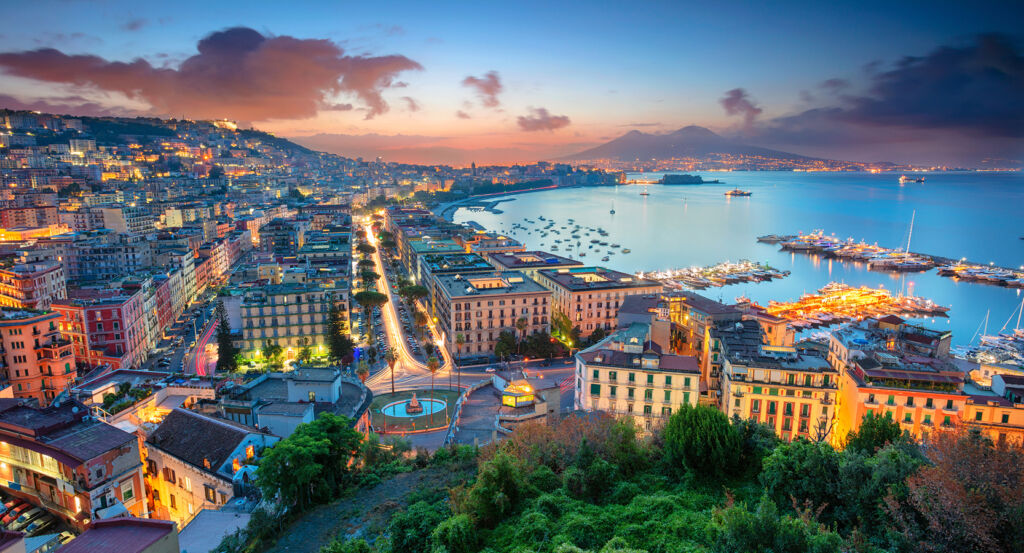
Why Museo Archeologico Nazionale di Napoli matters.
Museo Archeologico Nazionale di Napoli is a major archaeological museum where Museo Archeologico's expansive institutional heritage meets the extraordinary discoveries of Pompeii and Herculaneum, the classical sculpture collected by the Farnese dynasty and the artistic achievements of the ancient Mediterranean world.
Occupying an expansive building along Piazza Museo at the northern edge of Naples' historic center, near Via Santa Teresa degli Scalzi and the approaches to Piazza Cavour, the museum stands between the dense streets of the old city and the ascending neighborhoods of the surrounding hills. Its imposing Renaissance façade extends across a broad urban frontage, with symmetrical window arrangements, substantial stone detailing and a central entrance establishing the building's institutional character. The interior develops around expansive staircases, vaulted galleries and spacious exhibition halls whose proportions accommodate exceptionally large ancient sculptures and architectural fragments. Historic courtyards introduce natural light into the surrounding galleries, and the building's extensive exhibition rooms preserve the architectural character of successive centuries of institutional development. The result is an expansive archaeological museum whose Renaissance architecture, expansive galleries and prominent position within Naples' historic center establish an exceptional setting for one of the world's most important collections of classical antiquities.
What defines Museo Archeologico Nazionale di Napoli.
Museo Archeologico Nazionale di Napoli is best known for preserving the extraordinary archaeological discoveries of Pompeii, Herculaneum and the wider Vesuvian region alongside the Farnese collection of classical sculpture, establishing one of the most comprehensive records of ancient Roman art and domestic life. The museum occupies a building whose origins reach to the late sixteenth century, when Spanish viceroy Pedro Girón, duke of Osuna, commissioned the construction of a cavalry barracks on land near the northern boundary of the historic city. Architect Giulio Cesare Fontana developed the original project, creating a substantial structure whose institutional functions changed repeatedly during the following centuries. The building was subsequently adapted for use as the University of Naples, with architect Ferdinando Sanfelice contributing to its architectural development during the eighteenth century. A decisive transformation began under Charles of Bourbon, who became king of Naples in 1734 and initiated an ambitious program of archaeological collecting and royal cultural patronage. Excavations at Herculaneum began in 1738, followed by systematic exploration of Pompeii in 1748, bringing extraordinary quantities of ancient sculpture, frescoes, mosaics, inscriptions and domestic objects into the Bourbon collections. Charles also inherited the Farnese collection through his mother, Elisabetta Farnese, connecting the royal household to one of Europe's most distinguished collections of classical antiquities. The collection included expansive sculptures recovered from ancient Roman sites during the sixteenth century, particularly the Baths of Caracalla, where major excavations had supplied works for the Farnese family's palaces. Ferdinand IV subsequently pursued the consolidation of these collections in Naples, recognizing the need for a substantial public institution capable of accommodating the growing quantity of archaeological material. The former university building was selected for conversion into a museum during the late eighteenth century, and architect Ferdinando Fuga contributed to its adaptation for the new institutional purpose. The transfer of the Farnese sculptures from Rome to Naples began in 1787, establishing the foundations of the museum's internationally significant classical sculpture galleries. Political upheaval during the Napoleonic period interrupted the project, although the collections continued developing through successive changes in royal administration. Following the Bourbon restoration, the institution opened formally in 1816 as the Real Museo Borbonico, combining archaeological collections with the royal library and other cultural holdings. Its galleries became an important center for the study of classical antiquity during the nineteenth century, attracting European scholars, artists and travelers interested in the material culture of the ancient Mediterranean. The continued excavation of Pompeii and Herculaneum transformed the museum into an essential repository for objects recovered from the Vesuvian cities, supporting the development of modern archaeological scholarship. Giuseppe Fiorelli's appointment as director of the Pompeii excavations in 1860 introduced systematic recording methods and the division of the archaeological site into numbered regions and insulae, strengthening the relationship between excavation and museum collections. Following Italian unification, the institution became the Museo Nazionale, and its administrative organization increasingly emphasized the preservation and study of archaeological material. The royal library and other nonarchaeological collections were gradually transferred to separate institutions, allowing the museum to concentrate on the ancient Mediterranean world. The Secret Cabinet developed as a distinct collection of erotic artifacts recovered from Pompeii and Herculaneum, reflecting changing nineteenth-century attitudes toward the public display of Roman sexual imagery. Its restricted access became an important chapter in the history of museum censorship, with periods of closure and controlled admission continuing into the twentieth century. The collection eventually reopened permanently to the public in 2000, establishing a more comprehensive presentation of ancient Roman domestic and artistic culture. Major restoration and reorganization projects during the twenty-first century introduced renewed galleries, improved conservation facilities and expanded public access to collections previously held in storage. The museum's contemporary character as MANN reflects its position as a leading international archaeological institution, preserving the artistic, social and technological achievements of the ancient Mediterranean through an exceptional concentration of original material.
The Farnese collection establishes the museum's expansive approach to classical sculpture through works whose scale, composition and historical significance reveal the artistic ambitions of ancient Rome and the collecting practices of Renaissance Italy. The Farnese Hercules provides a particularly important example, presenting the mythological hero in a moment of exhaustion after completing his labors. The colossal marble sculpture was discovered in 1546 during excavations at the Baths of Caracalla in Rome and subsequently entered the Farnese collection. Its mighty anatomy, carefully balanced stance and resting posture demonstrate the technical sophistication of Roman marble carving and the adaptation of earlier Greek sculptural models. The Farnese Bull develops an even more elaborate composition through an expansive sculptural group depicting the punishment of Dirce by Amphion and Zethus. Recovered from the same Roman baths, the work incorporates multiple figures, animals and complex spatial relationships within an exceptionally large marble composition. Its intricate arrangement demonstrates the capacity of ancient sculptors to transform mythological narratives into ambitious three-dimensional works. The museum's Vesuvian collections introduce a different relationship with antiquity through objects preserved by the eruption of Mount Vesuvius in AD 79. Frescoes recovered from Roman houses retain vivid pigments and elaborate decorative schemes, preserving the artistic character of domestic interiors that disappeared beneath volcanic deposits. The Alexander Mosaic, discovered in the House of the Faun at Pompeii in 1831, provides one of the most important surviving examples of ancient mosaic art. Its composition depicts a battle between Alexander the Great and the Persian king Darius III, developing extraordinary visual complexity through the arrangement of 1.5 million small tesserae. The work's dramatic movement, expressive figures and carefully controlled color variations reveal the technical sophistication of Roman mosaic production and its relationship with earlier Greek painting. The museum's collection of Roman wall paintings extends this artistic record through mythological scenes, architectural illusions, landscapes and decorative compositions recovered from domestic and public buildings. Their preservation allows the study of ancient painting techniques, including the application of pigments to wet plaster and the development of complex visual effects through architectural perspective. The Temple of Isis collection introduces another dimension of Pompeian culture through objects recovered from a sanctuary dedicated to the Egyptian goddess. Excavations conducted during the eighteenth century revealed a substantial concentration of religious artifacts, demonstrating the importance of Egyptian cults within the religious life of Roman Campania. The museum's Egyptian collection extends this geographical perspective through sculptures, funerary objects and inscriptions associated with the civilizations of the Nile Valley. Its origins include the Borgia collection, assembled by Cardinal Stefano Borgia during the eighteenth century and subsequently acquired for the Bourbon museum. The collection also incorporates material gathered by Giuseppe Picchianti during nineteenth-century travels in Egypt, strengthening the institution's position within the development of European Egyptology. The Secret Cabinet provides a further perspective on Roman domestic life through erotic frescoes, sculptures and objects recovered from Pompeii and Herculaneum. These artifacts reveal the integration of sexual imagery into ancient decorative programs, religious symbolism and commercial environments, contributing to a more complete understanding of Roman social practices. The museum's numismatic collections preserve another important record through Greek, Roman and later coinage, documenting political authority, economic exchange and the circulation of imagery across the Mediterranean world. Coins bearing portraits of rulers and representations of cities provide evidence of changing political institutions and regional commercial relationships. The epigraphic collection develops this record through inscriptions that preserve legal decisions, religious dedications, funerary commemorations and the names of individuals otherwise absent from surviving literary histories. MANN's distinctive importance emerges from the exceptional relationship between expansive classical sculpture, original Vesuvian artworks, Egyptian antiquities and documentary material, preserving the artistic and social complexity of the ancient Mediterranean within a single institution.
How Museo Archeologico Nazionale di Napoli fits.
Museo Archeologico Nazionale di Napoli works as the centerpiece of an outing connecting Naples' early Christian religious heritage, the development of Renaissance medical education and the extraordinary preservation of the city's ancient subterranean infrastructure.
Begin at Santa Maria della Sanità, the expansive Dominican church constructed between 1602 and 1613 above the ancient Catacombs of San Gaudioso. Architect Giuseppe Nuvolo designed the building, developing an unusual elevated presbytery that accommodates access to the subterranean burial complex beneath the church. Its distinctive majolica-covered dome rises above the surrounding Sanità district, establishing a prominent architectural feature within one of Naples' oldest residential neighborhoods. The interior incorporates an elaborate marble staircase, substantial chapels and paintings by artists including Luca Giordano and Andrea Vaccaro. The underlying catacombs preserve early Christian burial chambers and later aristocratic funerary practices, connecting the church to the development of religious institutions across successive periods of Neapolitan history. Continue to Museo delle Arti Sanitarie, the museum occupying part of the historic Ospedale degli Incurabili complex, whose establishment in 1522 marked an important development in Naples' charitable and medical institutions. Maria Lorenza Longo founded the hospital to provide care for patients suffering from serious illnesses, establishing a substantial religious and medical foundation within the historic center. The complex subsequently developed into an important center for medical education and scientific practice, attracting physicians and surgeons whose work contributed to the development of Neapolitan medicine. Its surviving historic pharmacy preserves eighteenth-century decorative furnishings, elaborate majolica vessels and carved wooden cabinetry, demonstrating the relationship between medical treatment, pharmaceutical preparation and Baroque artistic patronage. The museum's collections incorporate surgical instruments, anatomical teaching material and historical medical equipment, preserving an important record of the city's institutional and scientific development. Conclude at Napoli Sotterranea, the extensive network of subterranean chambers and passageways beneath the historic center whose origins reach to the ancient Greek settlement of Neapolis. Greek builders extracted volcanic tuff from beneath the city to supply stone for fortifications and public buildings, creating substantial underground cavities that subsequently acquired new functions. Roman engineers adapted portions of the network into an aqueduct system, introducing channels and reservoirs that supplied water to the expanding city. The subterranean infrastructure continued operating through later centuries, with wells and cisterns supporting domestic and commercial water use. During the Second World War, underground chambers were converted into air-raid shelters, preserving inscriptions and objects associated with the experiences of civilians during Allied bombing campaigns. The progression moves from Santa Maria della Sanità's early Christian burial traditions through Museo delle Arti Sanitarie's development of medical institutions and culminates in Napoli Sotterranea's extraordinary record of ancient engineering and wartime adaptation, connecting three distinct dimensions of Naples' long urban history.
Where your story begins.
Foresyte Travel reveals places that feel extraordinary long before you arrive.
Enjoy editorial crafted for luxury travelers.
Foresyte may earn a commission when you book.




















































































































