
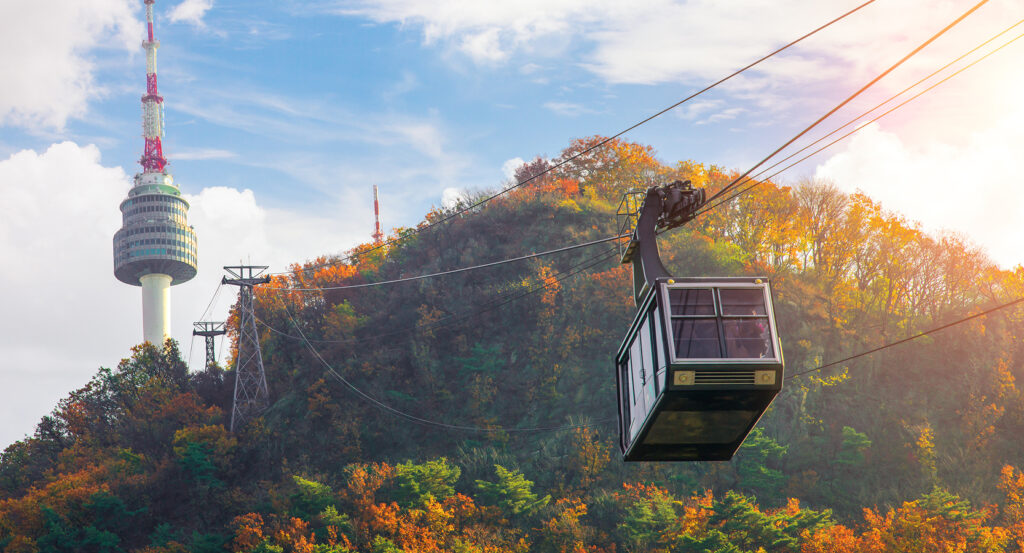
Why N Seoul Tower matters.
N Seoul Tower is a telecommunications observation tower where Namsan's forested summit meets South Korea's broadcasting infrastructure, the engineering of Seoul's modern communications network and panoramic views across the capital's mountain-ringed urban landscape.
Rising above Namsan Park near the summit of Namsan and accessible by the Namsan Cable Car from Hoehyeon-dong, the tower occupies an elevated position south of Myeongdong, overlooking Central Seoul between the Han River and the mountain ridges surrounding the historic capital. Its cylindrical concrete shaft supports an enclosed observation structure and a telecommunications mast. Landscaped terraces, pedestrian paths and viewing platforms connect the tower with the surrounding wooded slopes. The summit provides views toward Bugaksan, Inwangsan and the high-rise districts extending south of the river. The result is a communications structure whose engineering, elevation and public observation facilities connect Seoul's broadcasting history with the geographical setting of the Korean capital.
What defines N Seoul Tower.
N Seoul Tower is best known for its telecommunications infrastructure, panoramic observation decks and position above Central Seoul on the summit of Namsan. The tower originated during South Korea's rapid industrial and technological expansion under President Park Chung-hee, when the growth of television broadcasting created demand for improved transmission facilities. Construction began in December 1969 as part of a project to consolidate radio and television transmission equipment at an elevated location within the capital. The structure was completed in December 1971, becoming South Korea's first integrated radio and television transmission tower. Its location on Namsan provided the elevation required to distribute broadcast signals across Seoul's expanding metropolitan area. The tower supported broadcasting operations associated with major Korean television and radio networks, including KBS, MBC and SBS. Its original purpose centered on telecommunications, with technical facilities occupying substantial sections of the structure. Public observation facilities opened in 1980, expanding the tower's function beyond broadcasting infrastructure. The observation decks introduced a new public vantage point over a capital undergoing extensive redevelopment and population growth. During the following decades, the tower became associated with Seoul's tourism industry and the increasing international visibility of South Korean culture. In 2005, the complex underwent substantial renovation and reopened under the N Seoul Tower name, incorporating redesigned visitor facilities and commercial spaces. The renovation introduced contemporary lighting systems and expanded recreational amenities around the observation structure. Subsequent improvements strengthened the tower's role as a public attraction within Namsan Park. Its continued use for communications and public observation preserves the relationship between South Korea's broadcasting development and the architectural transformation of Seoul.
Namsan's elevation provides the geographical foundation for the tower's observation facilities, allowing its viewing platforms to overlook the city from a position 480 meters above sea level. The tower itself rises 236 meters above the summit, with its enclosed observation levels positioned beneath the telecommunications mast. Its circular observation decks provide views across the Han River, the northern mountain ridges and the densely developed districts of Central Seoul. Large windows incorporate directional information identifying principal urban districts and distant geographical features. The observation facilities contain displays connecting the tower's elevated position with the city's surrounding terrain. Digital lighting systems illuminate the exterior after sunset, changing the tower's appearance within Seoul's nighttime skyline. The structure's lighting has also been used to communicate environmental information, including conditions associated with urban air quality. The surrounding plaza contains railings covered with padlocks placed by couples, a custom associated with romantic commitment and popularized through Korean television and tourism. The locks have become a recognizable feature of the tower's public terraces, connecting the site with contemporary Korean popular culture. Restaurants and cafés occupy sections of the observation complex, including dining facilities positioned to overlook the city. The Namsan Cable Car provides an aerial approach from the northern slopes, crossing the wooded hillside toward the summit. Pedestrian routes through the surrounding park provide alternative access, incorporating stairways and forest paths. The tower's viewing terraces connect the engineered structure with the mountain's natural topography. Its combination of telecommunications equipment, public observation facilities and recreational spaces preserves the dual function established through its conversion into a public attraction.
How N Seoul Tower fits.
N Seoul Tower works as the elevated centerpiece for a Central Seoul itinerary connecting Joseon-era defensive infrastructure, traditional Korean residential architecture and the development of the capital's modern urban landscape.
Begin at Namsan Seoul City Wall, the surviving sections of the defensive fortifications extending across the slopes of Namsan. Constructed beginning in 1396 under King Taejo, the wall formed part of the fortification system protecting Hanyang, the Joseon capital. Its stone construction followed the surrounding mountain ridges, connecting elevated defensive positions with the city's principal gates. Different sections preserve masonry techniques associated with successive periods of construction and repair. Walking routes follow the wall through wooded slopes, providing views toward the historic city center. The surviving fortifications demonstrate the relationship between Seoul's mountainous terrain and its original defensive planning. Continue to Namsangol Hanok Village, the traditional architectural complex situated on the northern slopes of Namsan. Opened in 1998, the village contains five restored hanok residences relocated from different areas of Seoul. The buildings represent domestic architecture associated with households of varying social and economic positions during the Joseon period. Their timber frames, tiled roofs and enclosed courtyards demonstrate traditional Korean residential construction. The surrounding grounds incorporate gardens, a pavilion and a time capsule commemorating Seoul's six-hundredth anniversary as the national capital. Cultural programs introduce traditional crafts, domestic customs and ceremonial practices. Conclude at Myeongdong Cathedral, the Gothic Revival Catholic church situated within Central Seoul's principal commercial district. Completed in 1898, the cathedral became an important center of Korean Catholicism during the final years of the Joseon dynasty. Its red-brick exterior, pointed arches and stained-glass windows distinguish the building from the surrounding commercial architecture. The cathedral acquired additional political importance during South Korea's democratic movement, particularly during the protests of June 1987. Its grounds provided a gathering place associated with political activism and demands for democratic reform. The building preserves the relationship between religious institutions and the development of modern Korean civic life. The progression moves from Joseon defensive architecture through traditional domestic construction and culminates in the religious and political history of modern Seoul, connecting N Seoul Tower with the capital's architectural and civic development.
Where your story begins.
Foresyte Travel reveals places that feel extraordinary long before you arrive.
Enjoy editorial crafted for luxury travelers.
Foresyte may earn a commission when you book.

















































































































