
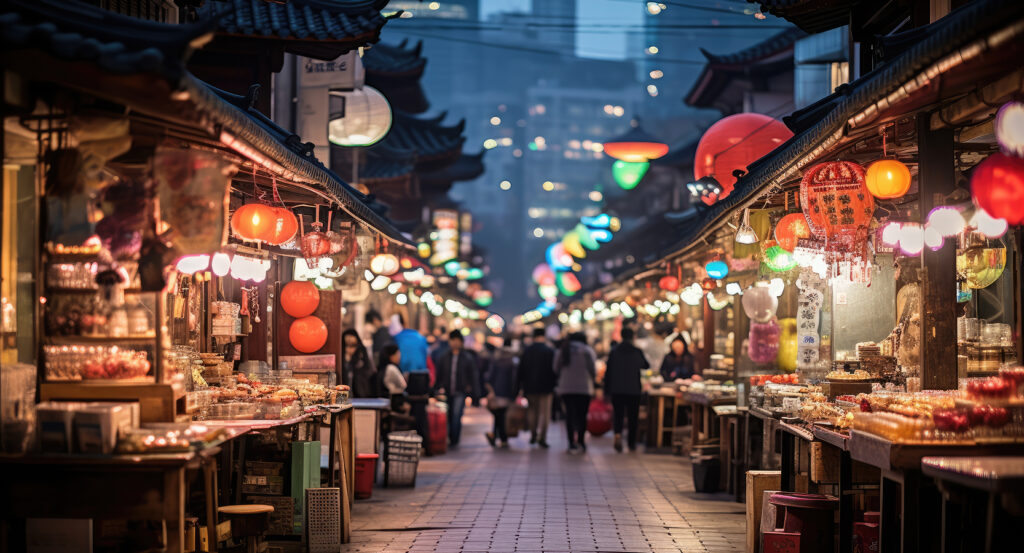
Why you should experience the Clothing Alley at Namdaemun Market in Seoul, South Korea.
The Clothing Alley at Namdaemun Market is Seoul's living fabric, a place where color, motion, and craftsmanship thread together centuries of Korean style.
Step inside, and the hum of the city narrows into a symphony of sewing machines, soft chatter, and the rustle of fabric. Bolts of silk and cotton spill from every corner, patterned with florals, stripes, and minimalist weaves that reveal both tradition and trend. Vendors greet you like old friends, measuring fabric by hand, cutting with the precision of habit passed down through generations. The energy is electric, a collision of wholesale trade and street-level artistry. One stall sells tailored suits; the next, delicate hanbok fabrics glowing under fluorescent lights. The air smells faintly of starch and dye, and sunlight filters through narrow awnings, catching the metallic glint of zippers and buttons piled high in baskets. The Clothing Alley isn't just a marketplace, it's Seoul's textile heartbeat, alive with the rhythm of creation.
What you should know about the Clothing Alley.
The Clothing Alley at Namdaemun Market has been the backbone of Korea's textile trade since the postwar era, when Seoul rebuilt itself from the ground up through craft and commerce.
After the devastation of the Korean War, this narrow corridor became a lifeline for local families, a space where tailors, seamstresses, and fabric merchants revived the art of making. Many of the stalls here are third- or fourth-generation businesses, their owners carrying memories of sewing machines powered by foot pedals before electricity was common. In the 1960s and 70s, the alley became an epicenter of export, small-scale manufacturers producing garments for emerging global markets. Some of Korea's most famous fashion brands trace their lineage to these very stalls. Today, it remains one of the few places in Seoul where handcraft meets wholesale, where custom tailoring, traditional fabric dyeing, and modern textile printing coexist. Few visitors realize that the alley connects to a network of subterranean storage rooms, where bolts of imported fabric are kept in temperature-controlled conditions. Even the market's signage tells a story: hand-painted boards from the 1950s preserved alongside sleek LED storefronts, a visual metaphor for the market's endurance. On weekends, student designers from nearby fashion schools visit to source materials for their collections, blending Korean heritage with contemporary design. The Clothing Alley has also become a quiet cultural archive, a record of Seoul's transformation stitched into every thread.
How to fold the Clothing Alley into your trip.
The Clothing Alley is best experienced with patience and curiosity, a slow walk through Seoul's most tactile form of history.
Enter through Gate 2 of Namdaemun Market and follow the narrow passage that curves left past the children's clothing section. The deeper you go, the more the world outside disappears, replaced by the hum of sewing machines and the faint shimmer of textiles draped from ceiling to floor. Touch the fabrics, most vendors welcome it, and you'll feel everything from raw linen to shimmering silk, from wool blends to handwoven cottons. If you're interested in hanbok fabrics, ask for “saeng-myeong” (raw silk) or “jeogori cloth”; local shopkeepers will guide you to the best stalls with quiet pride. Early morning visits are ideal, when the merchants are arranging their fabrics in color order and the market still smells of freshly steamed garments. Stay long enough to watch buyers from small boutiques negotiate wholesale prices, a dance of numbers and respect that reveals the market's unwritten code. For a deeper immersion, pair your visit with a stop at the Ginseng Market nearby or the Food Alley, where vendors serve warm bowls of bibim-guksu to tailors on break. Before leaving, step outside to see the massive rolls of fabric being loaded into delivery carts, a reminder that Namdaemun still fuels the lifeblood of Seoul's fashion scene. The Clothing Alley at Namdaemun Market in Seoul isn't just a place to shop, it's a place to witness Korea's craft, resilience, and beauty woven into every fold of fabric.
Where your story begins.
Foresyte Travel reveals places that feel extraordinary long before you arrive.
Experience premium editorial crafted for luxury travelers.

















































































































