
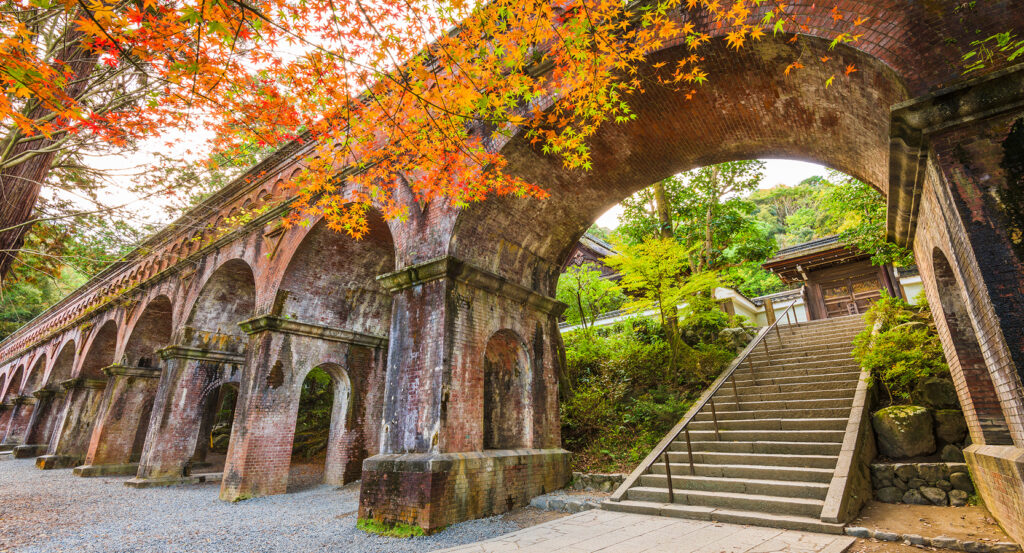
Why you should experience Nanzenin Garden in Kyoto, Japan.
Nanzenin Garden is Kyoto's quiet pulse, a sanctuary within a sanctuary where stillness takes shape in moss, stone, and reflection.
Hidden behind temple walls and shaded by towering cedars, this garden feels worlds away from the grandeur of Nanzen-ji's main grounds. A narrow stone path leads you inward, past the faint trickle of water and the hum of cicadas, until the air itself seems to slow. The garden opens suddenly, revealing a pond shaped like the Japanese character for “heart.” Around it, stepping stones ripple outward in silent symmetry, moss glowing in the filtered light like soft emerald fire. Everything here is deliberate, the placement of rocks, the curve of the bridge, the whisper of wind through bamboo. It is a landscape not designed to impress, but to dissolve the self. At Nanzenin, beauty isn't decoration; it's devotion.
What you should know about Nanzenin Garden.
The Nanzenin subtemple occupies the site of Emperor Kameyama's former palace, the very birthplace of Nanzen-ji Temple itself.
When the emperor renounced worldly life in the late 13th century to become a monk, he transformed his private residence into a Zen sanctuary, and this garden was its soul. Designed according to chisen-kaiyū (strolling pond garden) principles, it captures the ideal of shōjin, purity achieved through contemplation. The pond's heart-shaped form symbolizes compassion and clarity, qualities central to Kameyama's reign and spiritual legacy. The current design dates back to the 17th century, refined by the landscape master Kobori Enshū, whose sense of asymmetrical harmony defined the Edo period's garden aesthetics. Surrounding the pond, centuries-old maples, mosses, and azaleas blur the boundary between architecture and nature. Few realize that this garden also serves as the emperor's mausoleum, his stone pagoda lies quietly among the trees, facing the pond. The sound of water flowing from the nearby aqueduct joins the rustle of leaves, creating what monks call unsui no oto, the “sound of drifting clouds and flowing water.” To walk here is to hear time itself, patient and unhurried.
How to fold Nanzenin Garden into your trip.
Nanzenin Garden should be visited in silence, as if entering a memory.
From Nanzen-ji's main grounds, follow the path that veers southeast toward the subtemple gate. Remove your shoes, bow slightly, and step inside. The transition is immediate, the noise of footsteps and conversation fades behind you. Follow the winding garden trail clockwise around the pond; each bend offers a new reflection, a new fragment of light. In spring, the azaleas bloom in shades of pink and white; in autumn, the maples burn red above the green moss like fire against velvet. Sit for a while on one of the wooden benches along the veranda. Watch how ripples form and fade on the pond's surface, how the light filters differently through the trees every minute. Bring no agenda, no camera if you can help it. Let your senses lead instead, the smell of wet earth, the sound of a bamboo water spout, the sight of your own reflection merging with the pond. Before leaving, turn once more toward the water and bow. Nanzenin doesn't speak loudly, but it lingers. It is Kyoto distilled to its essence: fleeting, serene, and infinite all at once.
Where your story begins.
Foresyte Travel reveals places that feel extraordinary long before you arrive.
Experience premium editorial crafted for luxury travelers.

















































































































