
Why Nanzen-ji matters.
Nanzen-ji in Kyoto is where stillness meets grandeur, a sprawling temple complex that distills centuries of Zen philosophy into a living landscape of stone, water, and light.
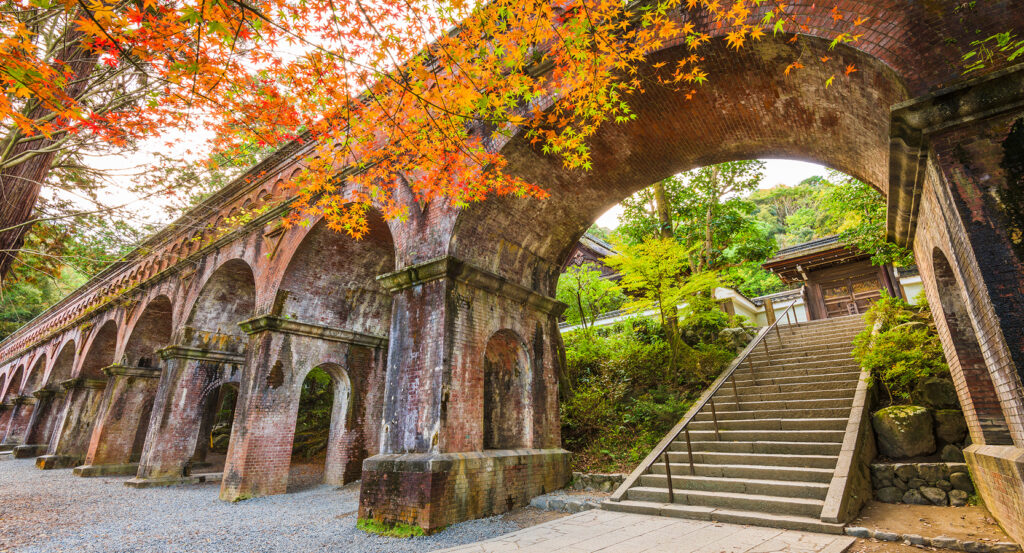
Set at the foot of Kyoto's forested Higashiyama hills, this 13th-century temple feels like a breath drawn in the middle of eternity. As you step through the colossal Sanmon Gate, its dark timbers rising high above the mossy grounds, you're greeted by the faint scent of incense and cedar carried on a cool mountain breeze. The world slows here, footsteps soften, voices hush, and the air seems to vibrate with quiet reverence. Inside, pathways meander through maple groves and gardens so meticulously composed they seem to breathe in rhythm with the visitor. The temple's main hall, Hatto, radiates calm with its sliding paper doors and painted ceilings depicting soaring dragons, while the nearby Hojo Garden, designed by master Kobori Enshū, captures the essence of Zen itself: restraint, harmony, and the perfect balance between void and form. Even the sound of trickling water from the Suirokaku Aqueduct, a red brick relic of the Meiji era that arches across the temple grounds, feels like part of the meditation. At Nanzen-ji, every view, from the flicker of light through bamboo to the sweep of stone raked in the sand garden, speaks to the soul with quiet eloquence.
What defines Nanzen-ji.
Though it stands among Kyoto's oldest and most revered Zen temples, Nanzen-ji began as an imperial retreat, and still carries that aura of elevated peace.
Originally built in the mid-13th century as a retirement villa for Emperor Kameyama, it was later transformed into a temple after the emperor converted to Zen Buddhism. Over the centuries, Nanzen-ji became the head temple of the Rinzai sect and a model for Zen design throughout Japan. Fires and wars destroyed much of the original complex, yet it was always rebuilt with devotion and precision, preserving its status as a place where the sacred and natural worlds coexist seamlessly. The temple's Sanmon Gate, rebuilt in 1628, became renowned after the 18th-century playwright Ikkyu immortalized it in a story of enlightenment, the view from its upper platform is said to reveal “nothing less than paradise itself.” Beneath the temple grounds flows an intricate network of water channels feeding Kyoto's gardens, a symbol of life, purification, and continuity. Few visitors realize that Nanzen-ji's vast complex includes not just one, but multiple sub-temples, each with its own gardens, tea houses, and private moments of Zen. Among them, Nanzen-in, the site of Emperor Kameyama's original residence, remains a hidden sanctuary of moss and reflection. During autumn, the temple becomes a living canvas, crimson leaves cascading against the dark temple eaves, while winter drapes it in a hush so complete it feels eternal.
How Nanzen-ji fits.
Visiting Nanzen-ji is not about seeing, it's about sensing.
Arrive early in the morning when the first light filters through the Higashiyama forest, painting the temple's rooftops in amber tones. Enter through the Sanmon Gate and climb to its upper balcony for one of Kyoto's most breathtaking views: the city unfurling below in mist and gold. Then wander slowly down into the heart of the complex, letting intuition guide you. Pause before the Hojo Garden, where stones and sand ripple in silent dialogue, and let your gaze soften until the patterns dissolve into calm. Walk beneath the Suirokaku Aqueduct, where sunlight breaks through the arches in golden stripes, and listen to the steady whisper of flowing water, a sound that has accompanied Kyoto's spiritual life for more than a century. Don't rush; Nanzen-ji reveals itself only to those who linger. If time allows, continue to the nearby Philosopher's Path, a scenic canal walk lined with cherry trees that once inspired Japan's most celebrated thinkers. Stop for a bowl of matcha at one of the tea houses near the temple gates, a small act of mindfulness to close the experience. Nanzen-ji is Kyoto in its purest form, serene yet commanding, ancient yet timeless. To stand within its gates is to understand that peace isn't found in silence alone, but in the harmony between what endures and what fades.
Where your story begins.
Foresyte Travel reveals places that feel extraordinary long before you arrive.
Enjoy editorial crafted for luxury travelers.
Foresyte may earn a commission when you book.

















































































































