
Why The National Gallery matters.
The National Gallery is an encyclopedic art museum where Trafalgar Square's civic grandeur meets centuries of European painting, expansive neoclassical architecture and an extraordinary concentration of works created by some of Western art's most consequential painters.
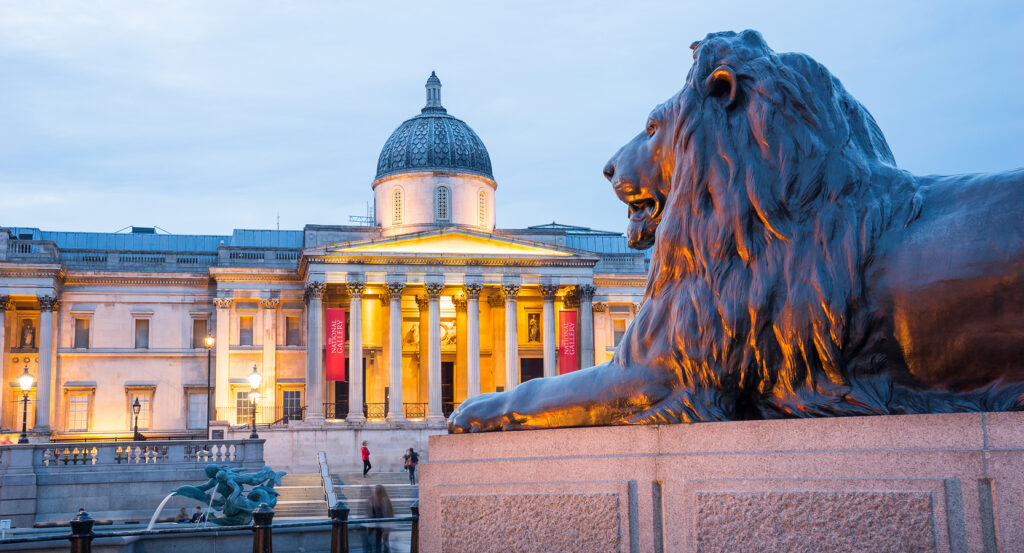
Set along the northern edge of Trafalgar Square near Charing Cross Road and just steps from the fountains surrounding Nelson's Column, the museum occupies a commanding horizontal position above one of Central London's principal public spaces. William Wilkins's Portland-stone frontage stretches behind a sequence of classical columns, pediments and projecting wings, giving the collection an architectural presence visible across the open square before entry. Interior rooms shift that metropolitan scale toward concentrated encounters with paintings, using changing proportions, wall treatments and overhead illumination to frame works individually and in tightly structured sequences. Movement through the galleries crosses Italian altarpieces, Dutch interiors, Spanish court painting, French landscapes and British pictures, allowing technique, patronage and artistic exchange to unfold across successive rooms. The result is a museum whose position, architecture and collection compress an immense span of European painting into a continuous encounter at the civic center of London.
What defines The National Gallery.
The National Gallery is best known for assembling Britain's national collection of Western European painting from an initial government purchase of 38 works belonging to banker and collector John Julius Angerstein. Parliament approved £57,000 for the acquisition in April 1824, and the pictures initially remained inside Angerstein's townhouse at 100 Pall Mall, where the new institution opened that May. Sir George Beaumont strengthened the young collection by promising his paintings to the nation on the condition that suitable accommodation emerged, and his gift entered the gallery in 1826. Parliament approved a purpose-built home in 1831, selecting a central site accessible from both affluent West End districts and areas farther east, and Wilkins designed the structure that opened seven years later. The Royal Academy initially occupied rooms west of the central portico, placing its Schools beside the national collection until the Academy departed for Piccadilly in 1869. Sir Charles Lock Eastlake became the institution's first Director in 1855, formalizing a position that gave sustained curatorial direction to a collection previously overseen by a Keeper and trustees. Acquisition progressively filled major historical gaps, with Jan van Eyck's The Arnolfini Portrait entering in 1842 as an early expansion into Northern Renaissance painting. More than two centuries after Angerstein's pictures established its nucleus, the collection contains over 2,300 works spanning the principal traditions of Western European painting. That trajectory transformed a compact private collection displayed in a Pall Mall house into a national institution whose holdings developed through parliamentary purchase, gifts, bequests and sustained curatorial acquisition.
The Sainsbury Wing established a separate architectural mechanism for expanding the museum westward and reshaping how the collection is entered and understood. Robert Venturi and Denise Scott Brown designed the extension, which opened in 1991 and created new accommodation for the earlier paintings alongside a prominent entrance facing the square. A major bicentenary project closed the wing in February 2023 before Selldorf Architects, working with heritage architects Purcell, reconfigured its public spaces for the museum's third century. Their intervention replaced dark stair glazing with clear glass, removed or narrowed columns, introduced a double-height foyer and surrendered part of the building footprint to a new exterior public area conceived as a square within the square. King Charles III and Queen Camilla formally reopened the transformed wing on May 6, 2025, and public access resumed four days later. The reopening coincided with C C Land: The Wonder of Art, the institution's largest-ever collection rehang, placing more than 1,000 works into a renewed chronological display that incorporated recent acquisitions and loans. Attendance at the Trafalgar Square site subsequently reached 4,147,544 during 2025, demonstrating the scale at which the renewed entrance and redisplay now operate. The Sainsbury Wing's successive architectural phases have given the historic institution an evolving threshold, connecting the inherited museum complex with changing approaches to circulation, public space and the presentation of its collection.
How The National Gallery fits.
The National Gallery works as the anchor for a Central London route through three nearby institutions that move from portraiture as national history through Stuart architecture and royal painting into the academy that joined artistic education with public exhibition.
Begin at National Portrait Gallery, founded in 1856 as the world's first institution devoted specifically to portraiture and charged with collecting images of eminent figures in British history. Its present St. Martin's Place building, designed by Ewan Christian, opened in 1896 after the collection had occupied successive premises in Westminster, South Kensington and Bethnal Green; the institution now holds more than 215,000 portraits across a collection extending from painting and sculpture to works on paper and photography. Continue to Banqueting House, completed by Inigo Jones in 1622 for James I as the third banqueting structure at Whitehall Palace and the surviving complete building from the royal complex largely destroyed by fire in 1698. Jones shaped its great hall as a double cube above a vaulted undercroft, importing classical principles encountered during his European travels into an English royal setting created for masques and state ceremony. Charles I commissioned Peter Paul Rubens to decorate its ceiling, and the immense canvases installed in 1636 remain the largest surviving work by Rubens in its original European location; the king passed beneath them before his execution outside the building in January 1649. Conclude at Royal Academy of Arts, founded in 1768 under the patronage of George III as an artist-led institution combining professional fellowship, artistic training and exhibition. Its eventual move to Burlington House placed the Academy inside the surviving Piccadilly mansion associated with the 3rd Earl of Burlington and the development of Palladian architecture in Britain, continuing the institution's historic connection between working artists, education and public display. The progression moves from National Portrait Gallery's construction of history through represented individuals through Banqueting House's union of architecture, painting and Stuart monarchy into Royal Academy of Arts' artist-led tradition of education and exhibition, extending The National Gallery through three distinct institutions that illuminate how London built its artistic culture.
Where your story begins.
Foresyte Travel reveals places that feel extraordinary long before you arrive.
Enjoy editorial crafted for luxury travelers.
Foresyte may earn a commission when you book.














































































































