
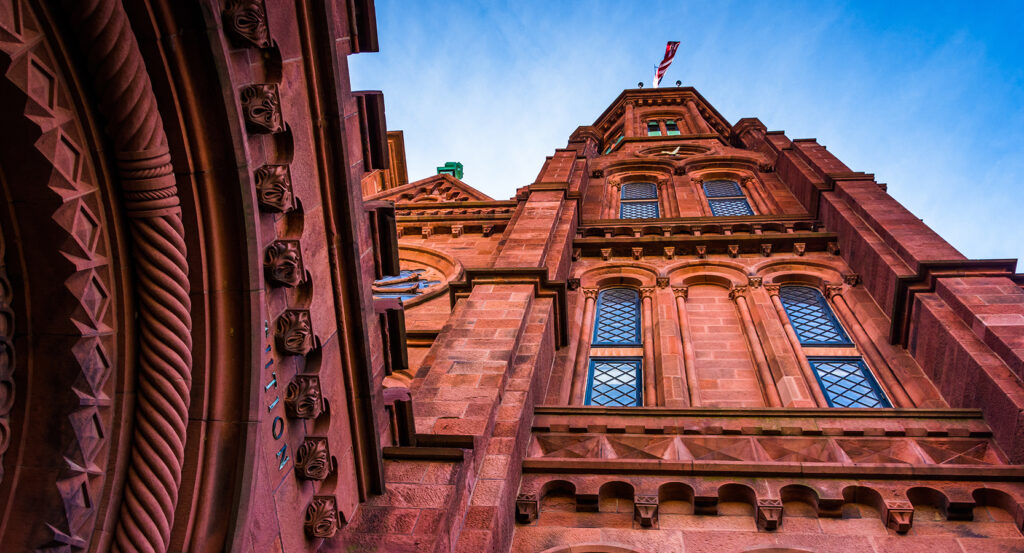
Why Smithsonian National Museum of Natural History matters.
The National Museum of Natural History is where Earth tells its story, from the birth of the planet to the endless wonder of life that thrives upon it.
It's a temple of discovery, filled with fossils, gems, creatures, and cultures that remind us how deeply we belong to the natural world. Step into the soaring Rotunda, where the towering African elephant, Henry, greets visitors under a canopy of light. Wander into the Hall of Fossils to stand face-to-face with a Tyrannosaurus rex frozen in eternal motion, or marvel at the Hope Diamond, its rare blue fire glittering with a legend of mystery and royalty. Every gallery, from ocean depths to cosmic origins, immerses you in the beauty and complexity of our planet. It's not just a museum; it's a living archive of evolution, geology, and human curiosity that connects visitors across time and space through the shared story of life itself.
What defines Smithsonian National Museum of Natural History.
Opened in 1910, the National Museum of Natural History was the first Smithsonian museum built specifically to house scientific collections.
Its archives now include more than 145 million specimens and artifacts, making it among the largest natural history collections in the world. The building's neoclassical design by Hornblower & Marshall was inspired by the Pantheon, symbolizing knowledge that transcends generations. Yet beyond its iconic architecture lies a global network of discovery, from field researchers studying coral reefs in the Pacific to paleontologists uncovering ancient bones in the deserts of Mongolia. The museum is also home to the Smithsonian Institution's Human Origins Program, tracing the evolutionary path that led to modern humanity. Its vast research centers remain on the cutting edge of genetics, climate science, and biodiversity, turning data into understanding and wonder into conservation. What most visitors don't realize is that the museum functions as both an exhibition space and a working laboratory, where science is not just preserved but actively created.
How Smithsonian National Museum of Natural History fits.
Exploring the National Museum of Natural History is a journey best taken slowly, each hall reveals a different world.
Begin at the Rotunda, then follow the flow toward the Fossil Hall for a dramatic walk through the prehistoric age. Continue to the Ocean Hall, where suspended whales glide overhead and deep-sea creatures shimmer in darkened tanks. Don't miss the Hall of Geology, Gems, and Minerals, home to the dazzling Hope Diamond, meteorites from Mars, and crystals that hum with natural geometry. For a more intimate experience, visit the Butterfly Pavilion, where hundreds of colorful species dance in a lush tropical setting. Families will love the Q?rius Discovery Zone, an interactive lab that lets kids handle real fossils, feathers, and rocks. After the visit, take a moment on the museum's front steps to look down the National Mall toward the Washington Monument, a view that bridges science, art, and history in perfect harmony. The National Museum of Natural History doesn't just display the world, it awakens your awe for it.
Where your story begins.
Foresyte Travel reveals places that feel extraordinary long before you arrive.
Experience premium editorial crafted for luxury travelers.







































































































