
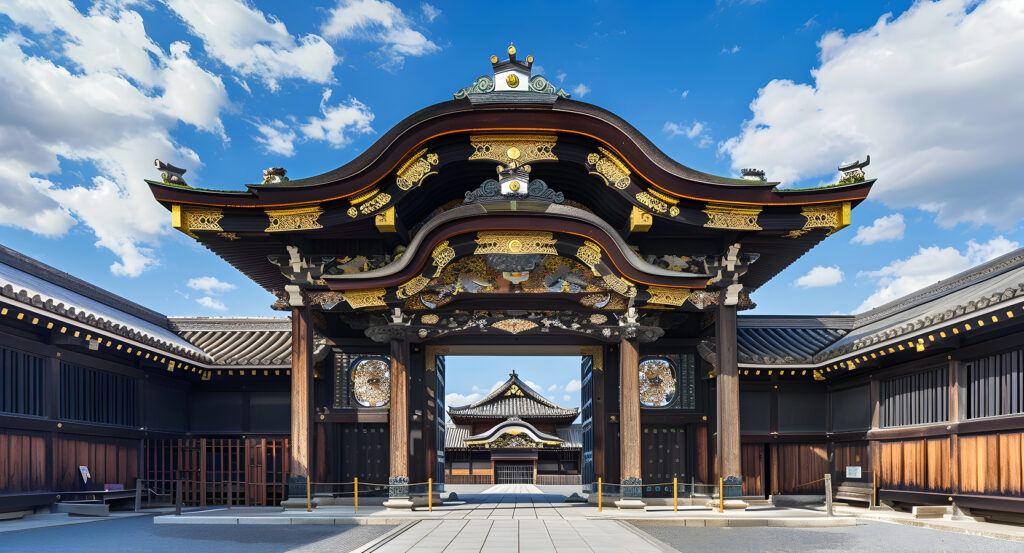
Why you should experience Honmaru-goten Palace in Kyoto, Japan.
Honmaru-goten Palace is the quiet afterpower of Kyoto's Nijō Castle, the space where Kyoto's tides of history softened into reflection.
Standing behind the moats and stone ramparts, it feels more secluded than its golden twin, the Ninomaru Palace, yet carries an equal gravity. The air here is lighter, calmer; the sound of the city barely reaches beyond the pines. What was once a bastion of defense evolved into a sanctuary of grace, where politics gave way to poetry and gardens replaced guard posts. Step through its gates, and the first thing you notice is balance, the harmony of open courtyards, slanted roofs, and pale cedar walls that breathe with light. Each corridor leads toward stillness, each view framed like a painting. While Ninomaru dazzles with gold and ceremony, Honmaru-goten whispers in quiet ink and shadow. It is Kyoto's more intimate truth, where authority learned how to exhale.
What you should know about Honmaru-goten Palace.
Honmaru-goten Palace was not part of Nijō Castle's original design.
The structure standing today was transplanted from the Imperial Palace in 1893, after the Meiji Restoration transformed the site from a military stronghold into a symbol of reconciliation between shogun and emperor. Built in the shoin-zukuri style, the palace features a refined blend of Edo-period simplicity and imperial elegance. Its airy verandas, delicate transoms, and wide corridors were meant not for defense but contemplation, an architectural language of peace. The palace once served as a temporary residence for Emperor Meiji during his visits to Kyoto, marking a historic inversion of roles: the emperor occupying the former domain of the shogun. Few realize that beneath its stillness, Honmaru-goten captures one of Japan's most profound political transformations, from feudal order to modern unity. The surrounding garden, redesigned by the court architect Ogawa Jihei VII, mirrors this evolution. Rocks and islands, placed with Zen precision, symbolize the merging of divided powers into a single flow of harmony. Unlike Ninomaru's golden opulence, Honmaru carries the subtle poetry of restraint, empty space as message, silence as memory. Each beam, each screen, feels imbued with the humility that follows power.
How to fold Honmaru-goten Palace into your trip.
Visiting Honmaru-goten Palace offers a quieter, more introspective counterpoint to Ninomaru's theatrical splendor.
Begin your journey through Nijō Castle as usual, passing through the Karamon Gate and the ceremonial palace first, but save the Honmaru-goten for later in the day. Cross the inner moat via the stone bridge, where the shift from grandeur to calm is immediate. The palace sits on slightly higher ground, surrounded by pines and sky. The pathways curve gently, guiding you through gardens that feel half-wild, half-composed. If open to the public during your visit, step inside the palace's restored chambers, their walls lined with subtle floral motifs, their windows framing Kyoto's skyline in quiet perfection. Even if the interiors are closed, the exterior walkways and gardens alone are worth the detour. From the elevated ramparts, you'll see the layered geometry of the entire complex below, moats, courtyards, roofs, and trees arranged like the brushstrokes of an ancient scroll. Arrive near sunset if you can; the western light catches the rooftops in copper tones, softening the fortress into a meditation. Honmaru-goten Palace isn't about performance, it's about peace earned after power, beauty found after battle. In Kyoto, where every structure tells a story of balance, Honmaru-goten is the final word, stillness triumphant.
Where your story begins.
Foresyte Travel reveals places that feel extraordinary long before you arrive.
Experience premium editorial crafted for luxury travelers.

















































































































