
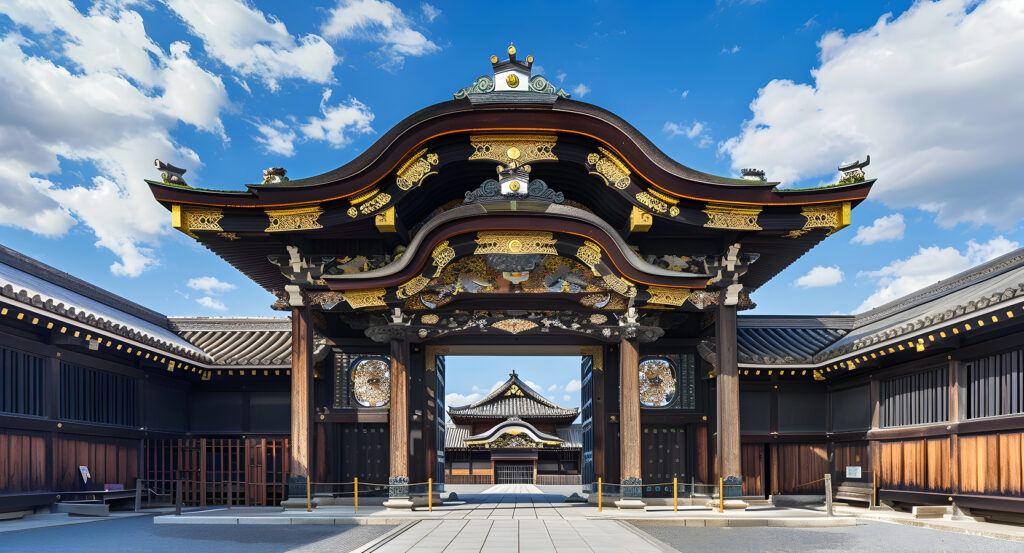
Why you should experience Ninomaru-goten Palace in Kyoto, Japan.
Ninomaru-goten Palace is the living heart of Nijō Castle, a masterpiece of gold, silence, and deliberate grace that reveals how power once moved in Kyoto.
Step across the threshold, and the world narrows to tatami and light. The palace unfolds in quiet rhythm, chambers connected by polished corridors that chirp beneath your feet, walls adorned with fierce tigers and serene pines painted on sheets of gold. This is where the shogun met his allies, commanded his subjects, and performed the art of authority with precision. Yet for all its grandeur, there's restraint in every detail, a harmony between dominance and decorum that feels almost spiritual. The floors sing with every step, the sound designed not to entertain, but to protect. The ceilings are dark, the air faintly perfumed with cedar and incense. The architecture doesn't shout; it whispers, reminding you that real power has no need to announce itself. In these rooms, diplomacy was ritual, silence was strategy, and beauty was a form of control.
What you should know about Ninomaru-goten Palace.
Constructed in 1626 as the formal residence and audience hall for the Tokugawa shoguns, Ninomaru-goten Palace stands as one of Japan's purest expressions of shoin-zukuri architecture, the refined style that shaped samurai and courtly dwellings alike.
The palace consists of five interconnected buildings arranged in a fan shape, each representing a different level of access and authority. The Shikidai entrance welcomed visiting lords, while the Ohiroma, the grand audience hall, hosted audiences with the shogun himself. The closer one moved toward the inner chambers, the fewer were permitted to enter. The golden wall paintings by the Kanō school weren't just decoration, they were visual language: cranes for longevity, pines for loyalty, and tigers for power. Even the tatami patterns signified rank, guiding where one could kneel or bow. The famed “nightingale floors”, boards fitted to chirp softly when stepped upon, served as a subtle alarm system against intrusion. Yet the most fascinating detail is how Ninomaru-goten was designed as a theater of etiquette: every movement, every bow, every silence choreographed with the precision of a Noh performance. In 1867, it was within these same gilded walls that the fifteenth shogun, Tokugawa Yoshinobu, formally restored power to Emperor Meiji, an act that transformed Ninomaru-goten from a stage of command to a chamber of surrender. Few places in Japan hold such paradox, a single space where authority ended and modernity began.
How to fold Ninomaru-goten Palace into your trip.
To experience Ninomaru-goten Palace is to walk the fine line between ceremony and serenity.
Enter through the Karamon Gate of Nijō Castle and follow the path past manicured pines and gravel courtyards until the palace rises before you, low, wide, and radiant. Before stepping inside, remove your shoes and let your senses adjust; this is not a place to rush. Move slowly through the chambers, pausing to observe the brushwork on each fusuma screen, gold leaf glowing softly, ink strokes alive even after centuries. As your steps awaken the nightingale floors, listen for the shifting tones, no two boards sing quite the same. Stand quietly in the Ohiroma and imagine the shogun seated before the painted pines, his courtiers kneeling in rows. Then wander through to the Kuroshoin, the private retreat where the air feels more human, less performative. Beyond the sliding doors lies the garden, designed by the great landscape master Kobori Enshū, a visual meditation of stones, water, and reflection. Visit in the morning when the sunlight floods the screens, or near sunset when the gold deepens to amber and the corridors darken to stillness. As you exit, the last sound you'll hear is the song of the floors, the same melody that's echoed for four hundred years, carrying the whispers of shoguns, samurai, and time itself.
Where your story begins.
Foresyte Travel reveals places that feel extraordinary long before you arrive.
Experience premium editorial crafted for luxury travelers.

















































































































